
Tweetflows: Turning the Twitter Timeline into a Global Workflow Engine
Tweetflows: flexible workflows with twier
The paper introduces Tweetflows, a lightweight coordination platform that integrates Service-Oriented Architecture (SOA) principles into the Twitter microblogging environment. It leverages Twitter's social structure to facilitate ad-hoc workflows, service discovery, and collaboration between human-provided and software services.
TL;DR
Tweetflows is a research framework that embeds Service-Oriented Architecture (SOA) concepts directly into the Twitter ecosystem. By using a custom set of command primitives and hashtags, the authors enable humans and software services to discover, bind, and execute complex workflows through simple status updates. It effectively turns a social media feed into a decentralized Enterprise Service Bus (ESB).
Problem & Motivation: The Rigidity of Enterprise Workflows
Standard workflow engines (like YAWL or BPEL) assume a "closed world" where every service is known and mapped beforehand. This breaks down in the modern Crowdsourcing era, where:
- Experts (Human-Provided Services) are distributed and mobile.
- Requirements change on-the-fly.
- Traditional Service Registries are too heavy for simple, ad-hoc tasks.
The authors’ core insight was to utilize the Follower/Following social graph of Twitter to replace the centralized registry. If you need a service, you don't look it up in a database; you broadcast a request to your network, relying on Information Cascades (Retweets) to find the right person or tool.
Methodology: SOA Primitives in 140 Characters
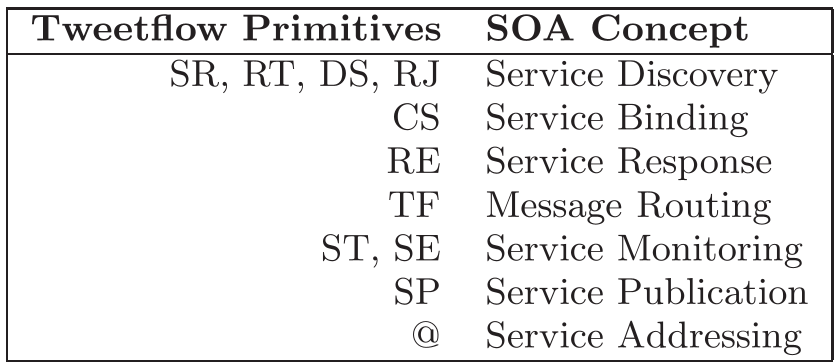
To make Twitter "service-aware," the authors introduced a domain-specific language for Tweets. Since Tweets are limited in length, they used Hashtags for metadata and URIs (shortened URLs) for actual data input/output.
The Core Primitives
| Primitive | SOA Equivalent | Description |
|---|---|---|
| SR | Service Request | Initiates a task request. |
| SP | Service Publication | Announces a service's availability. |
| TF | Message Routing | Creates a "Pipe" where output of one service flows to another. |
| RE | Service Response | Provides the result/link to the completed task. |
Architecture: The Tweet Bus
The architecture follows a Blackboard Pattern. The "Tweet Bus" serves as the global blackboard where state updates are posted.
Real-World Validation: The Android Porting Project
The team applied Tweetflows to a software project involving TU Vienna and ikangai solutions.
- Bootstrapping: The project lead posted SR (Service Requests) for infrastructure (Google Docs, Pivotal Tracker).
- Discovery: When a specific expertise (e.g., Japanese translation) was needed, a Tweet was broadcast.
- Execution: A "Pipe" (
TF) was created to ensure that once a blog post was written, it was automatically sent to the translation "service" (a human) before publication.
 Note: The image illustrates the conceptual intertwining of social networking and SOA.
Critical Analysis & Future Outlook
Why it Works
- Zero Barrier to Entry: Uses existing mobile clients and infrastructure.
- Social Trust: Discovery is filtered through your social network, providing an implicit layer of reputation.
- Human-Software Synergy: Treats a human programmer and a REST API with the same standardized "Service" interface.
Limitations
- Privacy: By default, Tweets are public. Passing sensitive URLs requires private "Direct Messages" or external encryption.
- Scalability of Coordination: In a high-volume environment, the "Tweet Bus" could become noisy, making it hard for participants to filter relevant tasks.
Conclusion
Tweetflows was a visionary attempt to gamify and socialize enterprise logic. Today, we see descendants of this idea in "ChatOps" (integrating Slack/Teams into DevOps) and AI Agent swarms that communicate via message buses. The project proves that the most effective coordination tools are often the ones people are already using.