
Tweeting While Pregnant: Decoding the Linguistic Patterns of Cravings and Embodiment
Tweeting While Pregnant: Is Online Health Communication About Physical Symptoms and Emotions About the Tweeter?
The study analyzes Twitter word usage (1,712 tweets) to explore how pregnant women communicate about food cravings, emotions, and embodiment. Using information-theoretic measures of lexical diversity and the "Pronoun Disclosure Hypothesis," researchers identified distinct linguistic patterns linked to self-disclosure (first-person pronouns) and social support-seeking behavior.
TL;DR
Pregnancy is as much a social "performance" as it is a biological state. By analyzing over 1,700 tweets, researchers found that when pregnant women use first-person pronouns ("I"), they describe their emotions with high variety but describe their bodies using very repetitive, shared language. This suggests a unique dual-strategy: expressing individual emotional experiences while seeking validation through a common physical vocabulary.
Problem & Motivation: Beyond the Survey
Historically, understanding the pregnancy experience relied on qualitative interviews or structured surveys. While deep, these methods often miss the "in-the-wild" dynamics of how women navigate changes in a digital social context.
The authors specifically look at Food Cravings—strong, irresistible urges—as a lens. They wanted to test the Pronoun Disclosure Hypothesis: does using "I" lead to "hiding behind the words of others" (low diversity), or does the healthcare context change the rules of social media engagement?
Methodology: The Information Theory of Speech
The research team leveraged Lexical Diversity, a measure derived from Information Theory.
- High Diversity: A wide, varied set of words (indicating personal elaboration).
- Low Diversity (Redundancy): A small set of frequently repeated words (indicating shared endorsements or social coordination).
They analyzed three specific dimensions:
- Valence: The emotional weight (Positive vs. Negative).
- Embodiment: Words referring to physical actions or states (e.g., SLEEP, KICK, CRAVE).
- Self-Disclosure: The presence or absence of first-person pronouns like I, me, my.
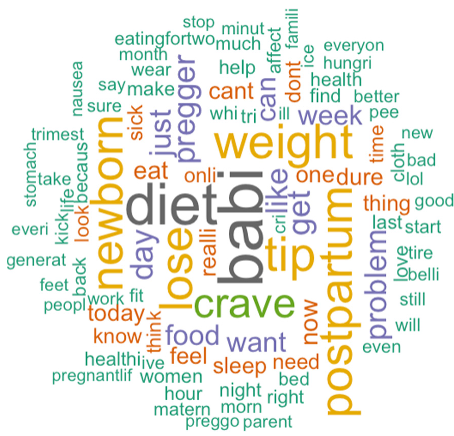
Results: The Divergence of Mind and Body
The data provided a fascinating contradiction to previous linguistic theories.
1. Emotions are Personal
Contrary to patterns seen in global crises (where people repeat slogans), pregnant women using "I" showed higher lexical diversity. When they say "I feel...", they use a rich, unique vocabulary. There is no pressure to conform to a specific emotional script.
2. Bodies are Shared
When discussing Embodiment (physical symptoms), the pattern flipped. Tweets with "I" showed lower lexical diversity.
- Insight: When describing their changing bodies, women use a "standardized" set of terms. This redundancy suggests they are checking their experiences against the community—seeking to know if what they feel is "normal."
3. The "Cravings" Landscape
Sweets (22%) and Fast Food (14%) dominated the conversation, but "Other" items like Ice and Salt (34%) were surprisingly prevalent. Interestingly, the most common emoji was the face with stuck-out tongue and winking eye, signaling that these communications are often layered with humor and self-deprecation.

Deep Insight & Conclusion
This paper challenges the traditional view of lexical redundancy as a "fear of self-disclosure." In the context of pregnancy, reduced diversity in embodiment terms is a feature, not a bug. It represents the "Collective Identity" of motherhood—a specialized language used to navigate the physical uncertainty of pregnancy.
Limitations: The study is a snapshot in time and doesn't track how these patterns change from the first to the third trimester.
Future Outlook: For health-tech developers and researchers, this suggests that monitoring "redundancy" in patient forums could be a powerful tool for identifying widespread physical concerns versus individual psychological distress.