
Decoding the Twitter Audience: Distinguishing Niche Targets from the General Public
Classification of Twitter Accounts into Targeting Accounts and Non-Targeting Accounts
This paper introduces a method to classify Twitter accounts into "Targeting Accounts" (those addressing specific niches or communities) and "Non-Targeting Accounts" (those broadcasting to the general public). By analyzing the statistical consistency of an account's followers relative to a reference universe, the authors achieve a SOTA classification accuracy of 0.944 using an SVM-based ensemble of metadata and network features.
TL;DR
Not all Twitter followers are created equal. While many studies focus on "who is influential," this paper shifts the gaze to "who is the target." By measuring the unusual consistency of an account’s followers—both in what they say and who they follow—the researchers from Kyoto University developed a method that can identify niche-targeting accounts with 94.4% accuracy, providing a vital tool for the next generation of recommendation engines.
The "General Public" Fallacy: Problem & Motivation
In the world of social media analytics, we often conflate popularity with purpose. A major news outlet and a local university's announcement bot might both disseminate information unidirectionally, but their intended audience is fundamentally different.
Existing research (like the "Elite vs. Ordinary" classification) often misses this nuance. The authors point out a critical gap: Target Specificity. An account posting tech specs about the iPhone 6s is "Targeting" a specific interest, while a general news channel is not. The difficulty lies in the relativity of the "General Public"—a Japanese news channel targets the general public of Japan, but a specific niche within the global Twitter population. The authors solve this by introducing an adjustable "Universe" against which specificity is measured.
Methodology: Measuring Unusual Consistency
The core intuition is simple yet mathematically robust: If a set of followers looks significantly different from a random sample of the population, the account is likely "Targeting."
1. The Consistency Metric
The authors define a score derived from how well a follower set is covered by "unusual" properties. They propose two ways to calculate the score for a property :
- (Statistical Rarity): Based on the probability that a random sample from the universe would contain a subset as consistent as the one observed.
- (Density Difference): The simple delta between the property's frequency in the follower set versus its frequency in the general population.
2. Feature Dual-Engine
The method uses two distinct types of "Property ":
- Metadata Terms: Noun phrases in profiles and locations (e.g., "Hakata," "Arashi").
- Network Followees: Identifying common accounts that the followers themselves follow.
 Figure 1: Illustration of the calculation where scores are assigned based on the rarity and coverage of follower properties.
Experimental Insights
The researchers tested their approach on a dataset of 1,000 Japanese Twitter accounts, categorized by human assessors into Targeting (User-specific, Topic-specific, or both) and Non-Targeting groups.
Performance vs. Baselines
| Method | Accuracy |
|---|---|
| Follower Count (Baseline) | 0.878 |
| Proposed SVM (Combined Features) | 0.944 |
| Proposed Decision Tree | 0.906 |
The study found that Combining Metadata and Network data via an SVM yield the best result. Interestingly, the method handles "User-specificity" (community-based followers) slightly better than "Topic-specificity" (interest-based followers), likely because community members share more idiosyncratic metadata like specific geographic locations.
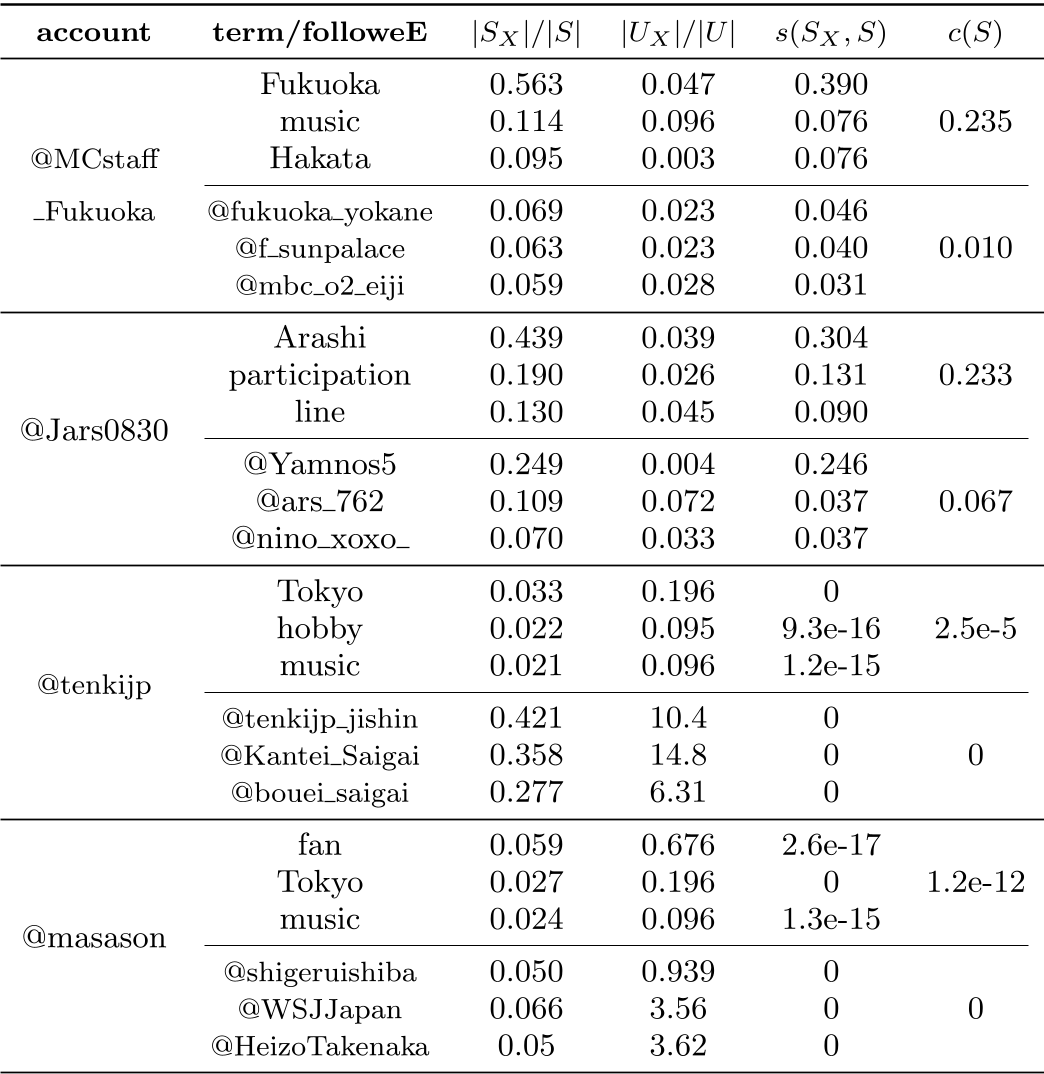 Figure 2: Real-world results. Note how @MCstaff (a concert hall) shows high scores for specific local terms and accounts, while @tenkijp (weather) shows zero consistency because its followers' interests mirror the general population.
Critical Analysis & Takeaways
Why this works
The genius of this approach is its resistance to "Popularity Bias." A massive account like a weather service may have millions of followers, but because those followers look like a "random slice" of the country, the system accurately classifies it as Non-Targeting. Conversely, a small community account with only 500 followers—all of whom mention the same obscure hobby—will be flagged as highly specific.
Limitations & Future Work
The authors acknowledge a common struggle: Subjectivity. 105 accounts were excluded because human assessors couldn't agree on the sub-type of targeting. Furthermore, the reliance on self-reported metadata (profiles/locations) means that "silent" or "low-profile" communities might be harder to detect.
Impact
For developers of Recommendation Systems, this is a goldmine. If we know an account is "Targeting," we should only recommend it to users who share that specific unusual property. If it's "Non-Targeting," the similarity between existing followers and the potential new follower becomes secondary to the content's general quality or popularity.
Conclusion
By moving beyond "who is elite" to "who is the target," Takemura and Tajima provide a framework for understanding the social fabric of microblogs as a collection of overlapping, specific communities rather than just one giant public square.