
TCAD: Why Following the "Influencers" is a Mistake in Cyber Security
Who Shall We Follow in Twitter for Cyber Vulnerability?
This paper introduces the Twitter Critical Account Discovery (TCAD) algorithm, a specialized framework designed to identify high-value information sources for cyber vulnerabilities on Twitter. By redefining the information cascade outbreak problem, TCAD out-competes traditional metrics like PageRank and follower counts in detecting critical alerts across nine security categories.
TL;DR
In the high-stakes world of cybersecurity, being the first to know about a new CVE can mean the difference between a successful patch and a catastrophic breach. This paper reveals that the most "popular" Twitter accounts (those with millions of followers or high PageRank) are often the last to post useful information. The authors introduce TCAD (Twitter Critical Account Discovery), an algorithm that identifies the true "sensors" of the network—often obscure scripts or niche experts—by prioritizing speed and originality over raw popularity.
Background: The Popularity Paradox
In social media research, we often assume that Popularity = Authority. However, cyber vulnerability data behaves more like an epidemic outbreak than a popularity contest. When a new exploit is discovered, the value of that information decays exponentially. If you follow an account that retweets a "breaking" vulnerability three hours late, you've already lost the battle.
The authors argue that existing algorithms like HITS or PageRank fail here because they measure the structure of the network rather than the velocity of information.
Methodology: The Three Pillars of a Critical Account
To find the best accounts to follow, TCAD doesn't look at follower counts. Instead, it evaluates every tweet through a multi-criteria lens:
- Timeliness (): Rewards accounts that post as close as possible to the very first mention of a CVE tag.
- Originality (): Uses a recursive logic (similar to PageRank but for information flow) to reward the source of a cascade rather than those who simply echo it.
- Influence (): Measures how many subsequent tweets were triggered by the original post.
Mathematically Framing the "Outbreak"
The problem is framed as a maximization of a global reward subject to a cost constraint (the number of accounts a human can realistically monitor).
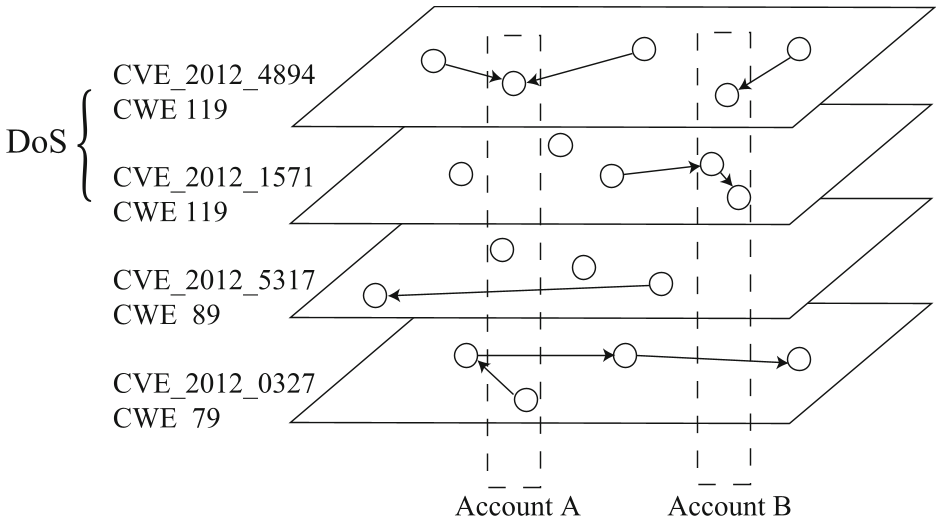 Figure 1: The information hierarchy, mapping CVEs to CWE categories and tracking the dissemination from original tweets to retweets.
Experiments: Performance Over Popularity
The researchers tested TCAD against PageRank and a "Number of Retweeters" baseline across 9 categories, including Denial of Service (DoS) and Memory Corruption.
Key Findings:
- Superior Coverage: In categories like "Execute Code" (EC), TCAD-selected accounts covered nearly double the topics that PageRank-selected accounts did.
- The "Bot" Advantage: Interestingly, the algorithm often selected "Twitter Machines" (automated scripts). While these lack human "insight," they are the most efficient sensors for raw vulnerability data.
- Category Specificity: The study debunked the "Global Influencer" myth. An account that is a top-tier source for Cross-Site Scripting (CSS) is rarely the best source for Gain Privilege (GP) vulnerabilities.
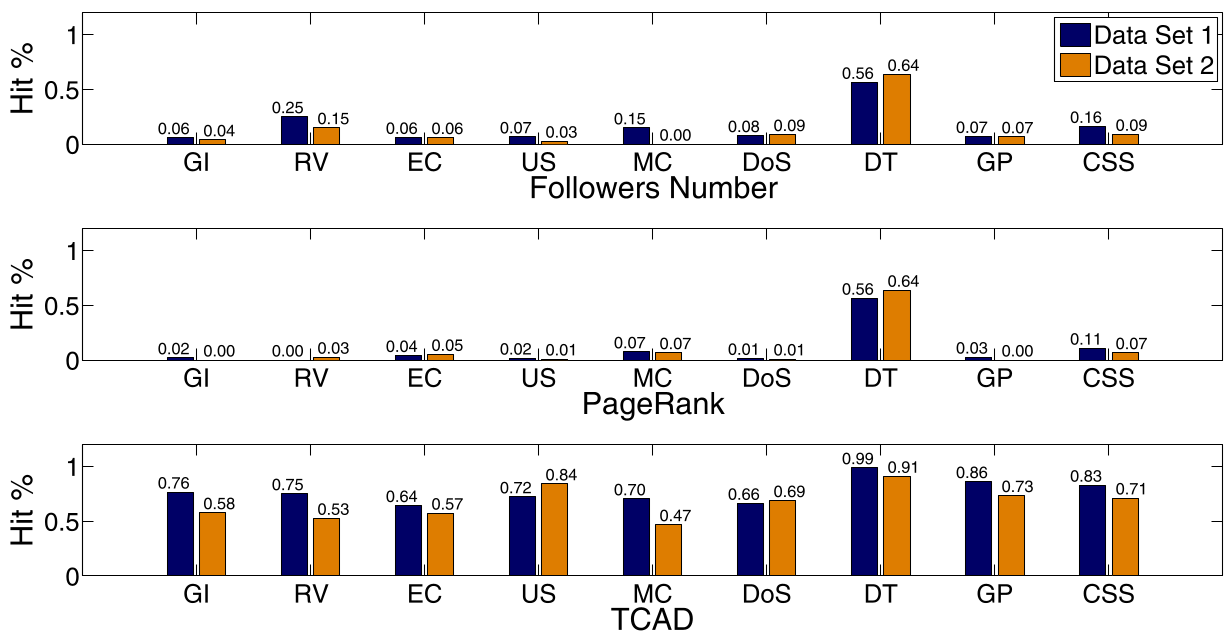 Figure 2: Information coverage across security categories. TCAD (blue line) consistently hits higher coverage than popularity-based metrics.
Critical Insight: The "Million Follower Fallacy"
The paper confirms what many practitioners suspect: the "Million Follower Fallacy." Large accounts act as amplifiers, not originators. By the time a vulnerability reaches a high-PageRank account, the "outbreak" is already in full swing, and the defensive advantage is gone.
Conclusion & Limitations
TCAD provides a robust framework for building Open Source Intelligence (OSINT) dashboards. By shifting the objective from "Who is famous?" to "Who is first and original?", it optimizes for the one currency that matters in security: Time.
Limitations: The current model relies on explicit keyword matching (CVE tags). Future iterations would benefit from NLP/Embeddings to identify vulnerabilities that are discussed in natural language before they are officially tagged with a CVE ID.
Future Work: Integrating semantic analysis to filter out "noise" (casual conversations about a CVE) from "signal" (actual proof-of-concept links or technical analysis).