
Harnessing the Social Pulse: Turning Twitter Hashtags into Instant Search Answers
Harnessing Twitter for Answering Opinion List Queries
This paper introduces the first end-to-end system for answering "Opinion List" (OL) queries (e.g., "valentines day gift ideas") by leveraging Twitter data. The framework identifies specific "OL-hashtags," extracts candidate items via regex patterns, ranks them using a Learning-to-Rank (L2R) approach, and augments sparse "tail" lists through a novel cross-list similarity mechanism.
TL;DR
While search engines are great at telling you the "temperature in London," they struggle with "creative gift ideas for parents." This paper presents the first system that mines Twitter to answer these "Opinion List" (OL) queries. By identifying specific hashtags, extracting items with regex, and ranking them via machine learning, the authors achieve over 90% precision in providing structured, instant list answers.
The Problem: The "Opinion Gap" in Search
Have you ever searched for something subjective, like "8th grade memories," only to be met with a wall of disorganized links, Flash presentations, or generic blog posts? This is the Opinion Gap.
Search engines treat these queries as document retrieval tasks rather than structured data tasks. However, the data exists—it’s just trapped in the chaotic stream of social media. Twitter, with its hashtag-centric conversations, is a goldmine for these lists, but mining it is technically difficult due to:
- Invisibility: OL-hashtags (like #schoolmemories) represent less than 2% of total traffic.
- Noise: Tweets are messy, filled with slang, and lack a standard list format.
- The Long Tail: Many niche topics only have a handful of tweets, making it hard to generate a "Top 10" list.
Methodology: From Hashtags to Hyper-Relevant Lists
The authors solve this through a four-stage pipeline:
1. Identifying the "Gold" (OL-Hashtag Detection)
Not every hashtag is a list. #MondayMotivation is a sentiment, but #3MoviesThatMakeYouCry is a goldmine. The system uses a Logistic Regression classifier with a specialized feature set:
- Linguistic Cues: Looking for plural nouns and specific patterns (e.g., "in 5 words").
- Search Engine Behavior: If you search the hashtag on Google and see different numbers in the titles (e.g., "10 gift ideas" vs "20 gift ideas"), it's likely an OL-hashtag.
- Tweet Dynamics: How the hashtag spreads over time.
2. Extracting Items (The Regex Engine)
Since tweets lack structure, the authors designed a set of regular expressions to split tweets into items. Interestingly, they distinguish between Objective lists (factual items like movie names) and Subjective lists (personal views).
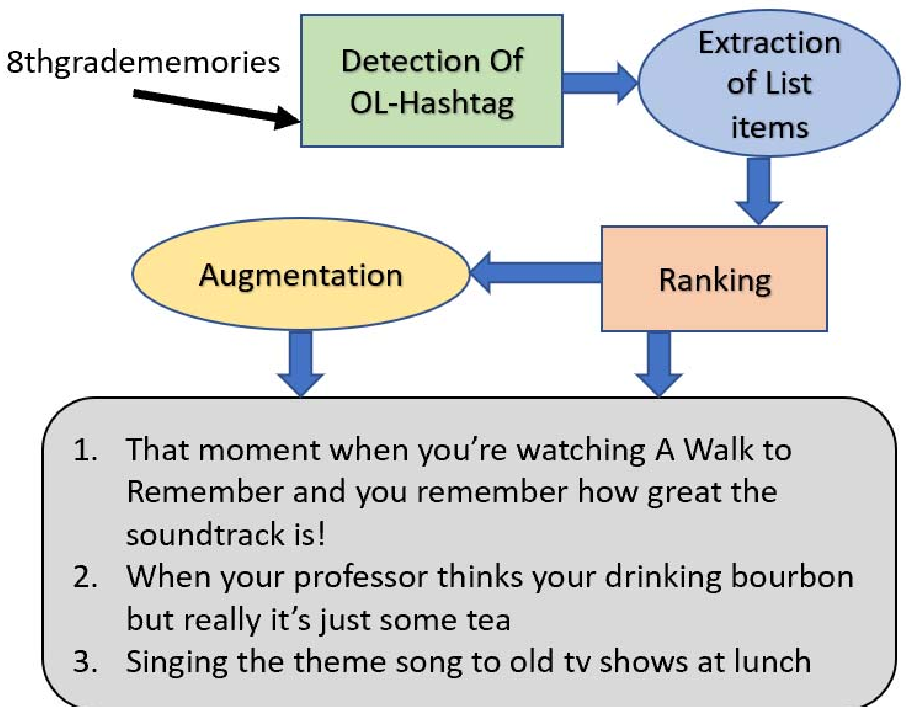 Figure 1: The overall framework from Twitter stream to ranked instant answers.
3. Ranking for Quality (Learning-to-Rank)
Simple frequency isn't enough—a "popular" item might just be spam. The system uses a Learning-to-Rank (L2R) framework using five core features:
- Frequency: How often the item appears.
- Follower Count: Influential users generally post better content.
- Recency: Newer opinions are often more relevant.
- Co-occurrence: Does the item appear with other high-quality items?
- PageRank: Treating items as nodes in a graph to find the "central" opinions of a topic.
4. Solving Sparsity: Tail Augmentation
What if a hashtag only has 3 items? The authors use Semantic Similarity (DSSM/CDSSM) to find "brother" hashtags. For example, a tail list for #moviesthatmakeyoucrysobad can "borrow" items from the much larger #moviesthatmakemencry.
Results: Better Than the Giants?
The results are striking. While a raw extraction from Twitter only yields ~66% accuracy, the Ranking (L2R) layer pushes this to 91.31% (Precision@10). This demonstrates that the bottleneck isn't the data availability, but the filtering of social noise.
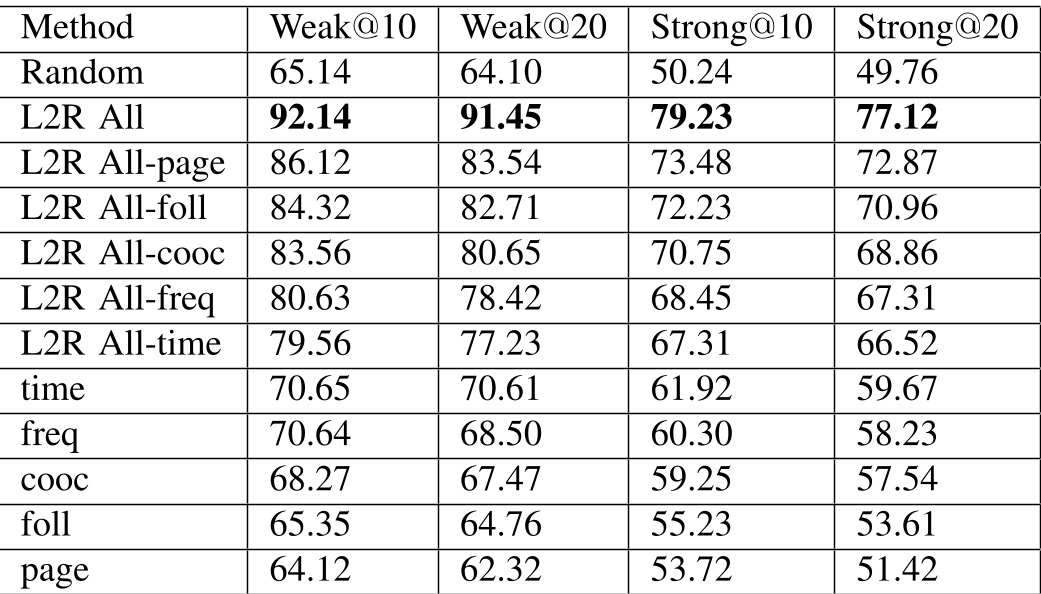 Figure 2: The impact of different ranking features. PageRank and User Influence prove critical for high-quality results.
Critical Insight & Future Outlook
The brilliance of this work lies in its "Search Feature" (Querying Google to validate a hashtag). It uses the existing web's structure to validate the social web's noise.
Limitations: The system relies heavily on regex, which might struggle with the evolving slang of social media (e.g., TikTok-style humor). In the future, replacing regex with Large Language Models (LLMs) for the extraction phase could make the system even more robust.
The Takeaway: This research proves that search engines don't need to wait for a blogger to write a "Top 10" list. By tapping into the real-time social pulse, we can generate structured, instant answers for almost any niche human experience.
Blog written by Senior Academic Tech Editor based on "Harnessing Twitter for Answering Opinion List Queries".