
DUST: Leveraging Knapsack Bandits to Outsmart Twitter API Limits
4379_What to track on the Twitter streaming API a knapsack bandits approach to dynamically update the search terms.
This paper introduces DUST (Dynamically Update Search Terms), a framework for optimizing Twitter data collection via the Streaming API. It utilizes a Knapsack Bandits approach to dynamically adjust search terms, achieving a 2x increase in relevant tweet acquisition compared to static keyword tracking.
TL;DR
Researchers from CMU have developed DUST, an iterative algorithm that treats Twitter search terms as "arms" in a Knapsack Bandit problem. By dynamically updating these terms based on real-time feedback, the system collects up to 3.89x more relevant data than traditional static keyword monitoring, effectively overcoming the strict 1% bandwidth caps of the Twitter Streaming API.
Background: The "Filter Bubble" of Data Collection
For researchers and disaster response teams, the Twitter Streaming API is a double-edged sword. While it provides a real-time pulse of global events, it is governed by a "black box" of limits. The authors observe a hard ceiling of approximately 4 million tweets per day (roughly 23GB), regardless of how many search terms you track.
The fundamental problem is drift. In an earthquake scenario, a user might start with #earthquake. Within hours, the conversation shifts to specific locations like #Anchorage or #Alaska. If your crawler isn't adaptive, it stays stuck in a dying conversation while the relevant data flows through terms you aren't tracking.
The Insight: Data Collection as an Optimization Problem
The authors argue that data collection shouldn't be passive. Instead, it should be modeled with:
- Cost (): A non-linear logit function reflecting the volume of tweets a term pulls. High-volume terms have high costs because they crowd out other terms.
- Value (): The utility of the term, often determined by a secondary classifier (e.g., "Is this tweet actually about a disaster?").
- Constraints: The API limit of 400 search terms and the total bandwidth limit.
Methodology: DUST1 and DUST2
The paper proposes two approaches to select the optimal "Knapsack" of search terms:
- DUST1 (Greedy Knapsack): Every iteration (e.g., every 30 mins), the system extracts high-frequency terms from the current batch, estimates their value/cost, and uses Dynamic Programming to pick the best set for the next batch.
- DUST2 (Bandit-driven): To prevent losing good terms due to temporary noise, DUST2 uses Multi-Armed Bandits (MAB). Specifically, they use the Upper Confidence Bound (UCB) strategy to balance Exploitation (keep using keywords that worked) and Exploration (try new, promising keywords).
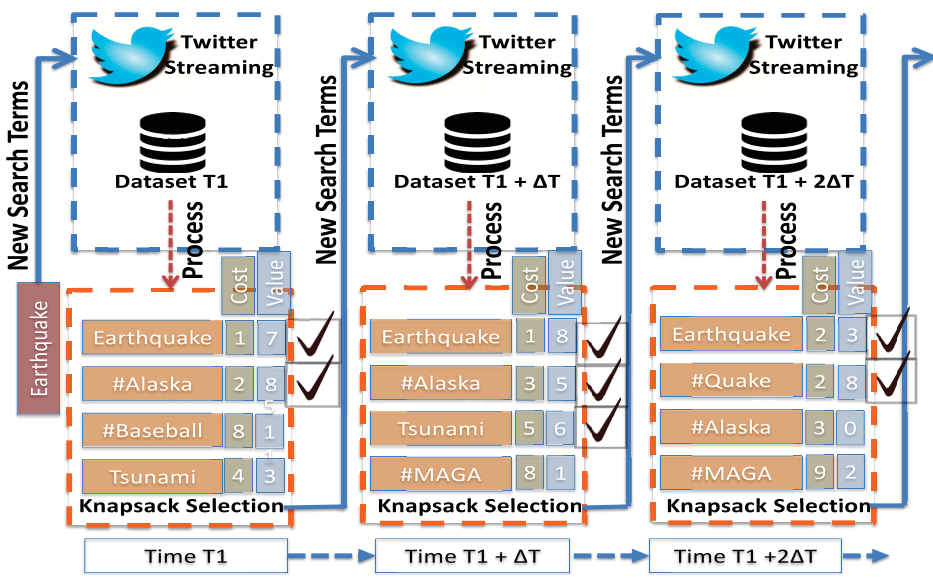 Figure 1: The Iterative DUST Process. Data is collected, processed for high-frequency candidates, and then passed through a Knapsack solver to update search terms.
Experimental Proof: Earthquakes in Real-time
The authors tested DUST against a static baseline (tracking only "earthquake") using a disaster-relevancy classifier.
Key Findings:
- Data Volume: DUST1 outperformed the baseline by 1.71x in total volume.
- Relevancy: When looking at the quality of data, the DUST framework yielded 3.89x more relevant tweets than static tracking.
- Bandit Efficiency: While UCB (DUST2) was more theoretically robust, DUST1 (the greedy version) actually pulled more data in short-duration tests, suggesting that in rapidly changing events like earthquakes, "exploitation" of current trending terms is highly effective.
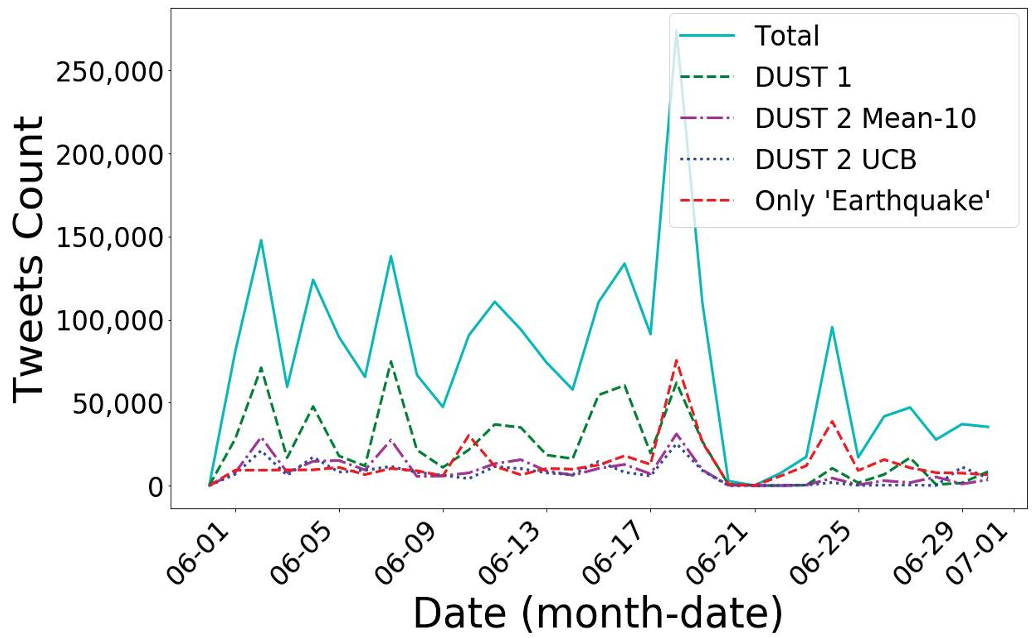 Figure 2: Daily data volume comparison. The DUST approaches consistently stay above the static seed-term baseline.
Critical Insight & Future Outlook
This work represents a shift in Social Media Intelligence. By treating "What to track?" as a reinforcement learning problem, researchers can maximize their signal-to-noise ratio under strict platform constraints.
However, there are limitations:
- Cold Start: The system still needs "seed terms" to begin.
- Staleness: High-frequency terms can become "stale" once a trend ends, requiring the FIFO queue mechanisms mentioned in DUST2 to purge dead-weight terms.
Future Prospect: Imagine a distributed swarm of DUST-enabled agents, each exploring different semantic subspaces of a global event, coordinating to "map" the conversation without hitting API rate limits. This is the roadmap for the next generation of real-time open-source intelligence (OSINT).