
Analyzing the Skeleton of Social Media: A Deep Dive into the Twitter User-Follower Network
A study on Twier user-follower network: a network based analysis
This study provides a large-scale network analysis of the complete Twitter user-follower graph using a distributed storage system (GraphStore) on Hadoop. It characterizes the network through degree distribution, connectivity, tie strength, and clustering coefficients, revealing that while Twitter follows a power-law distribution, it remains a highly sparse environment with distinct latent communities.
TL;DR
This research tackles the massive task of analyzing the complete Twitter user-follower network (41.7M users, 1.47B edges) using distributed computing. It reveals that while Twitter acts as a "connected" world where any user can reach another, it is incredibly sparse. The study identifies over 300,000 latent interest-based communities, providing a blueprint for how structural similarity can drive high-accuracy recommendations and targeted ads.
Background & Motivation: Scaling Beyond Samples
By 2013, Twitter had become a global powerhouse for real-time information. However, for social computing researchers, the sheer scale of the network was a technical wall. Most prior studies were forced to "thin" the data—removing high-degree nodes or sampling small sub-graphs—which often distorted the true network topology.
The authors' intuition was that to truly understand behavioral dynamics, one must process the entire graph. They achieved this by deploying GraphStore, a specialized storage layer on top of Hadoop, enabling them to run complex algorithms like community detection across a 30-node cluster without compromising data integrity.
Methodology: The Power of Structural Similarity
The core of the methodology revolves around moving beyond simple "follower" counts to Tie Strength and Structural Clustering.
1. Tie Strength (Similarity)
Instead of treating every "follow" as equal, the authors used a similarity metric based on common neighbors: This formula identifies how much two users' social circles overlap, distinguishing between a random celebrity follow and a tight-knit professional circle.
2. Community Detection with PSCAN
The authors utilized PSCAN, a MapReduce implementation of the Structural Clustering Algorithm for Networks. Unlike algorithms that only look at edge density, SCAN finds clusters of nodes that share similar neighbors, effectively filtering out "noise" (users with low similarity) to find the "signal" (organic communities).
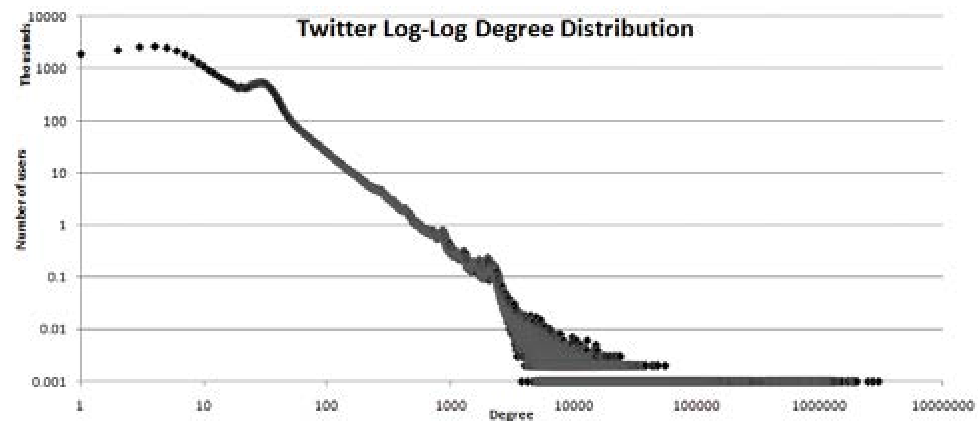 The Log-Log plot confirms the Power-Law nature of Twitter: a few "celebrity" hubs and a massive "long tail" of low-degree users.
Key Insights from the Data
The results paint a fascinating picture of digital society:
- The Connectedness Paradox: The network is a single "connected component." You can reach almost any user through a chain of followers. Yet, the Average Clustering Coefficient is only 0.072, meaning your friends are rarely friends with each other.
- The "Zero" Majority: Nearly 90% of users have a clustering coefficient of 0. This suggests that for the average user, Twitter is a broadcast medium rather than a tight social circle.
- Hidden Communities: Despite the sparsity, the PSCAN algorithm extracted 313,562 distinct communities.
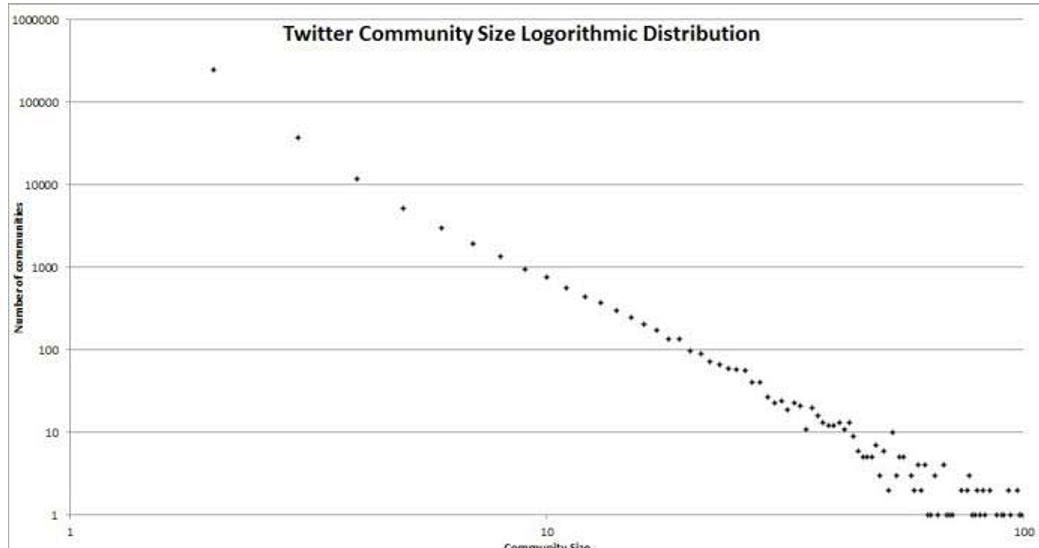 The community sizes themselves follow a power-law distribution, suggesting that social structures on Twitter mimic the fractal nature of the network itself.
Manual Validation: Does the Math Match Reality?
To ensure the 313K communities weren't just mathematical artifacts, the authors manually inspected random samples. The results were striking. Communities perfectly mapped to real-world niches:
- Community 10001792: Design and graphics enthusiasts in Chile.
- Community 10132722: Educators and teachers.
- Community 10139742: Mobile app developers.
| Community ID | Common Interests |
|---|---|
| 10035342 | Social media managers, architects, marketers |
| 10132722 | Teaching and education |
| 10139742 | Mobile app development |
Critical Analysis & Future Outlook
Value: This paper proved that big-data infrastructure (Hadoop/MapReduce) could handle billion-edge social graphs to uncover latent human structures that are invisible at a small scale.
Limitations: The study treats the network as undirected for simplicity. In reality, the "direction" of a follow (e.g., a fan following a star) is a crucial signal of influence vs. friendship that is lost in an undirected model. Additionally, the 140-character limit of the era's tweets is no longer the primary constraint of the platform.
Future Impact: The transition from simple "follower" metrics to "Structural Similarity" (SCAN) paved the way for the sophisticated recommendation engines we see today in platforms like X (Twitter) and LinkedIn, where "who your friends follow" is more important than "who you follow."