
Intelligent Curation: Scaling Investigative Journalism through Multi-View Network Recommenders
A system for twier user list curation
This paper presents a web-based recommender system designed for Twitter user list curation, specifically tailored for investigative journalism. Leveraging a multi-view SVD-based aggregation approach, the system transforms manual source discovery into an iterative "human-in-the-loop" process to identify credible topic-specific influencers.
TL;DR
In the fast-paced world of digital journalism, identifying the right "voices" amid the Twitter noise is a monumental challenge. This paper demonstrates a deployed recommender system that helps journalists at Storyful discover and monitor expert communities. By analyzing the "network of networks" (followers, retweets, and list memberships), the system semi-automates the discovery of credible sources while providing a "velocity" alerts for breaking news.
Context & Motivation: The Signal vs. Noise Dilemma
Journalists often rely on curated Twitter lists to monitor specific beats, such as the political situation in Afghanistan or election cycles. However, manual curation is a "bottleneck" process. It is slow, subjective, and risks missing crucial peripheral actors who might hold the first pieces of a breaking story.
The authors argue that a single view of the network (e.g., just who follows whom) is insufficient to capture the nuance of credibility and topical relevance. Instead, they propose a system that "crowdsources" curation by looking at how the broader Twitter community itself organizes users into lists.
Methodology: The Core-Candidate Iteration
The system operates on a feedback loop between the human curator and a multi-view recommendation engine.
1. The Multi-View Insight
Rather than treating the Twitter graph as a monolithic entity, the system decomposes it into distinct "views":
- Social Graphs: Friend and follower links (explicit connections).
- Interaction Graphs: Mentions and retweets (behavioral signals).
- Contextual Graphs: User list memberships (semantic grouping by the public).
2. SVD-based Aggregation
To consolidate these different views, the system uses Singular Value Decomposition (SVD) to aggregate information, ensuring that recommendations are robust across different types of interactions.
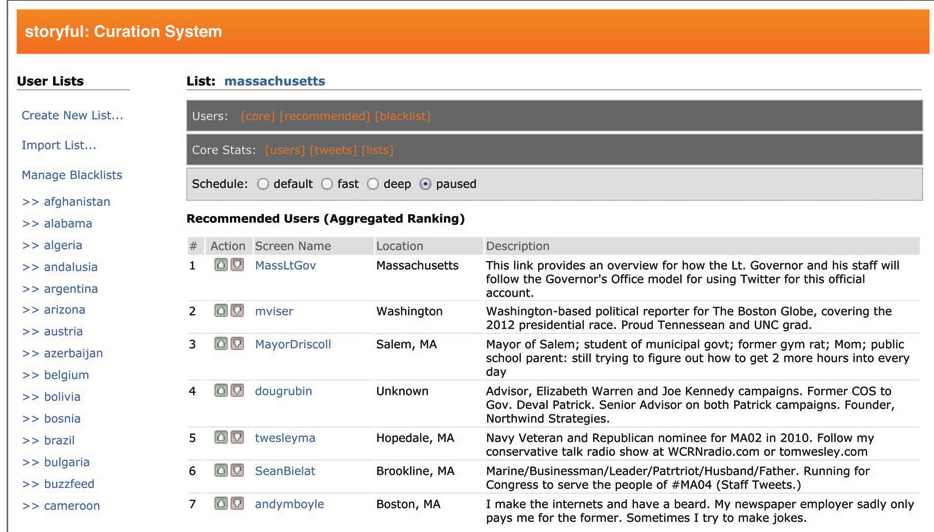 Figure 1: The UI allows curators to review "Candidate" users and promote them to the "Core" list based on ranked recommendations.
Real-World Impact: Monitoring Breaking News
The system isn't just a static recommender; it's a monitoring station. One of its most specialized features is the Velocity Measure. By tracking tweet frequency, user activity, and content similarity, the system can detect "spikes" that correlate with real-world events.
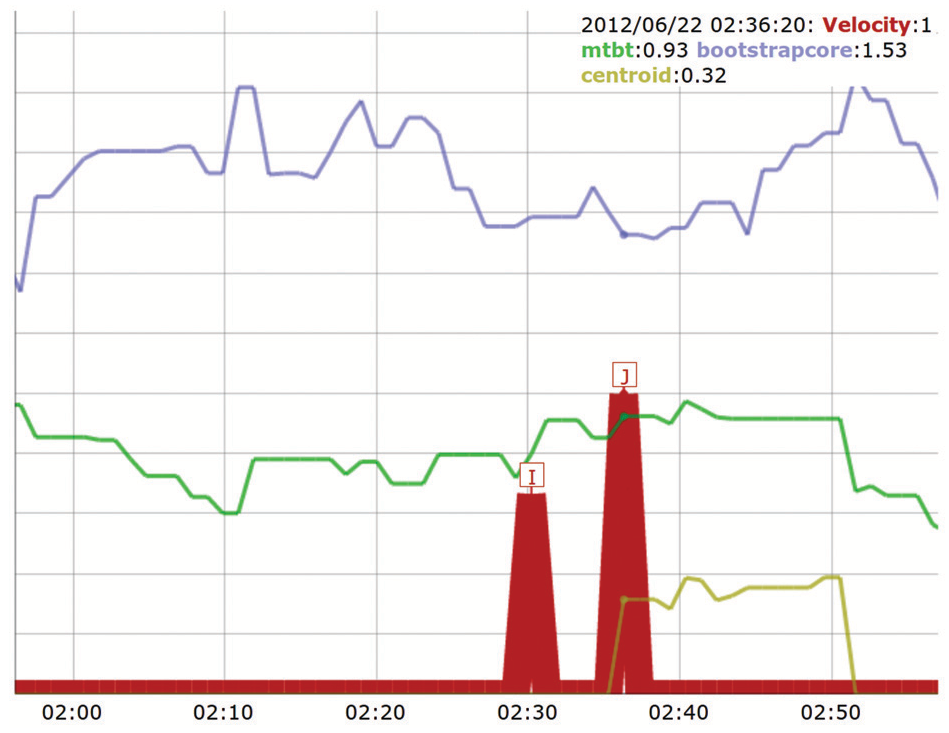 Figure 2: Velocity spikes in the Afghanistan list indicate specific breaking news events, allowing journalists to focus their attention exactly when it's needed most.
Critical Insight & Conclusion
While this work dates back to 2012, its core philosophy remains highly relevant: Discovery is Not Just About Content; It’s About Community Structure.
The system's strength lies in its Inductive Bias—the assumption that if several journalists and thousands of users have already grouped certain accounts together, the neighbors of those accounts are likely relevant. This "social metadata" is often more valuable than the text of the tweets itself for identifying authority.
Future Outlook: While this system focused on manual promotion, the next generation of such tools will likely use LLMs to summarize why a candidate is being recommended, further reducing the cognitive load on human curators. However, the requirement for a "Core list" as a ground-truth anchor remains a vital protection against the "hallucinations" of fully autonomous AI curation.