
Cuckoo: Decentralizing the Social Stream with Socio-Aware P2P
Twittering by Cuckoo – Decentralized and Socio-Aware Online Microblogging Services
Cuckoo is a decentralized, socio-aware microblogging architecture that leverages P2P techniques and social graphs to offload centralized servers. Built on a hybrid overlay (Pastry and Gossip), it ensures scalable micro-news dissemination and high availability without discarding existing service providers.
TL;DR
Cuckoo is a pioneering framework designed to fix the structural weaknesses of centralized microblogging. By transforming followers and friends into a decentralized P2P network, Cuckoo reduces server load, eliminates single points of failure, and leverages "social awareness" to ensure fast, reliable message delivery even when central servers are under attack.
The Fragility of the "Centralized Chirp"
In the early 2010s, Twitter’s "Fail Whale" was a frequent sight—a symbol of a centralized architecture buckling under the weight of its own success. The authors of "Twittering by Cuckoo" identify two fatal flaws in the traditional model:
- Inefficient Polling: Millions of clients blindly hitting servers to check for updates creates a massive, unnecessary bandwidth burden.
- Architectural Rigidity: A centralized database is a "single point of failure" and a prime target for DoS attacks and censorship.
The authors argue that microblogging is inherently suited for Peer-to-Peer (P2P) because it follows a publish-subscribe (pub-sub) model where social edges already define the data flow paths.
Methodology: The Hybrid Overlay & Socio-Awareness
Cuckoo doesn't just replace the server; it augments it with a Hybrid Overlay Structure.
1. Structured Overlay (Pastry)
Cuckoo uses the Pastry DHT (Distributed Hash Table) to organize user nodes into a structured space. This allows any node to locate another online user in steps, providing a robust decentralized location service.
2. Unstructured Overlay (Gossip)
For the actual dissemination of "tweets," Cuckoo forms unstructured overlays among users with shared interests (neighbors). This relies on a Gossip Protocol, ensuring that even if some nodes go offline, the message eventually reaches all active subscribers with high probability.
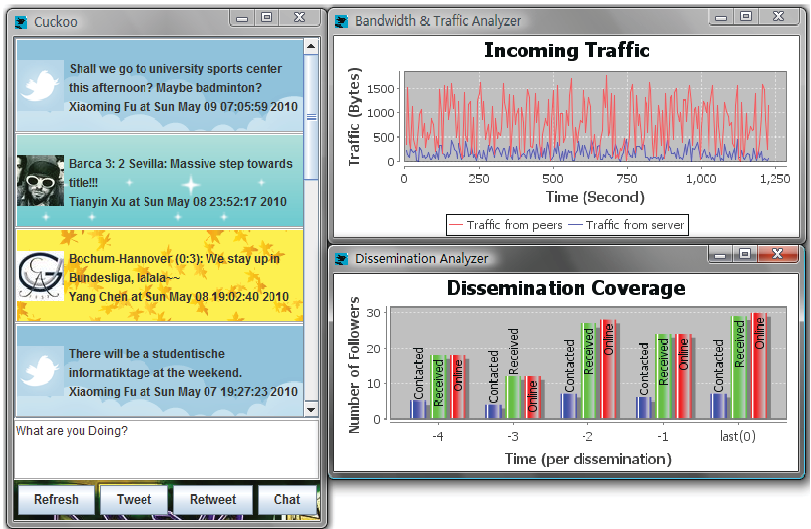 Figure 1: The Cuckoo interface featuring the real-time traffic analyzer and dissemination coverage monitor.
3. Socio-Aware Logic
What makes Cuckoo "Socio-Aware" is how it maps social roles to network functions:
- Friends: Reciprocal links where nodes act as "virtual nodes," helping each other with load balancing.
- Broadcasters: For celebrity accounts (like CNN), Cuckoo uses neighbor-based gossip to prevent the "thundering herd" effect on a single server.
Experimental Insights
The demonstration setup used netbooks acting as Twitter clients to prove compatibility with existing APIs without requiring server-side changes.
- Traffic Reduction: The bandwidth analyzer (red curve for peers, blue for servers) showed that the majority of traffic was shifted to the P2P network.
- Reliability: Since data is pushed between peers, the system remains functional for active users even if the central server hits its "rate limit" or goes offline.
- Coverage: The dissemination analyzer confirmed that high propagation coverage is achievable through "neighbors' mutual assistance."
Critical Analysis & Future Outlook
Cuckoo represents a critical bridge between the centralized Web 2.0 and the decentralized ideals of the modern Fediverse.
Strengths:
- Compatibility: It works as a wrapper around existing services (like Twitter).
- Efficiency: It targets the specific "blind polling" waste.
Limitations:
- Privacy/Security: In a P2P social network, metadata (who follows whom) might be more exposed to peer nodes.
- Node Stability: Mobile devices (the primary medium for microblogging) often have volatile connections, which can disrupt P2P meshes.
Conclusion: Cuckoo's legacy is visible in today's decentralized social protocols. It proved that by treating social connections as network routing paths, we can build services that are as resilient as the communities they support.