
TPM: Navigating the Trade-off Between Productivity and Energy Thresholds in FJSP
12479_A Two-Phase Meta-Heuristic for Multiobjective Flexible Job Shop Scheduling Problem With Total Energy Consumption Threshold.
The paper introduces a Two-Phase Meta-heuristic (TPM) designed for the Multiobjective Flexible Job Shop Scheduling Problem (FJSP) with a total energy consumption threshold. By integrating a novel Imperialist Competitive Algorithm (ICA) and Variable Neighborhood Search (VNS), TPM synchronizes the minimization of makespan and total tardiness while adhering to strict energy constraints, outforming NSGA-II and VNS baselines across 58 test instances.
TL;DR
Scheduling modern factories isn't just about speed () anymore; it's about staying under the "energy cap." This paper presents TPM (Two-Phase Meta-heuristic), which combines the sociopolitical logic of the Imperialist Competitive Algorithm (ICA) with the granular local search of Variable Neighborhood Search (VNS). It effectively solves the Flexible Job Shop Scheduling Problem (FJSP) under energy threshold constraints, providing a robust tool for green manufacturing.
Problem & Motivation: The "Hard Cap" Dilemma
In traditional multiobjective scheduling, researchers usually try to minimize energy consumption alongside time. However, in many industrial settings, the manager doesn't necessarily want "minimum" energy—they want to stay below a Total Energy Consumption (TEC) threshold to avoid peak-demand penalties.
Prior works fail here because:
- Standard decoders often produce "illegal" schedules that blow past the energy threshold.
- Deciding what the threshold should be is a "chicken-and-egg" problem—you need to know the optimal range before setting the limit.
Methodology: The Two-Phase Strategy
The authors suggest that if a constraint is hard to satisfy, we should first treat it as a goal, then as a boundary.
Phase I: Global Exploration via ICA
The problem is initially transformed into a tri-objective task: minimize Makespan, Tardiness, and TEC. Here, the Imperialist Competitive Algorithm (ICA) takes the lead.
- Sociopolitical Meta-heuristic: Solutions are "countries," and the best ones are "imperialists" that "assimilate" their colonies.
- Dynamic Thresholding: By running this phase, the algorithm discovers the natural "Pareto Front" of energy, allowing the system to set a realistic (threshold).
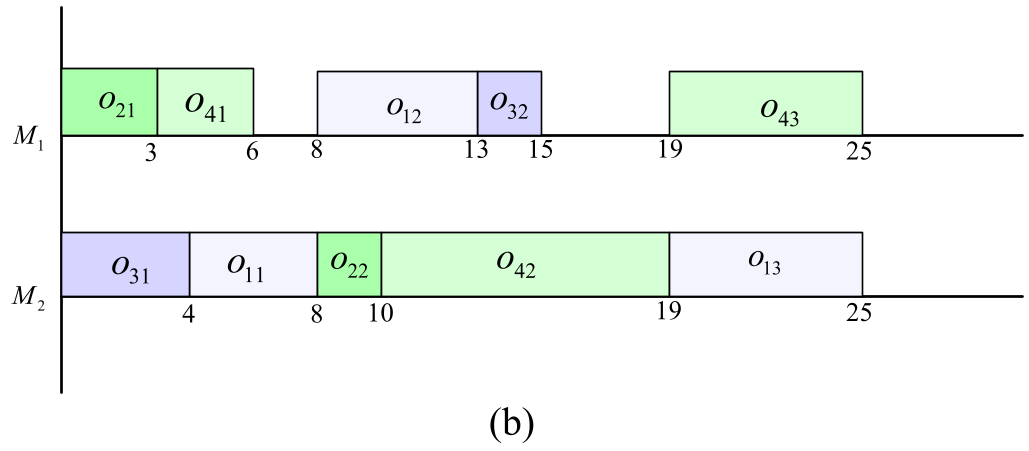 Fig 1: Illustrative FJSP schedule showing machine modes (Processing vs. Stand-by).
Phase II: Local Refinement via VNS
Once the threshold is set, the energy axis is "locked." The algorithm switches to Variable Neighborhood Search (VNS).
- VNS explores three "neighborhoods": Swap (scheduling), Insert (scheduling), and Change (routing).
- Solution Injection: To prevent the VNS from getting stuck in a local time-efficiency trap, it periodically pulls diverse, high-quality imperialist solutions from Phase I back into the current search.
Experiments & Results
The authors tested TPM against the industry-standard NSGA-II and a standalone VNS.
Metric Performance
The quality was measured using (Convergence) and (Success ratio).
- TPM consistently dominated: In the majority of the 58 instances (ranging from small 4-job cases to massive 18-job DP instances), TPM found a higher number of non-dominated solutions.
- Energy Adherence: TPM's ATEC (Average Total Energy Consumption) remained consistently below the threshold while significantly reducing tardiness compared to earlier hybrid models.
 Table 1: Comparison showing ATEC and MTEC metrics against thresholds.
Critical Insight & Conclusion
The genius of this work lies in the synergy between ICA and VNS. ICA provides the "macro" view of the landscape, identifying where the energy boundaries are. VNS provides the "micro" view, polishing the sequences to shave seconds off the makespan.
Limitations: The algorithm's performance relies on the parameter—if Phase I doesn't explore enough, the threshold determined for Phase II might be suboptimal.
Future Outlook: As industrial electricity prices become more volatile, applying this two-phase logic to Time-of-Use (ToU) electricity pricing—where the threshold changes every hour—is the logical next step for this research.