
Two Sites, Two Voices: How Platform Architecture Dictates Your Digital Personality
Two Sites, Two Voices: Linguistic Differences between Facebook Status Updates and Tweets
This research presents a comparative sociolinguistic analysis of Facebook status updates and Tweets using the LIWC (Linguistic Inquiry and Word Count) framework. The study identifies distinct "voices" for each platform, highlighting how network topology—bidirectional/private on Facebook versus unidirectional/public on Twitter—shapes user self-expression and emotional disclosure.
TL;DR
Do you talk differently on Twitter than you do on Facebook? Science says yes. A study of Singaporean users reveals that while Facebook is a space for intimate, emotional, and social sharing, Twitter is a high-stakes public square where we use more "complex" language and mask negative emotions to maintain a positive social image.
Problem & Motivation: The Platform is the Message
In the early 2010s, social media research often painted a broad brush over "online behavior." However, Marshall McLuhan’s famous adage, "The medium is the message," suggests that the structure of the platform itself influences what we say.
The authors of this study identified a critical gap: Facebook and Twitter have fundamentally different network topologies.
- Facebook is bidirectional (mutual friends) and largely private.
- Twitter is unidirectional (followers) and public by default.
The motivation was to prove that these structural differences create unique "linguistic fingerprints." Why do we feel comfortable venting on a status update but feel the need to sound "smart" or "witty" in a tweet?
Methodology: The Scalpel of Psycholinguistics
The researchers employed the Linguistic Inquiry and Word Count (LIWC) tool. LIWC doesn't just look at what you say; it looks at how you say it by categorizing words into psychologically meaningful groups:
- Function Words: Pronouns and prepositions that reveal clinical or social focus.
- Emotion Words: Tracking the ratio of "happy" vs. "angry" or "sad" content.
- Content Words: Identifying topics like work, money, or leisure.
The dataset consisted of the 100 most recent posts from college students active on both platforms, ensuring that differences in language were due to the site, not the user's personality.
Key Insights: Emotional Intimacy vs. Cognitive Complexity
1. Facebook: The Emotional Living Room
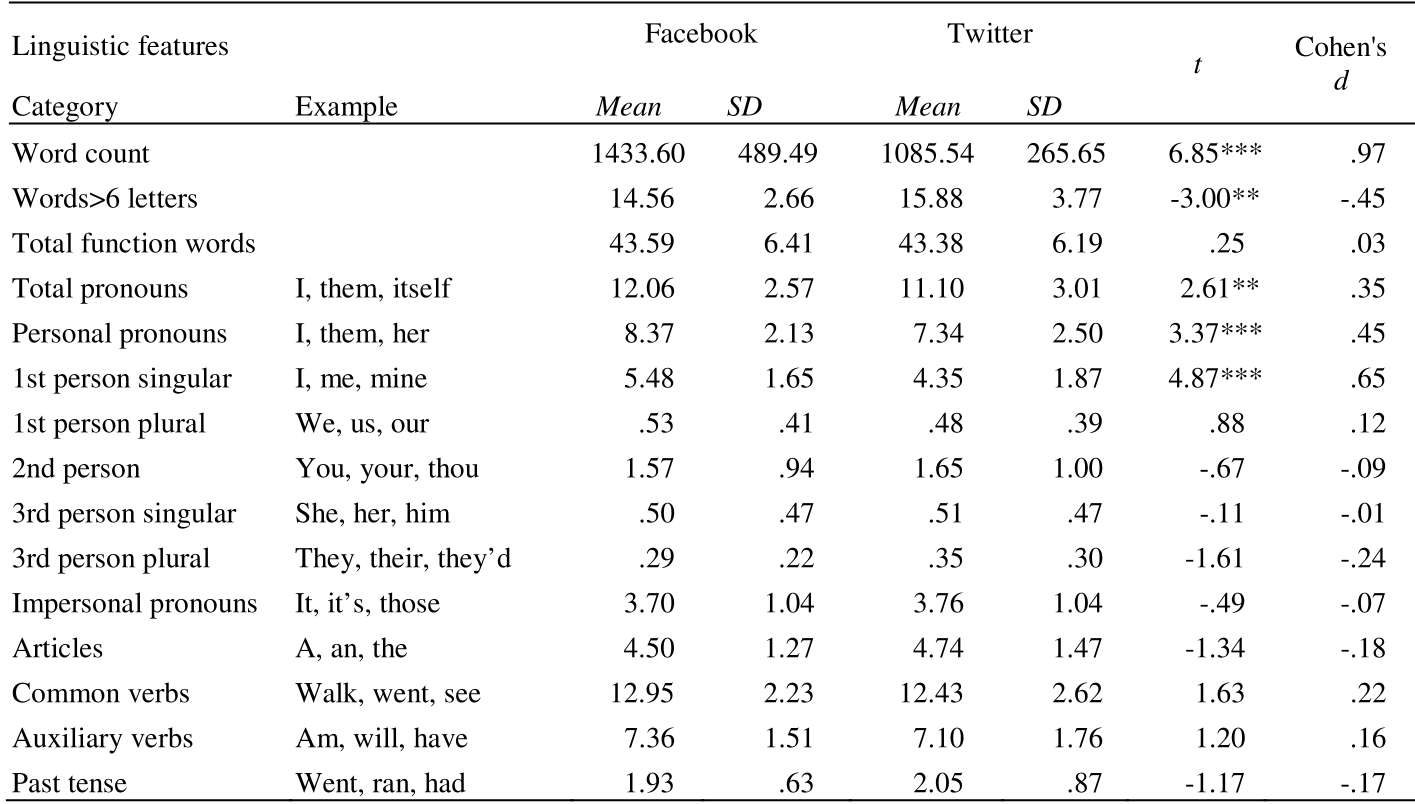
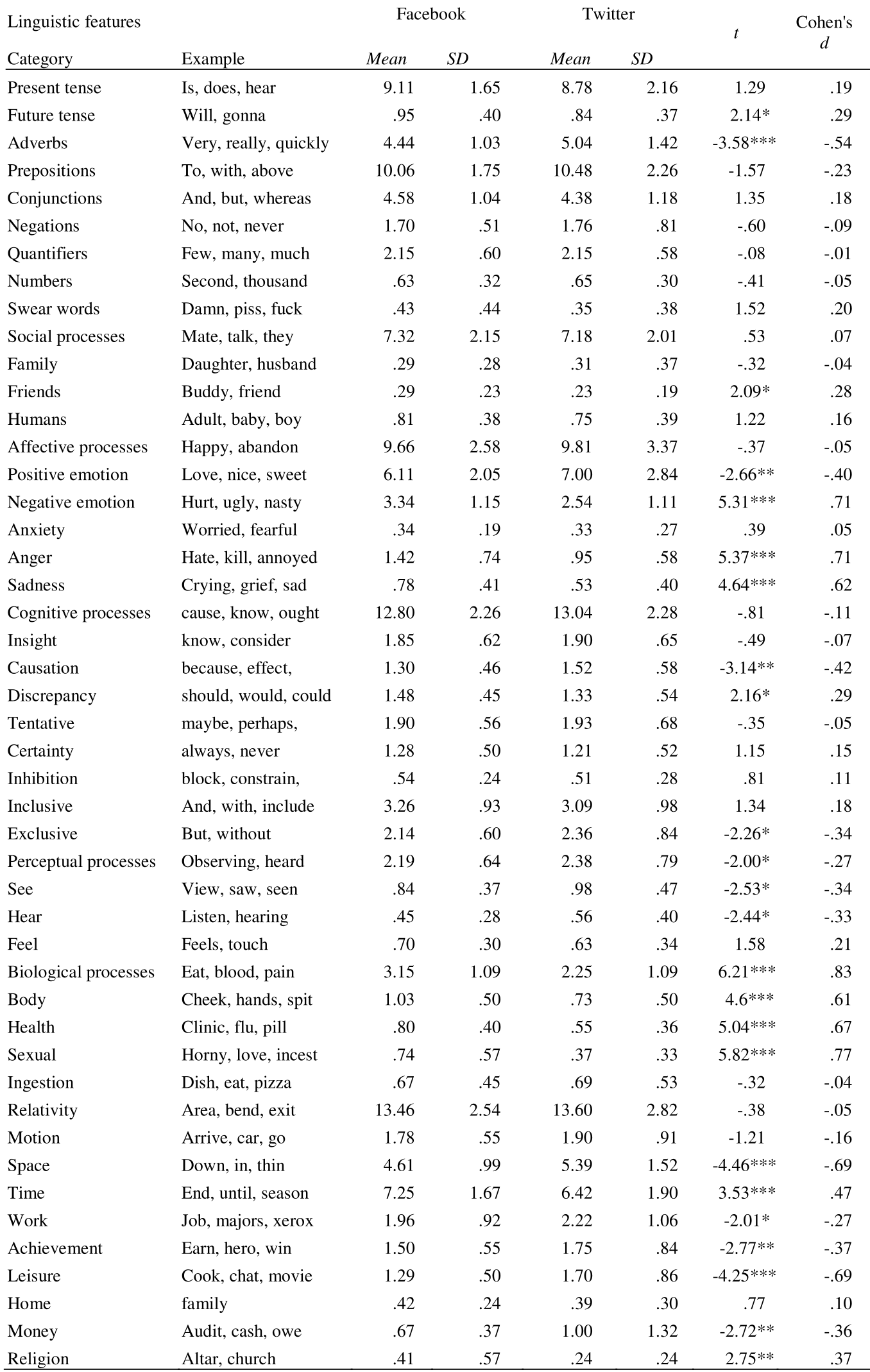
Facebook status updates showed significantly higher verbal immediacy. Users used more first-person singular pronouns ("I", "Me") and more "discrepancy" words (expressing how things could be). Interestingly, Facebook users were much more likely to express negative emotions like anger and sadness. Because they are talking to real-life friends, the "social cost" of being vulnerable or grumpy is lower.
2. Twitter: The Public Stage
Twitter users exhibited what sociologists call Impression Management. Even though Twitter is more "casual" in its use of slang (Singapore Colloquial English), users used more positive emotion words. When you talk to a crowd of strangers, you want to look like you're having a good time. Furthermore, Tweets showed higher cognitive complexity. The use of exclusive words (e.g., "but", "unless") and causal words suggests that Twitter is a site for appraisal and information exchange rather than just "feeling."
Experimental Analysis: SOTA Comparison
The study’s findings on content topics were particularly revealing.
- Facebook topics: Body, health, and biological processes. It’s personal and physical.
- Twitter topics: Work, achievement, money, and leisure. It’s interest-driven and achievement-oriented.
This aligns with findings that Twitter usage is correlated with conscientiousness (goal-oriented behavior), whereas Facebook is a hub for extraversion and sociability.
Critical Insight & Conclusion
Takeaway
The study confirms that our digital identity is not a monolith. We are "chameleons" who adapt our grammar, emotional range, and topics to match the "room" we are in. Facebook fosters social connectedness, while Twitter facilitates information dissemination.
Limitations & Future Work
The study focused on a 2012-era cohort of Singaporean students. In 2024, the landscape has shifted:
- Platform Evolution: Twitter (now X) has become more polarized; has the positive "impression management" been replaced by "outrage culture"?
- Algorithmic Influence: How do recommendation algorithms (like TikTok’s For You page) change linguistic style compared to the follower-based models of 2012?
This research remains a foundational piece for UX designers and marketers: if you want to connect with users on an emotional level, meet them where they feel "at home" (Facebook/Instagram Stories); if you want to engage them in debate or information, meet them on the "stage" (X/LinkedIn).