
Beyond Fixed Sectors: Optimizing Massive MIMO via Trace Quotient Formulation
Two-Stage Beamformer Design for Massive MIMO Downlink By Trace Quotient Formulation
This paper proposes an optimal outer beamformer design for two-stage beamforming in massive MIMO downlink systems. By maximizing a derived lower bound of the average Signal-to-Leakage-plus-Noise Ratio (SLNR), the authors cast the design problem into a Trace Quotient Problem (TQP) that adaptively balances signal power and interference based on channel statistics.
TL;DR
In the world of Massive MIMO, knowing the exact channel of every user is a luxury we often can't afford (especially in FDD mode). This paper introduces a sophisticated "divide-and-conquer" strategy for beamforming. By framing the design of the "outer beamformer" as a Trace Quotient Problem (TQP), the authors allow the base station to adaptively partition users into virtual sectors based solely on statistical covariance, significantly boosting the sum rate compared to static "one-size-fits-all" methods.
The Problem: The CSI Bottleneck
Massive MIMO is great on paper: more antennas equal higher capacity. But in Frequency Division Duplexing (FDD) systems, the base station needs to estimate hundreds of channel parameters, and users have to feed that data back. This "CSI feedback storm" eats up the very bandwidth the system is supposed to provide.
Prior works like Joint Spatial Division and Multiplexing (JSDM) proposed a two-stage approach:
- Outer Beamformer: Groups users into virtual sectors using long-term statistics (Spatial Covariance).
- Inner Beamformer: Handles the remaining small-dimensional "effective" channel at a much lower cost.
However, the "Outer" part was always the weak link. Methods like simple Block Diagonalization (BD) or fixed-weight projections are too rigid—they don't know how much to prioritize "killing interference" versus "boosting signal" when the scattering environment changes.
The Insight: Signal-to-Leakage Ratio (SLNR)
The authors turn to the SLNR criterion. Unlike SINR (which is hard to optimize because it depends on everyone else's beamformer), SLNR focuses on what one transmitter "leaks" to others. It’s a transmitter-side metric that is much more mathematically tractable.
But there’s a catch: the outer beamformer must be designed before the inner beamformer exists. To solve this, the authors derived a mathematical lower bound on the average SLNR that only requires knowledge of the channel covariance matrices ().
Methodology: The Trace Quotient Problem
The core of the paper is transforming the optimization of this lower bound into a Trace Quotient Problem (TQP):
Where:
- represents the "Desired Power" (corrected for inner ZF beamforming loss).
- represents the "Leakage + Noise".
Architecture Overview
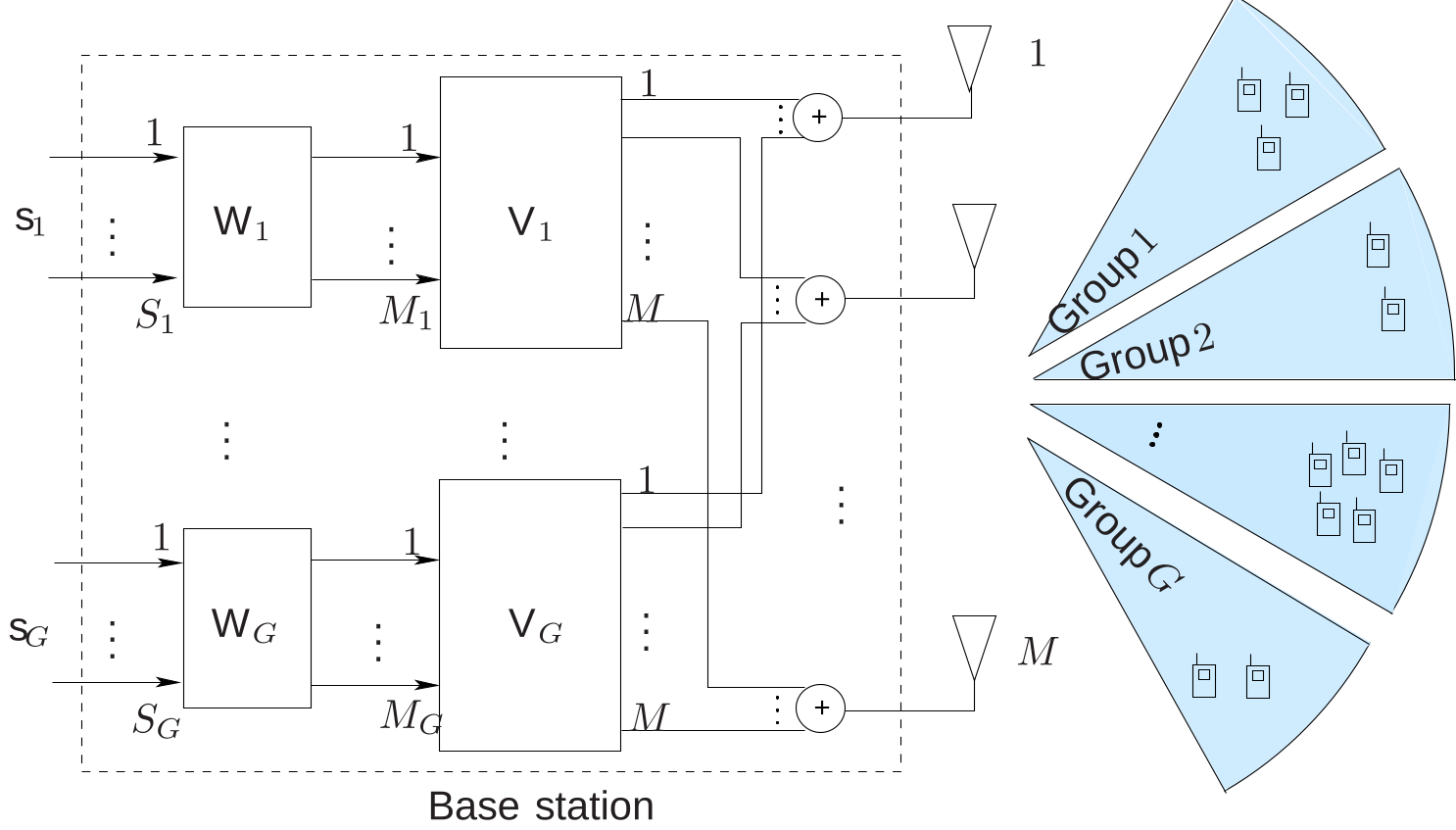
The system follows a hierarchical structure where the outer beamformer creates a reduced-dimension manifold for the inner beamformer .
The Iterative Algorithm
Since TQPs don't have a closed-form solution with orthonormality constraints, the authors use an iterative approach. In each step, they solve a Trace Difference Problem, which is a linear eigenvalue problem. This converts a complex nonlinear ratio optimization into a series of fast, convergent operations.
Experimental Evidence
The methodology was tested on a massive MISO system with antennas.
1. Superior Sum Rate
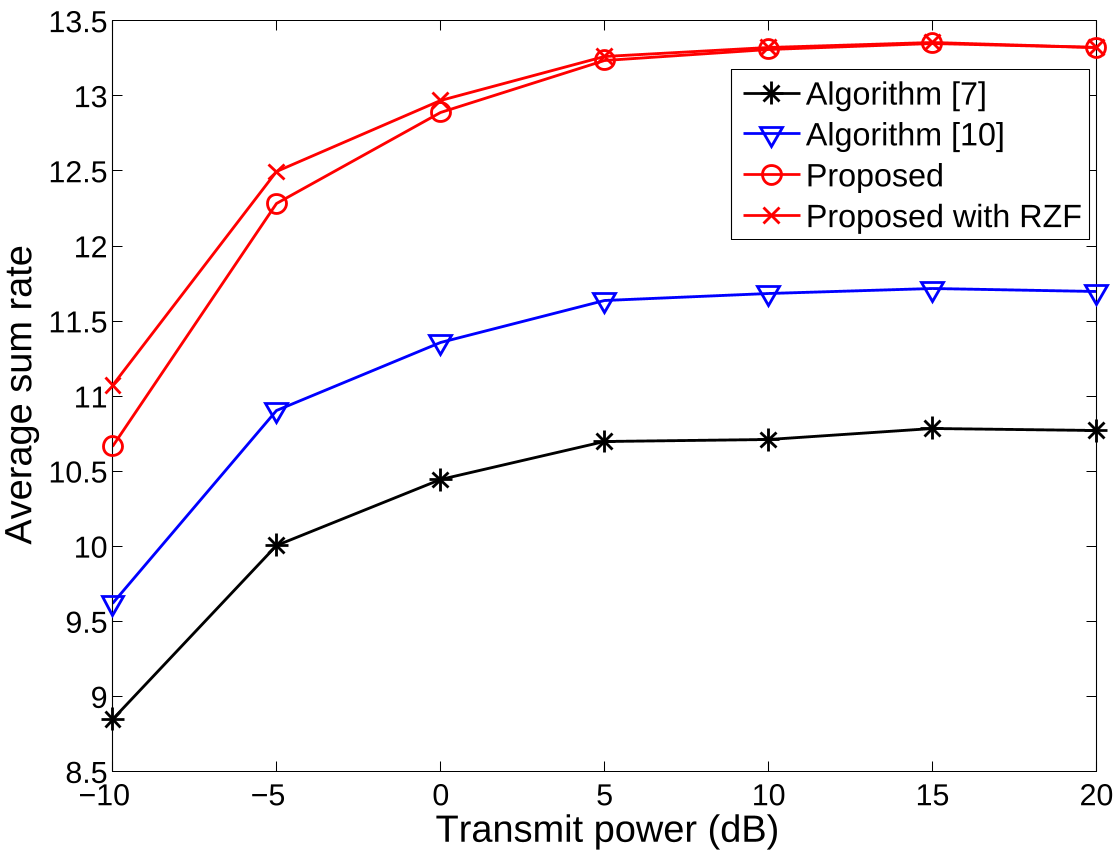
As seen below, the proposed TQP-based design (green/blue lines) significantly outperforms the Block Diagonalization (BD) and Chen's method.
2. Physical Intuition: Adaptive Weighting
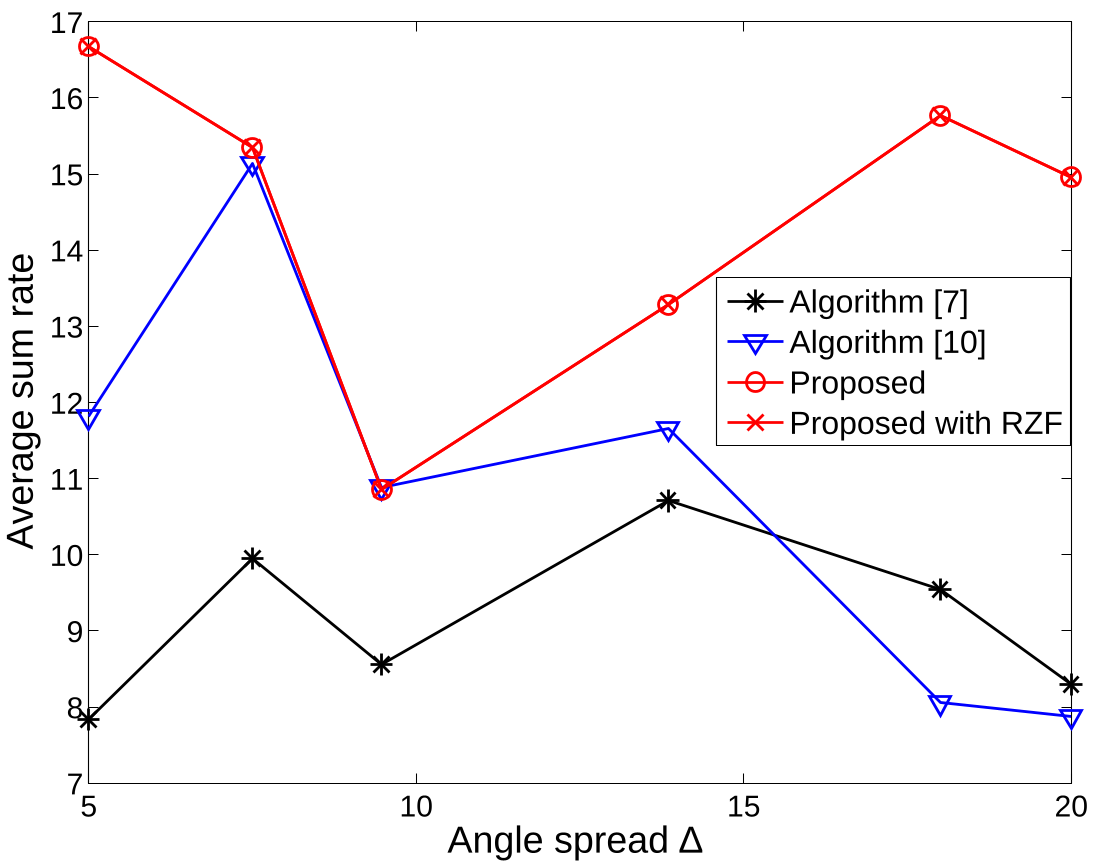
Why does it work? The paper demonstrates that the TQP formulation acts as an adaptive weighting mechanism. In environments with high angular spread (AS), the algorithm automatically shifts its focus to suppress leakage more aggressively, whereas static algorithms (like Chen's with fixed ) fail to adapt.
Critical Analysis & Takeaways
- The Power of TQP: The transition from "Linear Eigen-systems" to "Non-linear Eigen-systems" is the key. By letting the "weight" of the interference be a function of the beamformer itself, we reach the global optimum of the trace ratio.
- Limitations: The model assumes a "one-ring" scattering model which is mathematically convenient, but its performance in highly non-stationary or line-of-sight (LoS) dominated 5G/6G environments might require further tuning.
- Future Impact: This approach bridges the gap between machine learning dimensionality reduction (where TQP is famous) and wireless physical layer design. It opens the door for more "AI-native" precoding where long-term channel statistics drive the network architecture.
Conclusion
By treating virtual sectorization as an optimization problem rather than a geometry problem, the authors have provided a robust framework for FDD Massive MIMO. The TQP-based outer beamformer provides the "optimal glasses" through which the inner beamformer views the channel, maximizing throughput while keeping interference under control.