
Type and Leak Your Ethnicity: The Unseen Privacy Risk in Your Smartphone's Accelerometer
Type and Leak Your Ethnicity on Smartphones
This paper presents a novel side-channel attack on Android smartphones that infers user identity and ethnicity (specifically Chinese nationality) by analyzing accelerometer and gyroscope sensor data during soft keyboard typing. Using a Random Forest classifier, the authors achieved a 97.67% accuracy for individual identification and an 86.62% accuracy for ethnicity classification.
TL;DR
Researchers have uncovered a striking privacy vulnerability: simply by "listening" to your phone's motion sensors while you type, a malicious app can identify who you are with 97% accuracy and even predict your ethnicity with over 86% accuracy. This side-channel attack exploits physiological and behavioral nuances in how different groups interact with touchscreens.
Background: The "Harmless" Sensor Myth
In the hierarchy of smartphone privacy, we often guard our camera, microphone, and GPS with "Allow/Deny" prompts. However, motion sensors—like the accelerometer and gyroscope—are frequently categorized as insensitive. Most mobile operating systems allow apps to access these sensors without explicit user permission. This paper demonstrates that these "harmless" sensors are actually high-fidelity windows into our private identity.
Problem & Motivation: Beyond Password Cracking
While previous research has shown that motion sensors can be used to crack PINs or track locations, this study asks a more social-technical question: Can your physical interaction with a device leak your demographic background?
The authors hypothesize that factors such as finger length, hand grip strength, and the mechanical force of typing vary significantly between individuals and across different ethnicities. If a malicious actor can determine a user's nationality through sensor data, they can engage in ultra-targeted (and potentially discriminatory) advertising or profiling without the user ever knowing.
Methodology: Capturing the "Vibe" of a Keystroke
The researchers developed a background application called SensorReader to monitor three-dimensional space variations (X, Y, and Z axes) during typing.
The Feature Engineering Process
For every single tap, the system captures a window of data (before, during, and after the tap). From these raw signals, they extract 18 statistical features, including:
- Mean and Median: The central tendency of the movement.
- Standard Deviation (std): The intensity and variation of the tap force.
- Skewness: The asymmetry of the motion distribution.
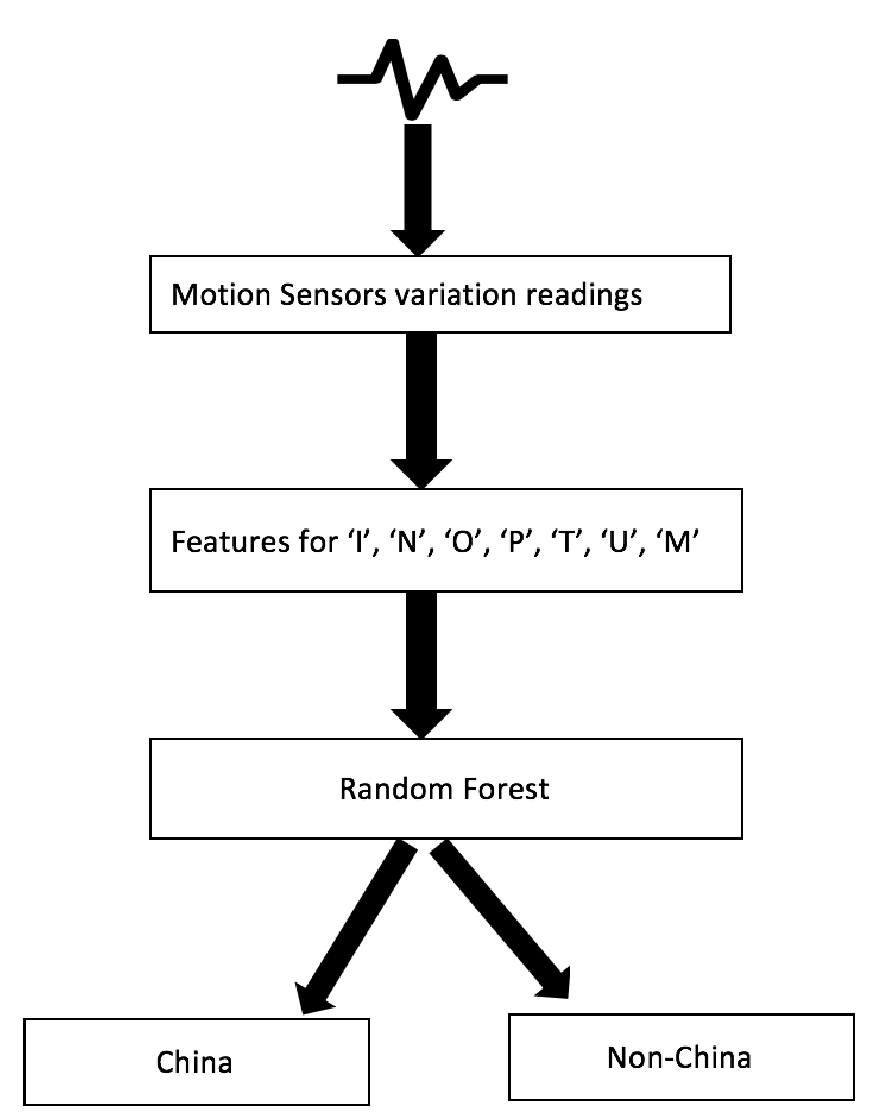 Fig 2. The data pipeline: From raw accelerometer readings to Random Forest classification.
The choice of a Random Forest algorithm was pivotal, as it outperformed Support Vector Machines (SVM) by building an ensemble of decision trees to vote on the most likely identity or ethnicity.
Experiments: Your Typing is Your Fingerprint
The study involved six volunteers (split between Chinese and other nationalities). The results were divided into two primary tests:
1. User Identification
The model proved that typing patterns are remarkably unique. The average accuracy across users was 97.67%, with several users being identified with 100% precision. This suggests that the way you hold your phone and strike the screen is as distinctive as a biological signature.
2. Ethnicity Identification (The "Chinese Nationality" Case)
When attempting to classify if a user was Chinese or non-Chinese, the initial model achieved 71.22%. However, the researchers discovered a fascinating nuance: certain characters are more "ethnically discriminative" than others.
By focusing exclusively on the keys I, N, O, P, T, U, and M, the accuracy jumped to 86.62%. This is likely due to the specific hand-stretch requirements and frequency of use for these characters in different linguistic contexts.
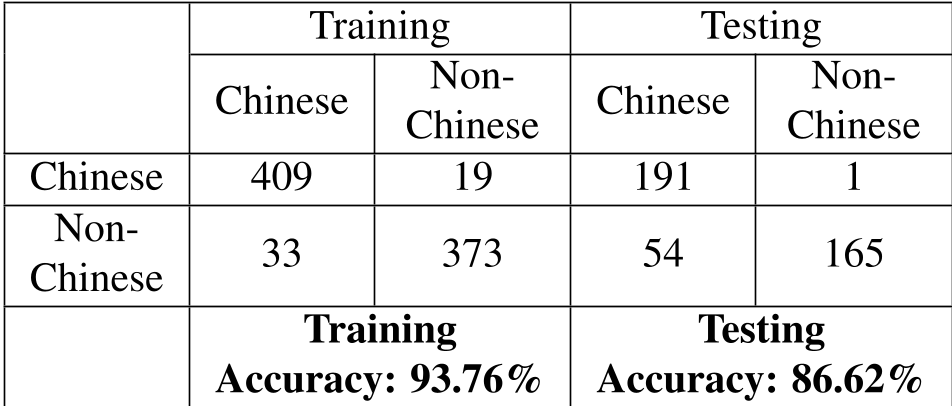 Table 3. Improved ethnicity classification using specific "high-impact" characters.
Critical Insight & Conclusion
This research is a wake-up call for mobile OS developers. It proves that side-channel attacks can move beyond simple data theft (like passwords) into the realm of demographic profiling.
Limitations & Future Work
- Sample Size: The study used a small cohort (6 users). While the results are statistically significant for this group, a larger, more diverse dataset is needed to validate the "ethnicity" signature across broader populations.
- Controlled Environment: Users were standing and using their right hand. Future research will need to account for walking, lying down, or two-handed typing.
The Takeaway: Your smartphone's accelerometer is more than just a tool for rotating your screen or counting steps—it is a sophisticated biometric sensor that can, and will, leak your identity unless stricter permission-based access is implemented.