
Unmasking the Impostors: A Deep Dive into Instagram's Impersonation Ecosystem
Typification of Impersonated Accounts on Instagram
This study presents a systematic typification of impersonated accounts on Instagram across three distinct communities: Politics, News, and Sports. Using unsupervised clustering (K-Means, GMM, Spectral), the authors identify and categorize 4K impersonators into three archetypes—Fan Pages, Ordinary Users, and Bot-Likes—achieving a granular understanding of malicious social media behaviors.
TL;DR
Social media impersonation is more complex than just "fake accounts." This research analyzes 4,000 Instagram impersonators across Politics, Sports, and News to reveal three distinct personas: the enthusiastic Fan Page, the sympathetic Ordinary User, and the predatory Bot-Like account. By combining CNN-based image analysis with unsupervised clustering, the study proves that bots have a strategic "appetite" for politics while largely ignoring news agencies.
Background: The Identity Crisis on Instagram
As Instagram has evolved from a photo-sharing app into a global arena for public discourse, the stakes for account authenticity have skyrocketed. While "blue checks" offer some protection, the platform is rife with accounts that mimic celebrities and politicians to spread misinformation or defraud followers. This paper moves beyond simple detection, providing a behavioral taxonomy of these bad actors.
Problem & Motivation: Why Current Detection Falls Short
Most security frameworks attempt to classify accounts as either "Real" or "Fake." This binary view misses the intent and mechanics behind the deception. For instance:
- Is a fan page dedicated to Leo Messi a "malicious impersonator"?
- Is an account using Barack Obama's photo to comment on policy a bot or just a passionate supporter?
The authors argue that we must analyze the Inductive Bias of these accounts—looking at their profile metadata alongside their interaction patterns—to truly understand the threat landscape.
Methodology: The Multi-Modal Detection Pipeline
The researchers built a custom crawler that analyzed 500k profiles interacting with 12 high-profile accounts (including Trump, Ronaldo, and the BBC). To identify impostors, they used a two-pronged approach:
- Textual Analysis: TF-IDF scores for usernames, display names, and biographies.
- Visual Analysis: A Convolutional Neural Network (CNN) to detect when an account was using the exact or modified profile picture of the genuine verified entity.
Architectural Insight: The 3 Clusters
After identifying the impersonators, the authors applied K-Means and Spectral Clustering to group them. The "Elbow Method" confirmed that these users naturally fall into three clusters:
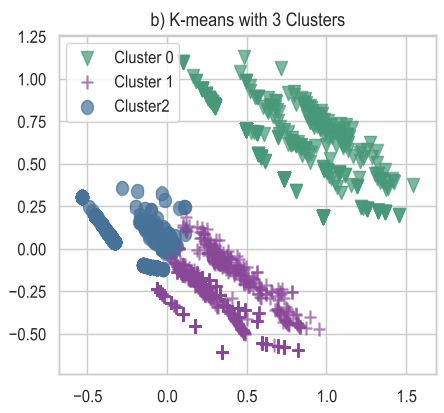
- C0 - Fan Pages: High followers, public profiles, and heavy engagement.
- C1 - Ordinary Users: Private accounts that use hashtags or mentions in their bios to show support; mathematically closer to "noisy" real users.
- C2 - Bot-Like: The most dangerous cluster. They have a 100% profile photo similarity to the target and a post-publishing rate 300% higher than ordinary users.
Experiments & Results: Behavioral Fingerprinting
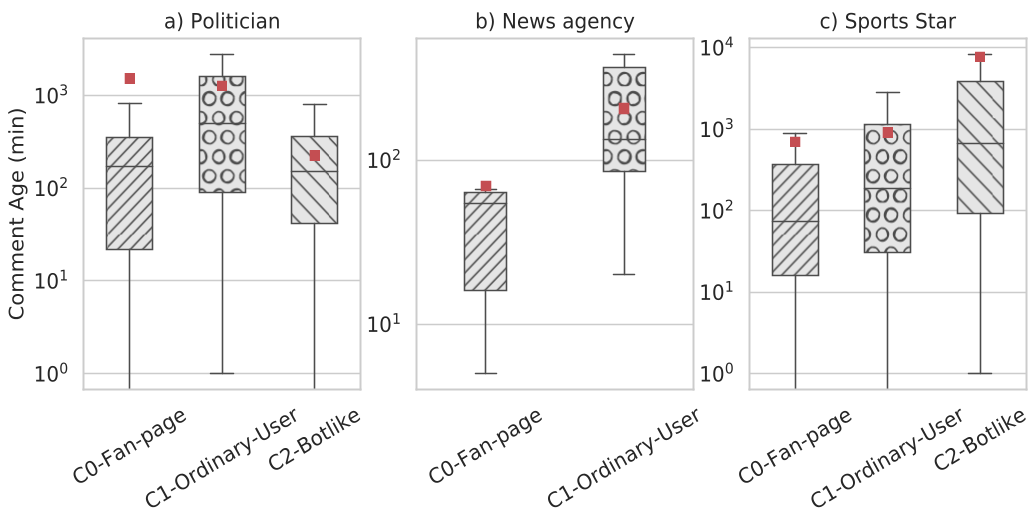
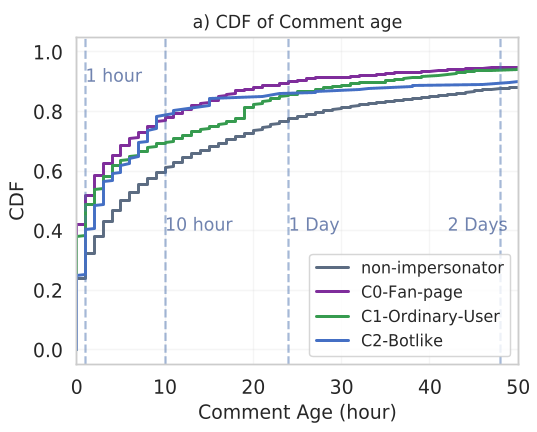
The study’s most striking findings come from comparing how these clusters behave over time.
The "Political Appetite" of Bots
A cross-category analysis revealed that Bot-Likes (C2) are significantly more active in the political sphere. They averaged 17 comments per user in the Politician community but had zero activity in the News agency community.
Temporal Dynamics (The 10-Hour Peak)
While non-impersonators comment steadily, Bot-Likes follow a suspiciously mechanical pattern. They begin commenting approximately 1 hour after a post is published and peak exactly at the 10-hour mark, suggesting a programmed delay likely designed to evade Instagram's immediate spam filters.
Deep Insight & Conclusion
This research highlights the social engineering aspect of bot design. Bot-Likes on Instagram aren't just trying to look like anyone; they are mimicking the authority of verified figures to gain traction in highly polarized political environments.
Limitations & Future Work
The study relies on profile metadata and timing. The authors admit that the next frontier is Semantic Content Analysis—analyzing what these bots are actually saying. As LLMs (Large Language Models) become more prevalent, the "Bot-Like" cluster will likely become even harder to distinguish from "Ordinary Users," necessitating more advanced behavioral models.
Key Takeaway: If you see an account with a celebrity's photo posting 3x more than average and peaking 10 hours after the original post—you've likely spotted a C2-Bot-Like.