
UBLF: Breaking the Monte-Carlo Bottleneck in Influence Maximization
UBLF: An Upper Bound Based Approach to Discover Influential Nodes in Social Networks
This paper introduces UBLF (Upper Bound based Lazy Forward), a novel algorithm for identifying influential nodes in social networks. By deriving a mathematical upper bound for the influence spread function under the Independent Cascade (IC) model, the method significantly optimizes the greedy selection process by pruning redundant Monte-Carlo simulations.
TL;DR
Influence Maximization (IM) is the task of finding nodes in a social network that maximize the "word-of-mouth" effect. While the classic CELF algorithm optimized this using the property of diminishing returns (submodularity), it remained slow because it required a full pass of Monte-Carlo simulations on every node to start. This paper introduces UBLF, which uses a mathematical upper bound to prune more than 95% of those simulations, achieving a 2-5x speedup without sacrificing accuracy.
The Motivation: Why is IM so slow?
The seminal work by Kempe et al. proved that IM is NP-hard. The standard solution is a greedy algorithm that picks the best node, then the next best, and so on. To know "how good" a node is, we usually run 10,000 Monte-Carlo (MC) simulations.
The industry-standard CELF improved this by observing that a node's marginal gain at step cannot exceed its gain at step . However, CELF has a "cold start" problem: in the first round, it must run MC simulations for every single node in the network to establish an initial ranking. For a million-node network, this is a disaster.
The Core Insight: An Analytical Shortcut
The authors' primary contribution is the derivation of a theoretical upper bound for the spread function. They essentially translated the stochastic propagation process into a series of matrix operations.
Methodology: The Matrix Bound
By representing the network as a propagation probability matrix , they proved that the expected spread is bounded by:
Where:
- is the initial state (nodes in the seed set).
- represents the reachability through all possible path lengths.
This formula allows us to estimate the maximum possible influence of a node using linear algebra rather than thousands of random simulations. In the UBLF algorithm, they use this bound as a "filter"—if a node's theoretical maximum influence is lower than the actual (sampled) influence of a node we've already checked, we can skip the MC simulation for that node entirely.
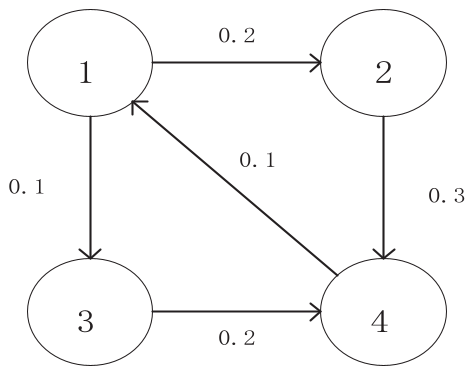 Figure: An illustration of how the analytical bound is calculated across paths to nodes in a graph.
Experiments: Efficiency without Loss
The authors tested UBLF across several datasets, including arXiv collaboration networks and Enron email logs.
Key Findings:
- Massive Pruning: UBLF reduces the number of MC calls by 95.6% to 99.8%. In the email-Enron dataset, CELF required 70,488 simulations, while UBLF required only 167.
- Identical Accuracy: Because UBLF uses the bound only to prune nodes that mathematically couldn't be the winner, the final seed set is identical to the one found by the greedy algorithm.
- Speed: The algorithm is consistently 2-5 times faster than CELF for small seed sets, and this gap often widens as the network scale increases.
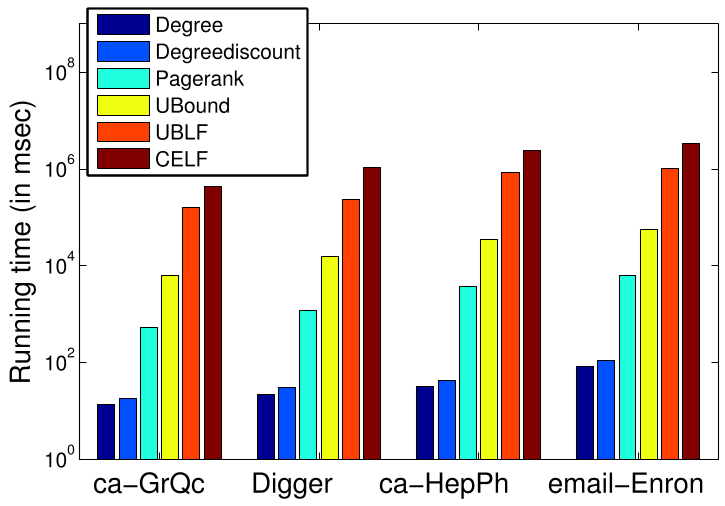 Figure: Comparison of runtimes. While heuristics like PageRank are faster, UBLF provides the approximation guarantees of the greedy algorithm with much lower latency than CELF.
Critical Analysis & Conclusion
The real value of UBLF lies in its "hybrid" nature. It doesn't replace Monte-Carlo simulations (which are still needed for high-precision ranking), but it uses linear algebra to eliminate the "obvious losers."
Limitations
- The Convergence Catch: The upper bound requires the matrix to converge. This usually happens in social networks where edge weights are small (e.g., ), but might fail in dense, high-probability networks.
- Memory: While they use an iterative method to avoid storing the full inverse matrix, large-scale matrix-vector multiplications still require careful memory management.
Final Takeaway
UBLF is a significant step forward for viral marketing and outbreak detection. It proves that we don't have to choose between "fast heuristics with no guarantees" (like Degree Centrality) and "slow greedy algorithms with guarantees." By using mathematical bounds, we can have the best of both worlds.