
UDesignIt: Crowdsourcing the Blueprint—From Social Tweets to System Design
UDesignIt: Towards social media for community-driven design
UDesignIt is a community-driven design platform that transforms unstructured social media discussions into structured software design artifacts. It leverages Natural Language Processing (NLP) and hierarchical clustering to automatically extract "feature models" from public discourse, enabling large-scale participatory design.
TL;DR
What if your community's Facebook complaints could be automatically turned into a structured software design? UDesignIt is a platform that does exactly that. By blending NLP, semantic clustering, and a unique "image-cloud" interface, it empowers non-technical citizens to participate in the high-level design of social systems (like healthcare or urban planning) simply by engaging in online discussions.
Strategic Position: This is a pioneering work in Social Software Engineering, moving beyond static crowdsourcing toward dynamic, large-scale participatory design.
The Problem: All Talk, No Design
Current social media initiatives like SeeClickFix or LoveLewisham are great at "pointing out problems" but terrible at "designing solutions." The missing link is the ability to synthesize thousands of unfiltered comments into a structured format that software engineers can actually use.
For the average citizen, a "Feature Model" (a standard tree structure in software engineering) is too technical. Conversely, for an engineer, a 5,000-comment Reddit thread is too messy. There is a deep communication chasm between community needs and system implementation.
Methodology: Mining Meaning from the Mess
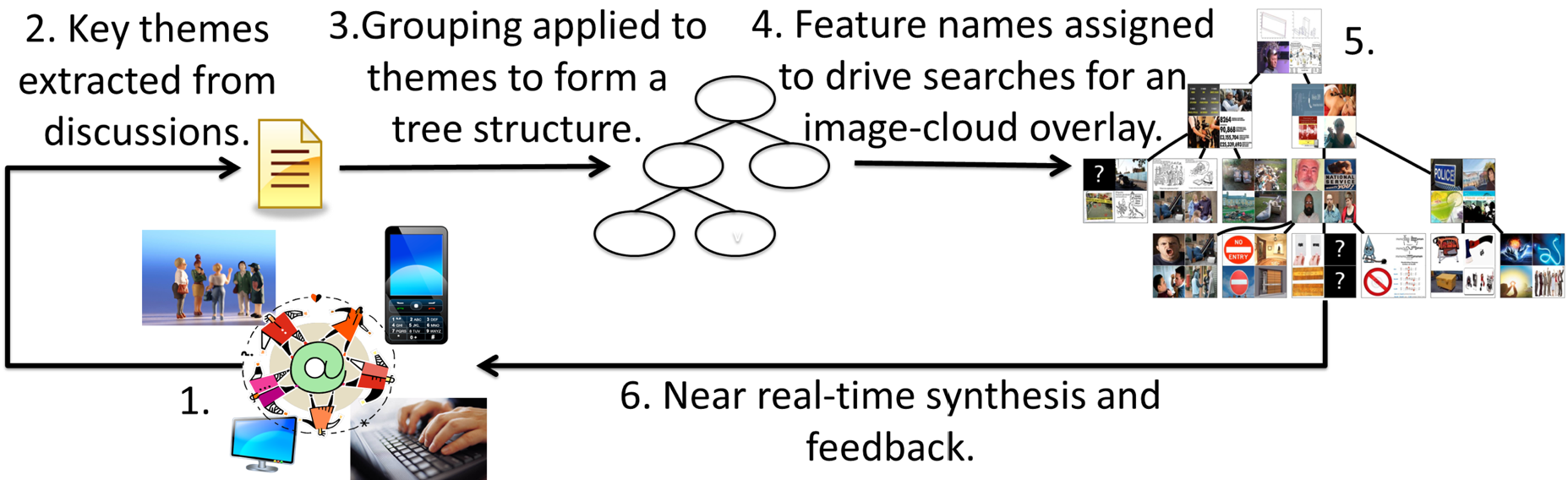
The UDesignIt architecture bridges this chasm through a multi-step pipeline that focuses on Semantic Synthesis:
- Semantic Clustering: It uses Latent Semantic Analysis (LSA) and Hierarchical Agglomerative Clustering (HAC) to find hidden patterns in text. It doesn't just look for keyword matches; it looks for thematic similarity.
- Semantic Refinement: By integrating WMatrix (a semantic tagging tool), the system groups synonyms and related concepts under broader "feature nodes."
- The Image-Cloud Overlay: This is the "secret sauce" for accessibility. Instead of showing users a dry tree diagram, the system performs real-time image searches for feature names and generates a visual cloud. This encourages exploration and "sense-making" for non-tech users.
Research Insight: Real-Time Reflexivity
A critical insight of this methodology is interactive reflection. The system processes text in near real-time. As a community's conversation shifts—perhaps due to a new government policy or a local event—the feature model and image cloud update. This creates a feedback loop where stakeholders can see their opinions taking shape as structural requirements almost instantly.
Experiments & Real-World Impact
The researchers deployed UDesignIt in two high-stakes scenarios:
- Village Community Action: Designing plans to improve the local economy for young people.
- Child Social Care: Collaborating with social workers and citizens in an economically deprived area to design a care system that respects local constraints.
Key Findings:
- Inclusivity: The support for large interactive screens in public spaces allowed "digitally marginalized" groups to contribute alongside tech-savvy users.
- Drill-down Capability: Each node in the generated visual model is linked back to the original text chunks, allowing engineers to verify the context behind a requested feature.
Critical Analysis & Future Outlook
Strengths
- The "Twin Peaks" Realization: It realizes the theoretical "Twin Peaks" model (co-developing requirements and architecture) on a massive, public scale.
- Visual Intuition: Using images to represent software features is a bold and effective move for end-user engagement.
Limitations
- Linguistic Ambiguity: The system can be tripped up by polysemy (e.g., "power" meaning electricity vs. "power" meaning political authority).
- Text-Only Input: In a world of TikTok and Instagram, the current reliance on text input is a limitation.
Conclusion: The Next Generation of Social Action
UDesignIt provides a blueprint for the future of "Social Media for Social Good." It proves that the "unstructured noise" of community venting can be distilled into the "structured signal" of software requirements. For the industry, this signals a shift where users are no longer just "customers" giving feedback, but "co-architects" of the digital platforms they inhabit.