
ULNC: Masking Mobile Movements Through the Power of Algebraic Geometry
ULNC: An Untraceable Linear Network Coding Mechanism for Mobile Devices in Wireless Mesh Networks
The paper introduces ULNC (Untraceable Linear Network Coding), a novel lightweight mechanism designed to provide flow and movement untraceability for mobile devices in Wireless Mesh Networks (WMNs). By leveraging the algebraic properties of Linear Network Coding (LNC) without the need for computationally heavy encryption of global encoding vectors (GEVs), the method effectively hides communication paths and user movement patterns.
TL;DR
Protecting user privacy in Wireless Mesh Networks (WMNs) usually comes at a high cost of encryption overhead. ULNC (Untraceable Linear Network Coding) changes the game by using the inherent math of network coding to hide "who is sending what" and "where they are moving." By ensuring that every outgoing packet is mathematically tied to multiple potential origins, it makes tracking a specific mobile device a needle-in-a-haystack problem—without encrypting the packet headers.
Background: The Traffic Analysis Trap
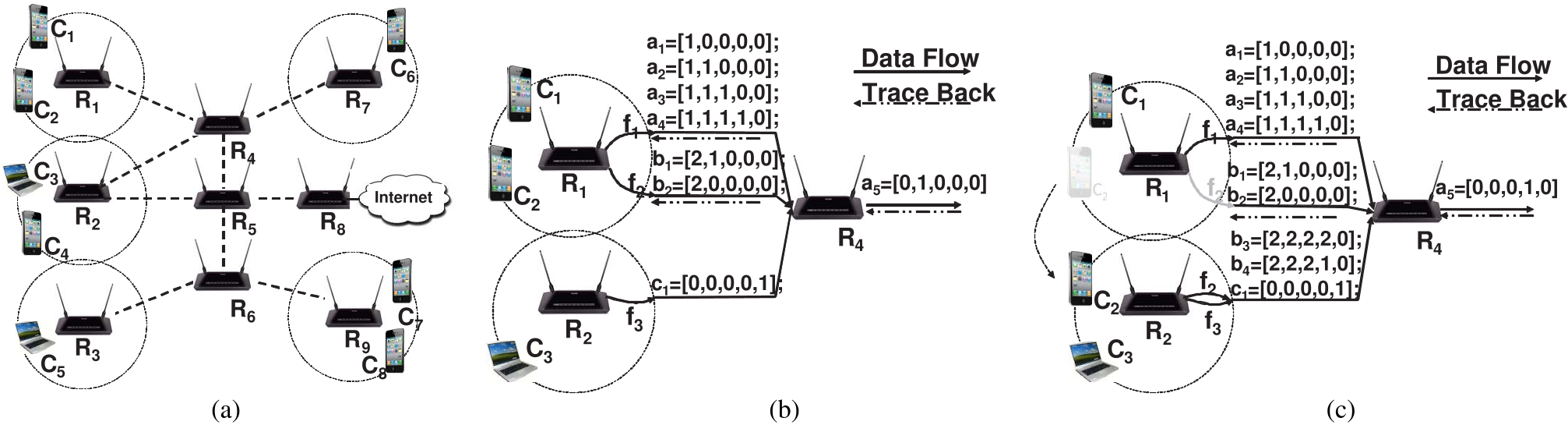
In a typical Wireless Mesh Network, an attacker doesn't need to decrypt your messages to spy on you. By observing the Global Encoding Vectors (GEVs)—the mathematical "ID tags" used in network coding—an attacker can perform traffic analysis. If an incoming packet and an outgoing packet at a router share a linear relationship, the attacker knows they belong to the same flow. Even worse, if you move from one router to another, your movement track becomes visible as your packets hop across the network.
Traditional fixes, like Onion Routing, wrap packets in multiple layers of encryption. This is slow and drains the batteries of mobile devices. ULNC asks: Can we use the math of the code itself to become a privacy shield?
The Mathematical Intuition: Creating UGEVs
The core innovation is the Untraceable GEV (UGEV). In standard LNC, a router takes incoming packets and combines them linearly. ULNC forces this combination to include GEVs from other flows or locations.
The authors identify a "Sufficient and Necessary Condition": for a packet to be untraceable, it must be linearly correlated with GEVs from locations the source has never visited.
Why this works:
- Flow Untraceability: Attackers can't distinguish which incoming flow produced an outgoing packet.
- Movement Untraceability: Even if an attacker traces a packet back, the math points to multiple possible locations.
Methodology: The Vandermonde Matrix Trick
To guarantee untraceability, the router must select Local Encoding Vectors (LEVs) that have no zero elements. If an LEV contains zeros, it might accidentally exclude the "noise" or "other-location" packets needed for cover.
The authors use a Vandermonde Matrix to generate these LEVs. Because a Vandermonde matrix has a full-rank property and no zero entries, it ensures that every outgoing packet is a "mix" of all potential incoming packets. This ensures the output is always a UGEV as long as the network reaches a certain density.
Experimental Evidence: Hiding in the Crowd
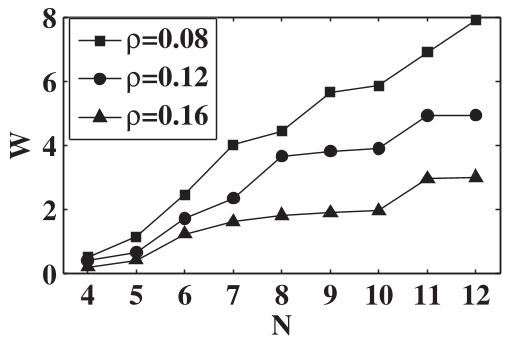
The paper uses sensitivity analysis to show how factors like field size () and generation size () affect privacy.
- The Density Rule: As the total number of received packets () increases, the probability of untraceability () rapidly approaches 100%. In a busy mesh network (), privacy is almost guaranteed.
- The Computational Wall: For an attacker to "solve" the linear equations and find the real path, the complexity scales as . This means as the network grows, the effort required to track a single user becomes astronomical.
Critical Analysis & Future Outlook
The beauty of ULNC lies in its efficiency. It achieves privacy-at-scale without the heavy lifting of per-packet asymmetric encryption. However, there are trade-offs:
- Packet Density Necessity: The method relies on there being enough background traffic. In a very "quiet" network with only one user, the algebraic trick has no "crowd" to hide in.
- Throughput vs. Privacy: Higher privacy levels require larger generations (), which can increase latency.
The Road Ahead
ULNC's distributed nature makes it a perfect candidate for Software-Defined Networks (SDN) and Content-Centric Networking (CCN), where routers already manage local caches. By integrating coding into the cache management, future networks can provide "Privacy by Design" as a standard feature rather than an expensive add-on.
Conclusion
ULNC demonstrates that the same linear algebra used to speed up our networks can also be used to protect our identities. By turning traffic analysis into an unsolvable equation, the authors provide a lightweight, distributed blueprint for the future of private mobile communication.