
USRS: Breaking the Efficiency Bottleneck in Unbiased Social Network Sampling
Towards Unbiased Sampling of Online Social Networks
This paper introduces a theoretical framework for unbiased sampling in Online Social Networks (OSNs) by modeling the crawling process as a Markov Chain. It proposes Unbiased Sampling with Reduced Self-loops (USRS), a method that achieves statistical accuracy while significantly outperforming the standard Metropolis-Hastings Random Walk (MHRW) in crawling efficiency.
TL;DR
To understand massive Online Social Networks (OSNs), we often rely on sampling. However, most methods are either biased or painfully slow. This paper provides a rigorous mathematical condition for unbiased sampling and introduces USRS (Unbiased Sampling with Reduced Self-loops)—a method that is as statistically accurate as gold-standard random walks but up to 70% more efficient at exploring new nodes.
The Bias vs. Efficiency Dilemma
In the world of social graph analysis, getting the "ground truth" is nearly impossible due to privacy restrictions and sheer scale. We usually resort to "crawling." But here is the catch:
- BFS & Greedy Algorithms: They naturally gravitate toward "social butterflies" (high-degree nodes), leading to an overestimation of the network's average connectivity.
- Metropolis-Hastings Random Walk (MHRW): It achieves unbias by forcing the walker to wait at certain nodes to balance the probabilities. However, these "self-loops" act like quicksand—walkers get stuck on low-degree nodes for iterations, wasting time and resources.
The Mathematical Breakthrough: A Sufficient & Necessary Condition
The authors treat the crawler as a walker in a Markov Chain. For the sampling to be unbiased (uniform), every node must have an equal probability of being visited in the long run (stationary distribution ).
The paper identifies that the key requirement for this is a transition matrix where the sum of incoming probabilities to any node equals 1. This insight allows us to move beyond MHRW and design more flexible algorithms.
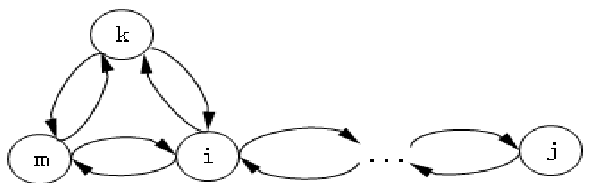 Figure 1: Visualizing the OSN crawling process as a Markov Chain.
Methodology: How USRS Outsmarts MHRW
USRS takes the "waiting time" (self-loops) inherent in MHRW and effectively "spreads" it to neighboring nodes. By increasing the probability of moving to a neighbor while maintaining the symmetry of the transition matrix, the walker moves more frequently while the underlying math still guarantees a uniform visit probability.
The Core Logic:
- Calculate how much "waiting time" () a node has.
- Identify neighbors with available capacity to receive more transition probability.
- Shift the probability from "staying" to "moving."
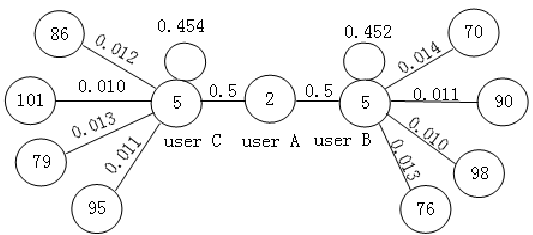 Figure 2: By reducing self-loops (node A goes from 0.6 probability of staying to 0), the walker explores the vicinity faster.
Experimental Results: Renren Case Study
The authors tested USRS on a massive real-world dataset from Renren (China's equivalent of Facebook in 2010).
- Self-loop Reduction: The average self-loop probability dropped from 0.41 (MHRW) to 0.13 (USRS).
- Convergence: Despite moving faster, USRS converges to the correct statistical average node degree at the same rate as MHRW.
- Exploration Speed: USRS discovered unique nodes 1.7 times faster than MHRW. In practical terms, to see 50% of the network, MHRW requires 2.5 samples per node, while USRS only needs 1.5.
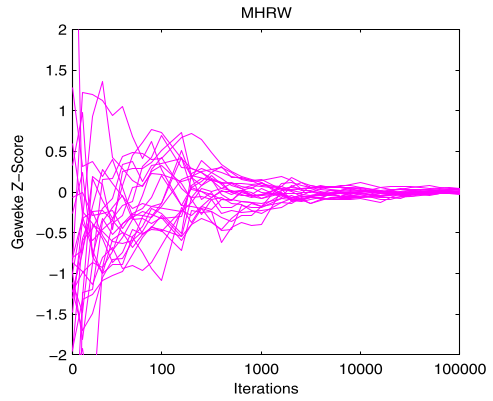 Figure 3: Distribution of self-loop probabilities—USRS shifts the mass toward zero.
Critical Insight & Future Outlook
The brilliance of this work lies in realizing that unbias is a property of the stationary distribution, not the specific path. By decoupling the "wait time" from the "visit probability," USRS proves that we can explore dark parts of the social web much faster than previously thought.
However, there are limitations: the method assumes a relatively static graph and requires knowledge of neighbor degrees. Future research could explore how this "self-loop reduction" logic applies to directed graphs or networks where degree information is hidden.
Conclusion: USRS is a powerful upgrade for any researcher using MCMC-based techniques to study large-scale graphs, offering a rare "free lunch" of increased efficiency without statistical cost.