
Boosting Social Network Privacy via Triadic Closure and Uncertain Graphs
Uncertain Graph Method Based on Triadic Closure Improving Privacy Preserving in Social Network
The paper introduces an efficient Uncertain Graph method based on the Triadic Closure principle for privacy preservation in social networks. By strategically adding "potential edges" to form triangles and injecting existence probabilities, it creates an obfuscated graph that achieves high privacy levels (measured by Node Signature diversity) while maintaining SOTA data utility.
TL;DR
Social network data is a double-edged sword: it offers immense business value but contains sensitive personal relationships. This paper presents a novel approach to protect user identity by transforming a real social graph into an Uncertain Graph. By leveraging the Triadic Closure principle, the researchers add potential edges and inject probabilities so that the "expected" graph remains statistically identical to the original, while the actual structure becomes ambiguous to attackers.
Problem: The Fragility of Anonymity
Most people believe that removing names or IDs from a social network dataset makes it safe. They are wrong. Adversaries use "structural signatures"—such as the specific degree of your friends—to de-anonymize you.
Existing solutions often fall into two traps:
- Data Distortion: Adding or deleting edges randomly changes the average degree and connectivity, rendering the data useless for researchers.
- Scalability: Complex k-anonymity algorithms often struggle to process thousands of nodes.
Insight: The Power of Triangles (Triadic Closure)
Humans tend to follow a simple rule: A friend of a friend is likely to become a friend. This is Triadic Closure. The authors use this social intuition to modify graphs intelligently. Instead of adding edges between random strangers, they add edges that complete triangles (nodes at distance 2).
The Methodology
The workflow follows a 3-step pipeline:
- Edge Addition: Find nodes and that share a common neighbor (distance = 2) and add a "potential edge" between them.
- Triangle Selection: Organize these new edges into unique triangles to ensure no edge is overloaded with conflicting constraints.
- Probability Injection: Assign probabilities to the three edges of each triangle such that .
 Fig 1: The process from original graph to uncertain graph via triangle formation.
Why does matter? Because in the original graph, there were only 2 edges. By ensuring the sum of probabilities equals 2, the Expected Degree and Total Edge Count of the graph remain exactly the same as the original, maximizing data utility.
Experimental Validation
The authors tested their method on the famous Karate Club and Dolphin Social Network datasets.
Privacy Gain vs. Utility Loss
The performance was measured using Privacy Measurement (PM), based on node signatures.
| Dataset | Added Edges () | Privacy (PM) | Utility (SNE) |
|---|---|---|---|
| Karate (Original) | 0 | 123 | 78 |
| Karate (Ours) | 75 | 140 | 78 |
| Karate (Baseline) | K=20 | 123 | 71.82 (Lower) |
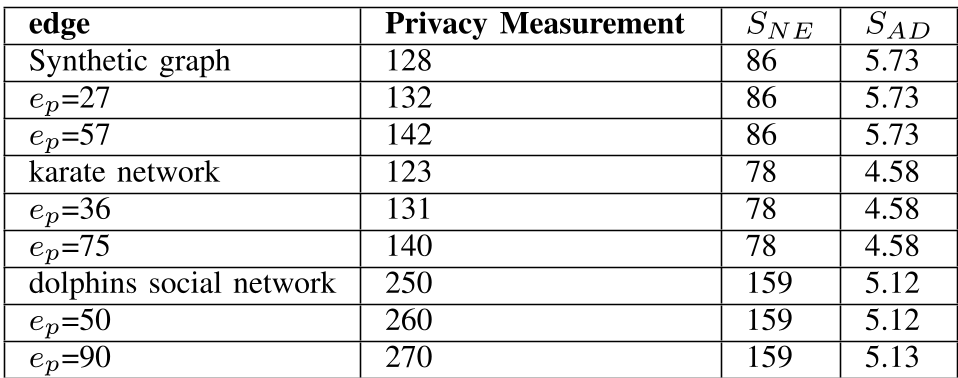 Fig 2: Comparison showing increased privacy while utility metrics (SNE, SAD) remain constant.
As shown in the data, the Triadic Closure method increased the privacy score while keeping the utility metrics (SNE and SAD) rock-solid. The baseline method, however, saw a drop in utility without any significant gain in structural privacy.
Critical Insight: Why it Works
The brilliance of this approach lies in its Inductive Bias. By mimicking how social networks naturally grow (triangles), the "noise" added by the algorithm looks like natural variation. To an attacker, it is mathematically difficult to distinguish whether an edge exists with 100% certainty or 60% probability, especially when the overall structure looks socially plausible.
Conclusion & Future Outlook
This paper proves that we don't need to destroy data to protect privacy. By moving from Deterministic Graphs to Uncertain Graphs, we can "hide" individuals in a cloud of probability.
Limitations: While effective for medium-scale graphs, further research is needed to see if this triadic constraint creates "islands" of uncertainty that could be isolated in massive, sparse networks.