
Uncovering News-Twitter Reciprocity: Who Really Breaks the Story?
9280_Uncovering News-Twitter Reciprocity via Interaction Patterns.
This paper introduces a principled framework to analyze the symbiotic reciprocity between traditional news media and Twitter. By developing an online story chaining algorithm and a peak-detection state encoding (N, T, B, E), it classifies the direction of information flow and discovers distinct interaction patterns across different news topics.
TL;DR
In the digital age, news doesn't just happen; it flows. This paper presents a framework to track the "symbiotic relationship" between traditional news and Twitter. By chaining articles into "story threads" and measuring Twitter activity peaks, the authors quantify who leads and who follows. The verdict? It depends entirely on the topic—protests start on Twitter, but tragedies start in the news.
The Problem: The Media Echo Chamber
For years, researchers have asked: "Can Twitter replace newswire?" or "How does news spread on social media?" However, most existing work looks at one side of the coin. They either treat Twitter as a passive echo of news or news as a slow-moving dinosaur. The reality is a complex back-and-forth—a reciprocity where a tweet can spark a news investigation, and a news report can ignite a global hashtag.
The challenge lies in Story Chaining: How do we automatically group thousands of disparate articles into a single evolving narrative and then align them with the chaotic, high-volume "noise" of Twitter?
Methodology: Mining Interaction Patterns
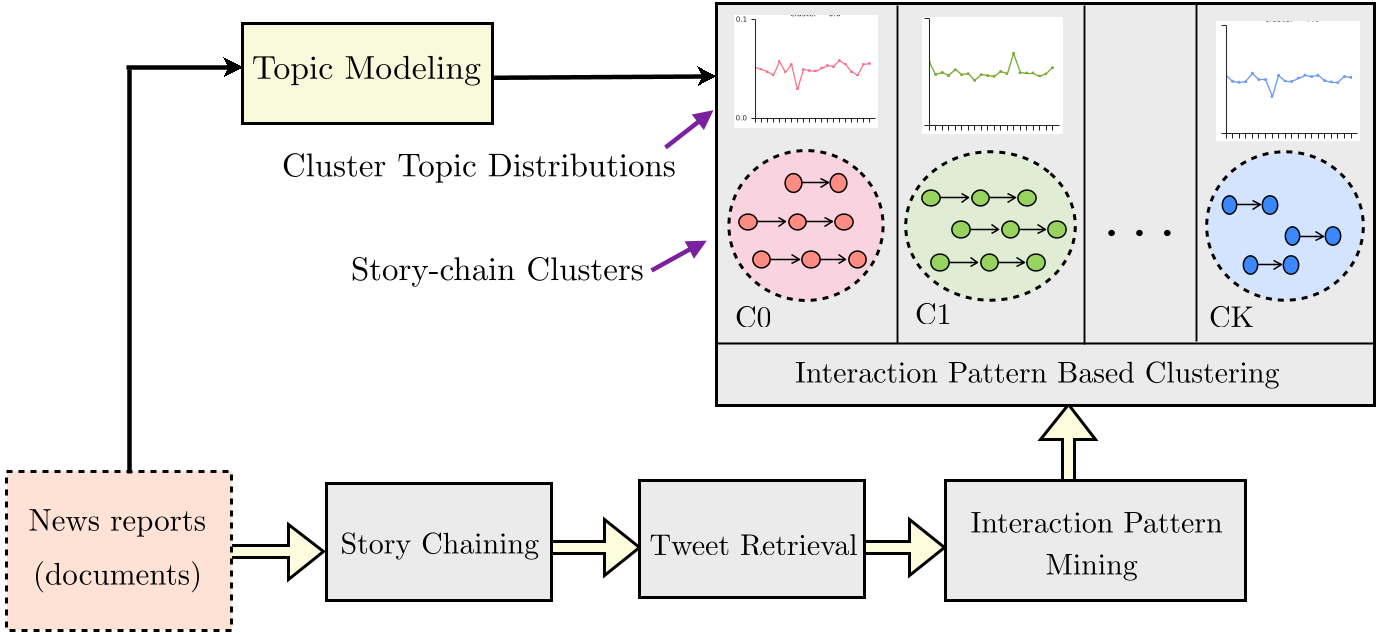
The authors propose a robust pipeline to solve this, focusing on three core pillars:
1. Online Story Chaining
Instead of simple keyword matching, the framework uses a weighted similarity score across three dimensions:
- Textual: TF-IDF vectors of keywords.
- Spatial: Geocoded locations (Country, State, City).
- Actors: Identified persons and organizations.
2. The Four Interaction States
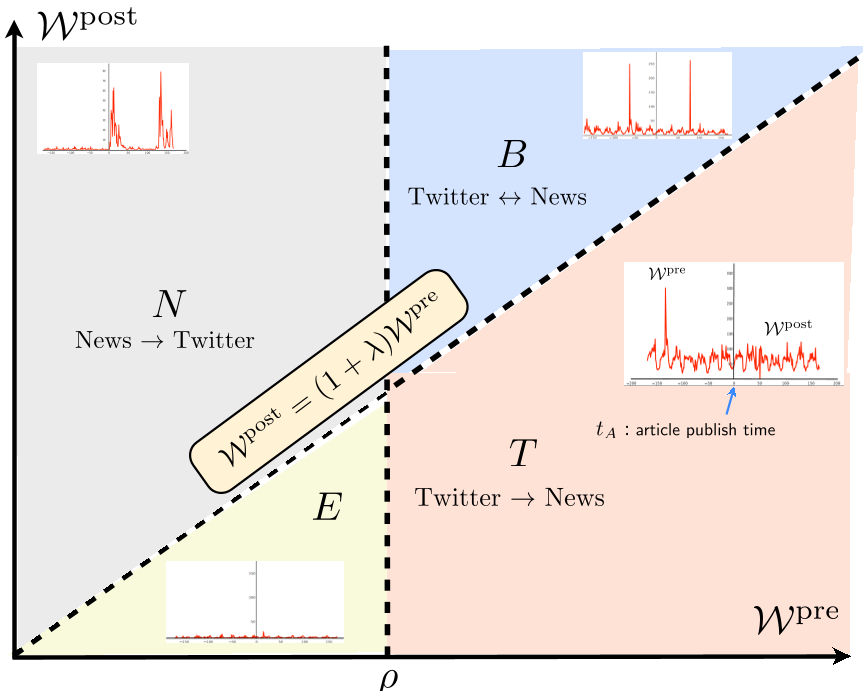
The most innovative part of the paper is the encoding of an article's relationship with Twitter into four states based on whether Twitter activity "peaks" before or after the news publication:
- N (News to Twitter): News breaks it; Twitter reacts later.
- T (Twitter to News): Twitter trends first; News reports it later.
- B (Bi-directional): High activity both before and after (a true conversation).
- E (Empty): The news article generated zero social signal.
3. Clustering and Topic Modeling
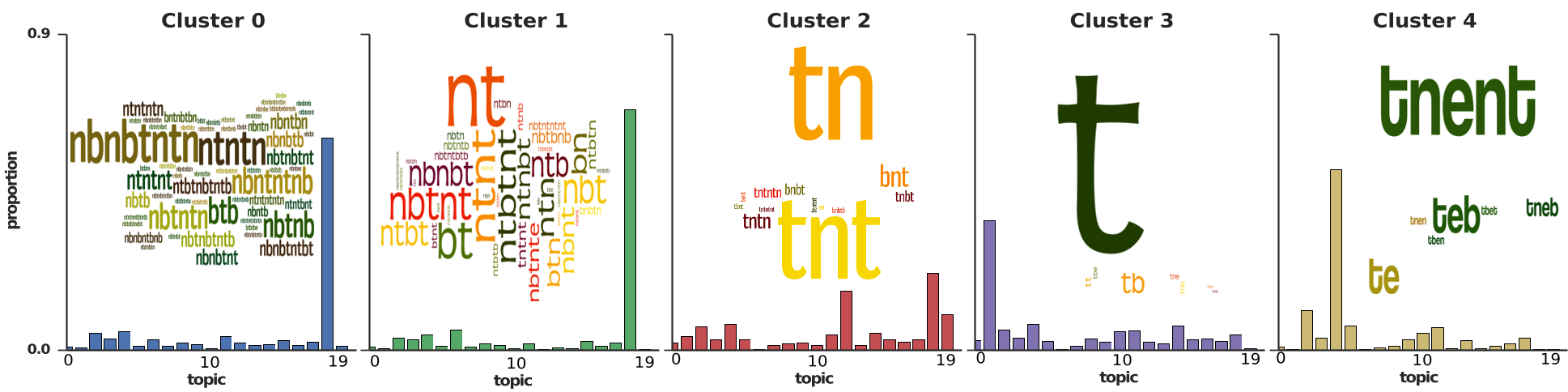
By treating a story chain as a string of these states (e.g., "NTNTBN"), the authors use String Edit Distance and Dynamic Time Warping (DTW) to group stories with similar information-flow dynamics.
Experiments: Lessons from the "Brazilian Spring"
The researchers tested this on a massive dataset from Brazil (2012-2013), covering the major "Brazilian Spring" protests.
Key Finding 1: Protests vs. Tragedies
The data revealed a striking divide. Protests (Government policies, generalpopulation strikes) had a high percentage of Twitter Starts (77% for Government policies). Meanwhile, "Local Events" like fire accidents or crimes almost always started with News Starts.
Key Finding 2: The "Main Influencer"
The authors calculated an "Influence Weight." A high positive weight means Twitter is the primary source; a negative weight means News leads.
- Twitter-Led: Student protests, celebrity arrivals (e.g., Rafael Nadal).
- News-Led: Major tragedies (e.g., the Kiss Nightclub fire), official mourning decrees.
- Balanced Reciprocity: Sporting events and marketing campaigns where information flows constantly between both.
Critical Insight: Why This Matters
This paper moves beyond the "Twitter vs. News" debate and introduces Interaction Patterns as a new feature for social sensing. For developers of event-forecasting systems (like EMBERS), this means that looking at Twitter alone isn't enough; you need to understand the pattern of how it interacts with the news.
Limitations: The study relies on keyword-based tweet retrieval, which can be noisy. Modern approaches would likely use embeddings (like BERT or CLIP) to match tweets to news more semanticallly.
Conclusion
The symbiotic relationship between social media and traditional news is not a zero-sum game. Twitter acts as the world's nervous system—fast but erratic—while news agencies act as the digestive system—slower but structured. By mapping the "reciprocity" between them, we can better predict how stories will evolve and which platforms will lead the charge for different types of global events.