
Beyond the "Like" Button: Decoding the Information Literacy Gap in Social Media
Understanding Undergraduates' Information Literacy from their Facebook Usage
This study investigates undergraduate students' Information Literacy (IL) through the lens of Facebook usage, developing a research model that incorporates perceived behavior control, risk, privacy self-protection, and ease of use. The empirical validation reveals a "privacy paradox" where students continue heavy usage despite recognizing significant online risks.
TL;DR
Higher education aims to equip students with the tools to navigate the digital world safely, yet a significant gap remains between curriculum goals and real-world behavior. This research explores how undergraduate Facebook habits reveal a startling lack of Information Literacy (IL). Despite being aware of risks, students’ perceived control over their actions actually drives them toward riskier usage patterns.
The Illusion of Control: A Modern Literacy Crisis
Traditional Information Literacy was about finding and evaluating sources. Today, it is about survival in a social-media-driven ecosystem. The author, Kan Min Lin, identifies a critical problem: students believe that because they "control" the mouse—clicking "Like," sharing posts, or adjusting a few privacy settings—they are safe.
However, the study argues that this Perceived Behavior Control is often an illusion. Students frequently misunderstand the legal ramifications of their online footprints and underestimate how simple interactions can serve as gateways for scammers and malware.
Methodology: The Determinants of Usage
The study utilizes a LISREL structure model to validate the relationships between four key psychological constructs and Facebook usage behavior:
- Perceived Behavior Control: The belief that one has total agency over their posts.
- Perceived Risk: The awareness of potential threats like identity theft.
- Perceived Privacy Self-Protection: The proactive steps taken to secure data.
- Perceived Ease of Use: How frictionless the platform experience is.
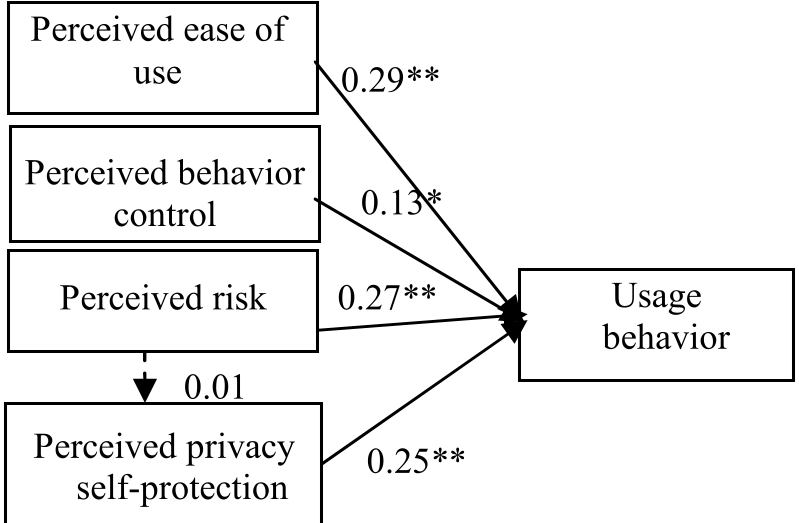 Figure 1: The validated structural model showing the positive correlation between risk perception and usage behavior.
Counter-Intuitive Insights & Results
The most provocative finding is the positive relationship between Perceived Risk and Usage. Unlike many architectural or security models where high risk discourages use, Facebook users who perceive high risks are often the most frequent users. This suggests:
- Reciprocal Causation: Frequent users encounter more incidents, raising their risk awareness, yet their "addiction" or social necessity keeps them on the platform.
- The Misconception Trap: Students believe that as long as they avoid "foul language," their shares and likes are safe. They fail to realize that "Like-farming" can fund criminal enterprises or that inadvertent sharing can lead to legal penalties for defamation.
Key Data Points:
- Perceived behavior control has a direct positive effect on usage frequency.
- Students acknowledged that risks (identity theft, stalking) are serious, but their behavior does not change to mitigate them.
- Current IL education is failing to address the legal and ethical nuances of social media interactions.
Critical Analysis: Why This Matters for the Future
This paper serves as a diagnostic warning for educators. Information literacy is no longer just about academic research; it is about digital citizenship.
Limitations & Outlook
While the study provides a robust look at Facebook, the landscape has shifted toward algorithmic feeds (like TikTok) where "Perceived Behavior Control" might be even lower. Future research should investigate if the "Privacy Paradox" holds true when the user is no longer active (posting) but passive (consuming).
Conclusion
The takeaway for universities is clear: Information Literacy curricula need a "refresh." We must move beyond technical tutorials on privacy settings and dive deep into the legal consequences and psychological traps of social media. Until students understand that their "Likes" have weight in the physical and legal world, they remain digitally illiterate, regardless of how many privacy buttons they click.