
COSINE: Cracking the Code of Event Popularity in Social Networks
14553_Understanding Event Organization at Scale in Event-Based Social Networks.
The paper introduces COSINE, an integrated framework for predicting event popularity in Event-Based Social Networks (EBSNs) like Meetup.com. It models latent factors across spatial, temporal, group, and semantic dimensions, combined with a novel group-based social influence propagation network, achieving over 130% improvement in R² accuracy over baseline methods across five global cities.
TL;DR
Why do some Meetup events pull in hundreds of attendees while others struggle with a handful? This paper moves beyond personalized recommendations to solve the Organizer's Dilemma. By introducing the COSINE framework, researchers from the University of Colorado Boulder have quantified the "vibe" of an event through spatial, social, and semantic metrics, boosting popularity prediction accuracy by 130%.
Contextualizing the Challenge
While we have plenty of algorithms telling us which movie to watch or which person to follow, we lack tools that help organizers plan successful offline gatherings. In Event-Based Social Networks (EBSNs), popularity isn't just about a "good title"—it's a high-stakes calculation involving travel distance, group dynamics, and competing local events. Existing work often treats all social influences as equal, but the truth is: a "tech influencer" in an AI group carries much less weight when they RSVP to a hiking trip.
The Four Pillars of Event Context
The authors identified four latent factors that determine whether an event will thrive:
- Spatial Dynamics: It’s not just about the venue; it’s about Location Quality (the attractiveness of nearby group categories) and Competitiveness (the density of similar events nearby).
- Group Diversity: Interestingly, the paper finds that groups with high Entropy (diverse participation) grow faster, but excessive Loyalty can actually hurt a group by creating a "closed-loop" environment that repels newcomers.
- Temporal Patterns: Events aren't just time-slots; they follow a rhythmic "Weekly Pattern." Most successful groups treat events like a heartbeat, occurring every 7 or 14 days.
- Semantic Hook: For irregular events (e.g., a "Special Valentine's Meditation"), the writing style, sentiment, and title novelty become the primary drivers for attendance.
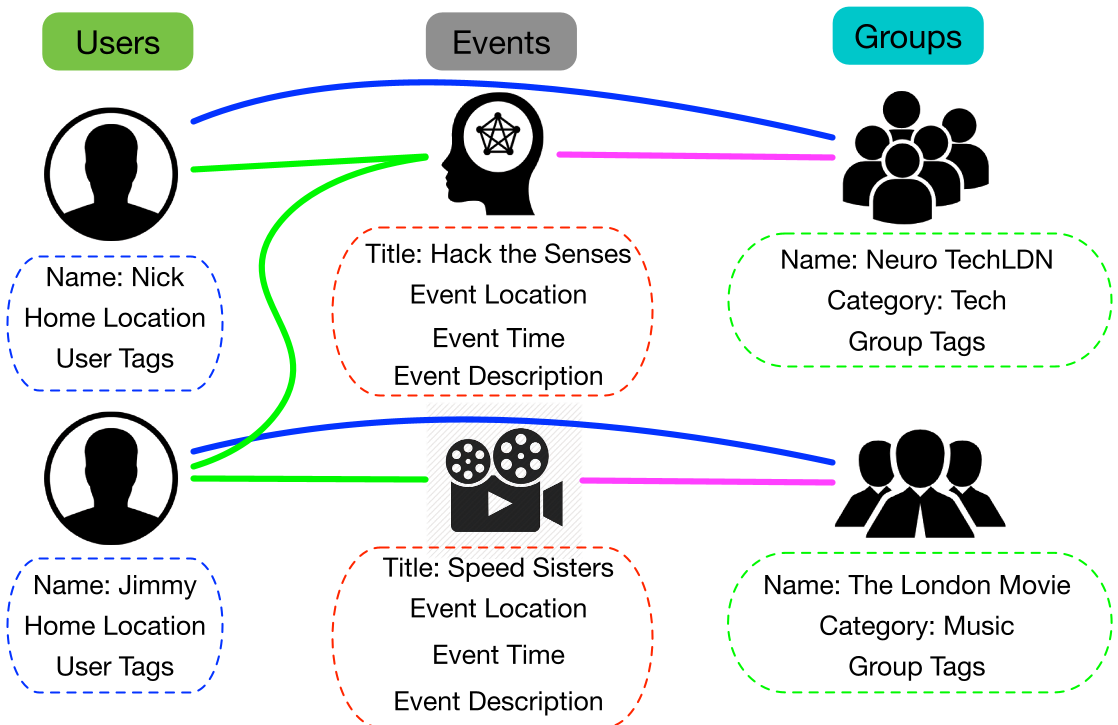 Figure: The spatial "fingerprint" of different categories. Career events cluster in Manhattan, while Adventure events move to the suburbs.
Methodology: The COSINE Framework
The core innovation is the integration of Context-aware features with a Group-based Social Influence Network.
Instead of a flat social graph, the authors created a propagation model where the "influence credit" between two users is weighted by their historical interactions within specific groups. If User A follows User B to three different "Python Coding" events, B’s influence on A for a future "Java Workshop" is calculated as much higher than for a random "Yoga Session."
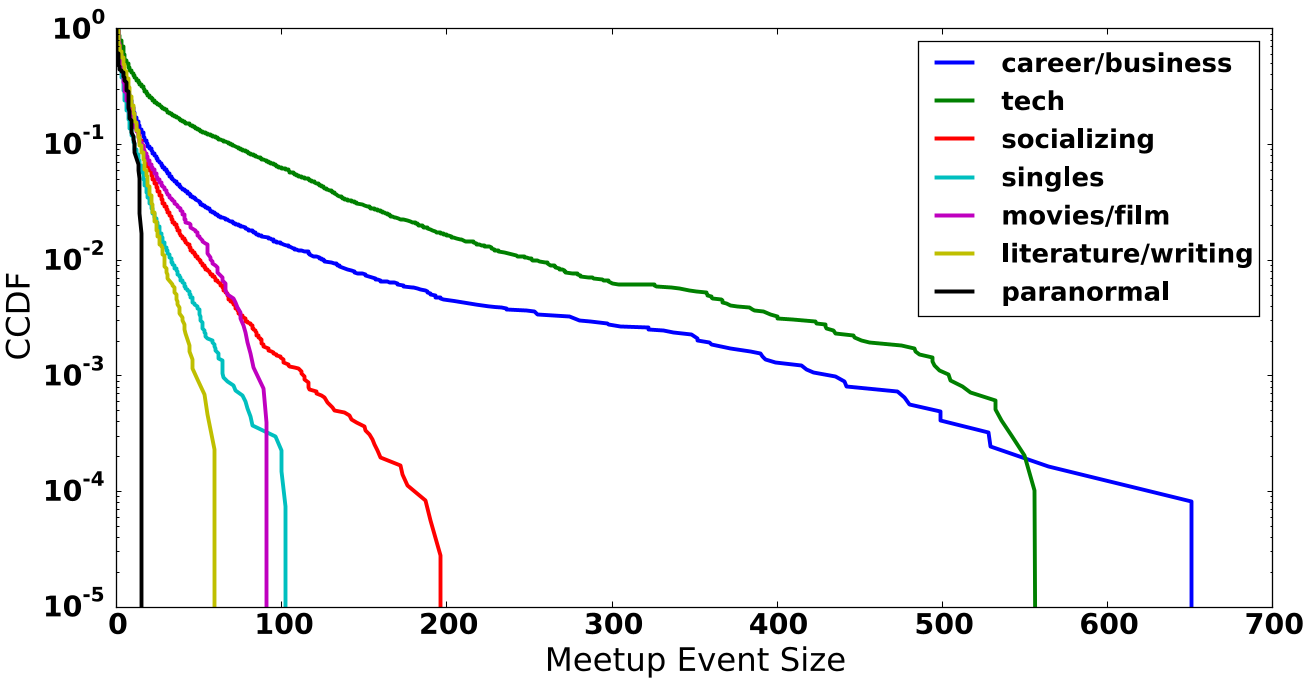 Figure: Event size distribution varies wildly across categories, necessitating the normalized 'Relative Popularity' metric used in COSINE.
Experimental Results: High Stakes, High Accuracy
The framework was tested on data from 2013-2015 across five global cities.
- SOTA Comparison: COSINE outperformed standard Linear Regression and Neural Networks significantly, achieving an R² of up to 0.758 in NYC.
- The "Social" Edge: The study proved that member entropy and group loyalty markers were the strongest individual predictors, even more so than location.
- Complexity Matters: Professional categories like "Tech" and "Career" were the easiest to predict due to their stable, regular nature, whereas "Outdoors" and "Fashion" remained more volatile due to external factors like weather.
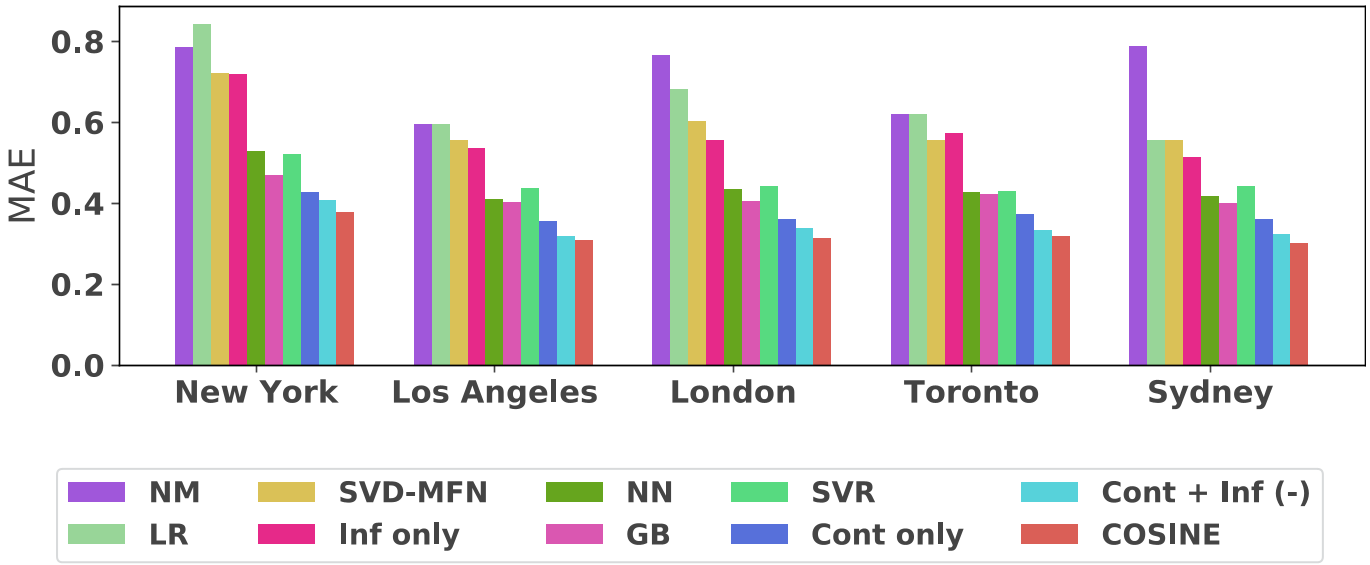 Figure: Comparison of COSINE against baselines like Naive Mean (NM) and SVD-MFN.
Critical Insight & Future Outlook
The beauty of this research lies in its Inductive Bias: it recognizes that human behavior offline is constrained by physical friction (distance) and social context (group identity).
However, a limitation remains: the model assumes organizers want to maximize size. In reality, some of the most successful groups thrive on exclusivity and small, intimate settings. Future iterations could refine "success" to mean "optimal size" rather than "maximum size." This work provides the foundation for an "AI Organizer Assistant" that could suggest the perfect time, place, and title to ensure your next event doesn't end up being a room full of empty chairs.
Takeaway for the Industry: In the age of hybrid work, understanding the levers of "Real World" engagement is vital for community platforms. COSINE shows that the secret sauce is a mix of spatial convenience and the right level of group "churn" (entropy).