
Antisocial Networks: Turning Social Platforms into Distributed Attack Engines
6321_Understanding the behavior of malicious applications in social networks.
This paper investigates the exploitation of Online Social Networks (OSNs) to create "antisocial networks" by deploying malicious applications. The authors demonstrate proof-of-concept attacks including DDoS (FaceBots), disk compromise via self-signed Java applets, and massive personal data leakage, achieving a 65% victim infection rate in real-world trials.
TL;DR
Online Social Networks (OSNs) are not just for connecting with friends; they are fertile ground for "Antisocial Networks." Traditionally thought of as safe havens, platforms like Facebook and Orkut can be weaponized into botnets. This paper demonstrates how third-party applications can launch DDoS attacks, steal local files via Java applets, and harvest private data with a terrifying 65% success rate among users.
The Motivation: Trust as a Vulnerability
The researchers identify a critical paradox: the very features that make OSNs successful—distributed user bases, trust-based clusters, and platform openness—are the exact requirements for a powerful botnet.
Prior security research often focused on simple phishing. However, this paper looks deeper into the application ecosystem. By providing developers with "Canvas" pages and custom languages like FBML (Facebook Markup Language), platforms inadvertently gave attackers a way to execute code within the context of a trusted domain.
Methodology: The FaceBot Architecture
The core of the attack lies in the interaction between the User’s browser, the Social Network Server, and the Attacker’s hosting server.
1. The FaceBot (DDoS) Mechanism
An attacker creates a seemingly benign application (e.g., "Photo of the Day"). When a user visits the app, the browser requests the page from Facebook, which in turn fetches content from the attacker’s server.
- The Exploit: The attacker embeds
<fb:iframe>tags pointing to a victim’s server. - The Result: The user's browser, acting as a "FaceBot," sends unsolicited HTTP GET requests to the victim. Because the traffic originates from millions of legitimate residential IPs, it is nearly impossible to filter.
Note: The architecture relies on the Facebook REST server acting as a proxy for rendering malicious FBML into executable HTML.
2. Disk Compromise via Self-Signed Applets
The authors used self-signed Java applets embedded within iframes. Despite security warnings that the signature "cannot be verified," a staggering number of users accepted the risk to continue using the app. Once accepted, the applet gains full control over the user's disk.
Experimental Results: A 65% Compromise Rate
The researchers deployed several apps across Facebook, Friendster, and Orkut, including "Lucky Art" and various quizzes.
| Application | Installations | Acceptance Rate |
|---|---|---|
| Lucky Art (Facebook) | 147 | 77.5% |
| Quizzes (Multi-platform) | 404 | 65.3% |
| Total Weighted Avg | 1,009 | ~65% |
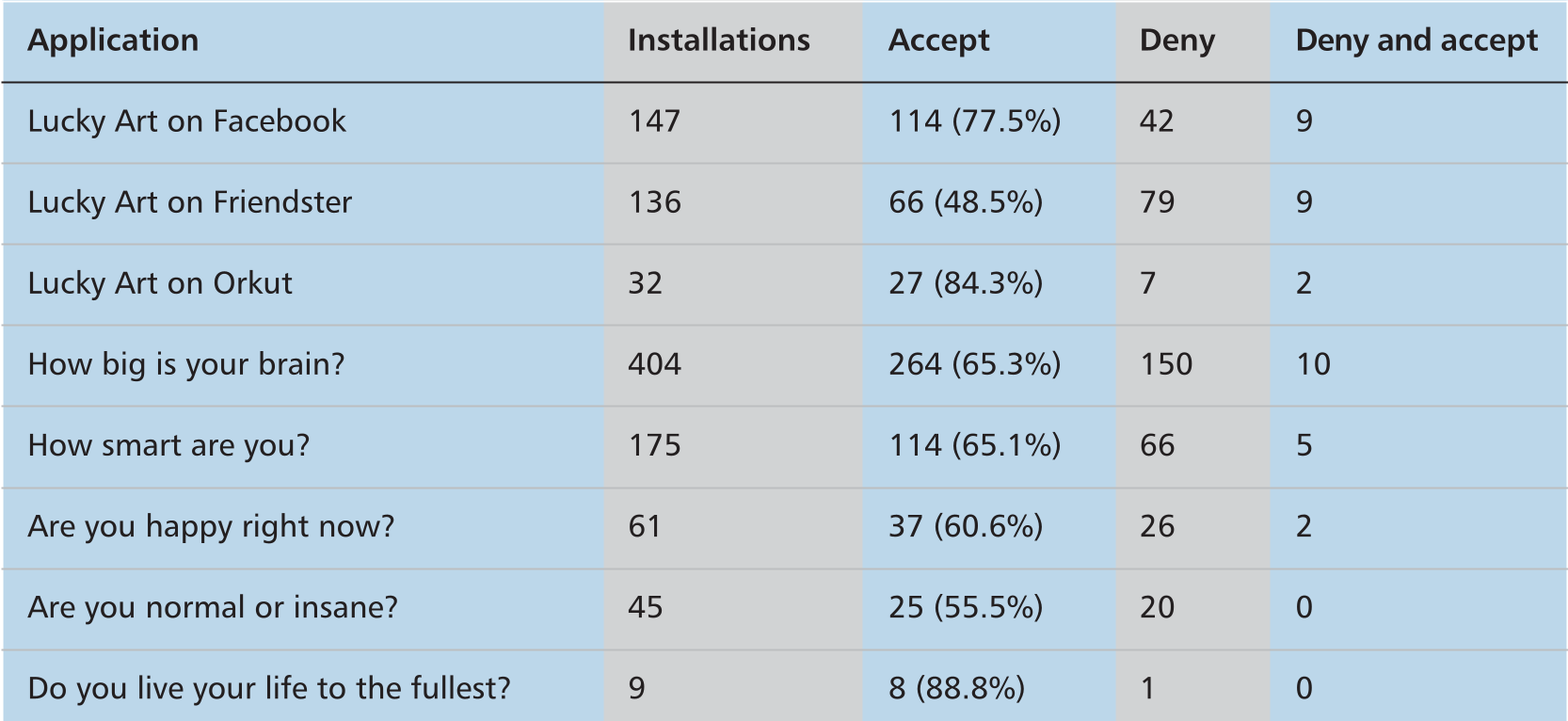
The results are sobering. Even when OSNs (like Friendster) initially rejected an app for security reasons, the authors could simply remove the offending code, get approved, and then hot-swap the malicious functionality back in after the manual review was complete.
Data Leakage: Beyond the User
By using standard API calls like Users.getInfo, a malicious app doesn't just steal the installer's data—it crawls the data of the installer's friends.
- Parallel Fetching: To bypass the 10-second timeout imposed by Facebook, the authors used hidden iframes to fetch data in parallel, allow the "Antisocial Network" to build comprehensive profiles of thousands of non-users through a single victim.
Critical Insights & Conclusion
This paper serves as a seminal warning about the "Platformization" of the web. The key takeaways are:
- Social Sandboxing is Leaky: Custom markups like FBML were intended to be safe, but they provided enough flexibility to trigger side-channel attacks.
- The Human Element: Users exhibit "security fatigue." They are so accustomed to clicking "Accept" to access content that they provide administrative-level disk access to unknown developers.
- Vetting is Fragile: The "approval-then-update" loophole allows any motivated adversary to bypass early-stage platform security checks.
As we move into an era of even deeper API integrations (OpenGraph, OAuth2, 3rd-party Plugins), the lessons of the "Antisocial Network" remain more relevant than ever. Security cannot rely on user discretion; it must be enforced at the protocol level.