
The Multi-Platform Dilemma: Does "Friending" on a New App Kill the Old Relationship?
Understanding Relationship Overlapping on Social Network Sites: A Case Study of Weibo and Douban
This study investigates "relationship overlapping" on Social Network Sites (SNS), specifically analyzing how interactions on a new platform affect communication frequency on a focal (existing) site. Using a longitudinal dataset of 6,771 overlapping relationships between Weibo and Douban, the authors employ a quasi-experimental approach to determine relationship robustness across platforms.
TL;DR
In an era where we follow the same people across Weibo, Douban, Twitter, and Instagram, does this "overlapping" strengthen our bonds or dilute them? This research proves that connecting on a new platform typically leads to a sharp decline in interaction on the original one. However, the study uncovers a surprising "Robustness Ritual": relationships centered around active, small common interest groups are far more likely to survive the migration than long-standing but passive ties.
Problem & Motivation: The Battle for Limited Attention
The average social media user is no longer a monogamist; they juggle roughly 8 different SNS accounts. When two friends who interact on "Site A" start talking on "Site B," two things could happen:
- Synergy: They become closer and talk more on both (Media Multiplexity).
- Substitution: Site B steals the time previously allocated to Site A (Displacement).
The authors sought to find which theory wins and, more importantly, what makes a tie "robust" enough to withstand the "Site B" intervention.
Methodology: The Quasi-Experiment
The researchers leveraged a unique dataset from Weibo (the "Chinese Twitter") and Douban (an interest-based book/movie review site). By identifying users who linked their accounts, they tracked 6,771 dyads.
Using Regression-Discontinuity Design (RDD), they didn't just look at correlations; they looked for a "break" in the trend. They monitored interaction frequency 3 months before and 3 months after the friends connected on the second platform.
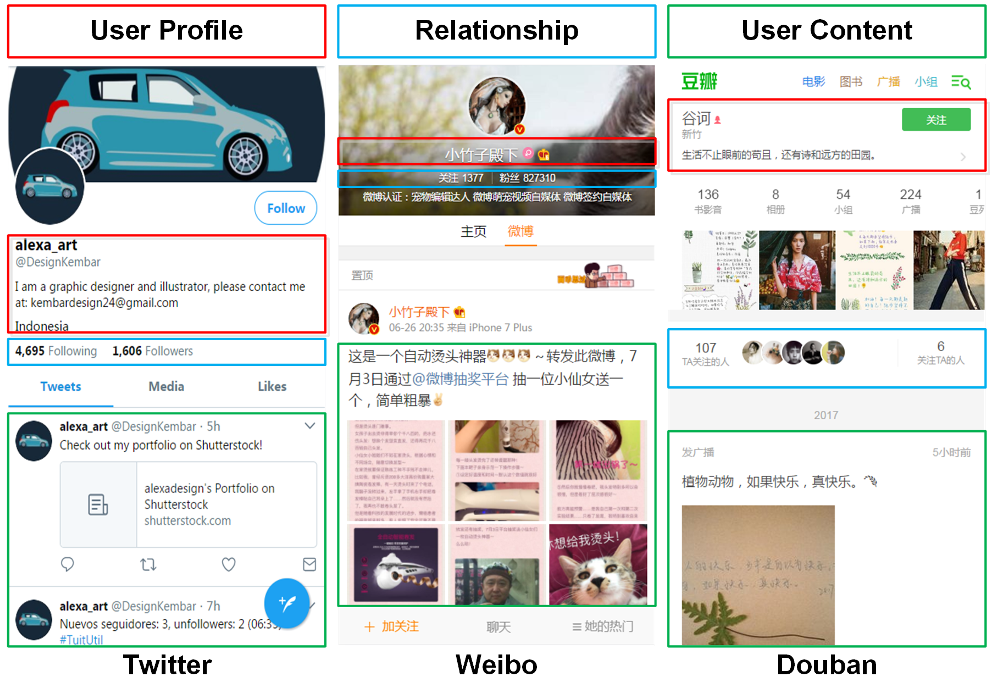 Figure 1: Comparison of UI elements across Twitter, Weibo, and Douban, illustrating the shared functional blocks of identity and communication.
Key Findings: Why Old Friends Drift Apart
The results from the random-effects negative binomial regression provided several "Academic Reality Checks":
1. The Displacement Effect is Real
Contrary to the hope that more channels mean more talk, the data showed a significant negative impact. Once a new channel opens, the focal channel suffers. In the Douban-to-Weibo migration, 99.5% of relationships saw a decrease in focal site communication.
2. The "Age" Paradox
We often assume old friends are the most stable. This study found the opposite: Older relationships were more susceptible to being displaced. This suggests that users’ interest in each other erodes over time, making them "low-hanging fruit" for a new platform's novelty.
3. The Power of "Small Circles"
The most robust relationships shared three specific traits:
- High Post Frequency: Users who create content provide "hooks" for interaction.
- Common Groups: Sharing interest groups creates a mutual environment.
- The "Goldilocks" Group Size: Ties in smaller, highly active groups were the most resilient. Large groups tended to "overload" users, making focal ties more fragile.
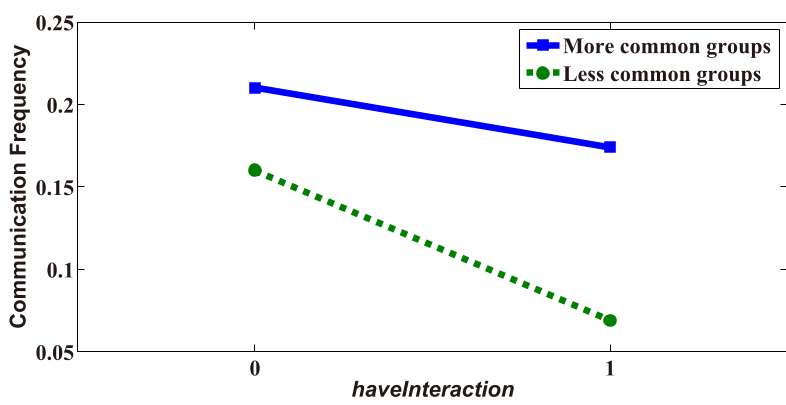 Figure 2: Temporal evolution pattern showing the sharp drop in communication frequency on the focal SNS after time T0 (the moment of new SNS interaction).
Critical Analysis & Takeaways
Platform Insights
For product managers, the message is clear: Retention is a group effort. If you want to keep users from migrating their conversations elsewhere, don't just recommend "friends of friends." Instead:
- Nurture Niche Communities: Small, high-activity groups are the "glue" that keeps relationships anchored to your platform.
- Content as Currency: Encourage posting. Interaction follows content; without new "posts," the relationship has no oxygen on your site.
Limitations
The study focuses on Weibo and Douban, which are culturally specific. However, the core psychological drivers—limited time and interest erosion—are universal. Interestingly, the study found that "Follower Count" doesn't help robustness, likely due to the "Context Collapse" or social overhead of maintaining a large audience.
Conclusion
Relationship overlapping is a double-edged sword. While it signifies a strong tie, it also initiates a competition between platforms. To win this competition, SNS platforms must move beyond being mere "phonebooks" and become "activity hubs" where specific, interest-driven content keeps the conversation alive.