
Deciphering Intent: Predicting Question Subjectivity in the Chaos of Twitter
16898_Understanding and Predicting Question Subjectivity in Social Question and Answering.
This paper introduces a binary classification framework to distinguish between subjective (opinion-based) and objective (fact-based) questions in Social Q&A (specifically Twitter). Using an SVM-based model with lexical, syntactical, and contextual features, the authors achieved a SOTA classification accuracy of 85.4% on this task.
TL;DR
Social Question and Answering (Social Q&A) on platforms like Twitter is a double-edged sword: it offers high speed and personalization but suffers from noise. This paper presents a machine learning approach to distinguish between subjective (opinion-seeking) and objective (fact-seeking) questions with 85.4% accuracy. By understanding these intents, we can better route "How do I fix my iPhone?" (Objective) to technical experts and "What’s the best coffee in NYC?" (Subjective) to local enthusiasts.
Background: Why Subjectivity Matters
In the world of Social Q&A, a "one-size-fits-all" approach to answering questions is doomed to fail. An objective question seeks a single "correct" answer, whereas a subjective question thrives on diverse perspectives and personal anecdotes. Identifying this orientation is the first step toward building intelligent routing systems that respect the user’s underlying intent.
The Problem: Short Text and Messy Data
Unlike Community Q&A sites (like Stack Overflow or Yahoo! Answers), Twitter posts are:
- Short and Informal: Meaning traditional NLP tools often struggle with lack of context.
- Noisy: Distinguishing a genuine information need from a sarcastic remark or a conversational "check-in" is notoriously difficult.
- Real-time: The value of an answer often decays within minutes.
Methodology: Feature Engineering is King
The authors moved beyond simple keyword matching, employing three layers of features:
- Lexical Features: Word N-grams and POS (Part-of-Speech) tagging. Interestingly, bigrams were the strongest indicators of subjectivity.
- Subjectivity Lexicon: Integrating the MPQA Lexicon allowed the model to detect "strong subjective clues" (e.g., words like "best," "recommend," or "decent").
- Contextual Features: Analyzing Twitter-specific metadata, such as hashtags, mentions, and emoticons.
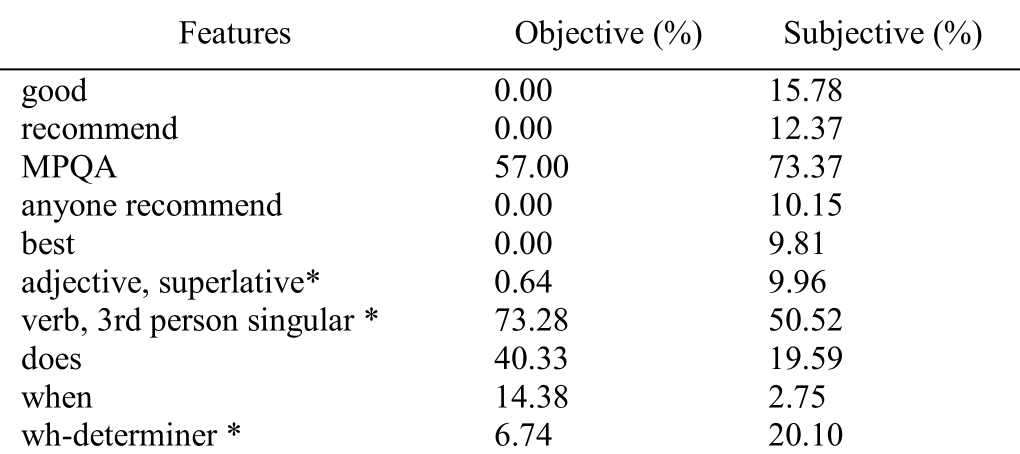
The results showed that SVM (Support Vector Machines) provided the best balance of precision and recall.
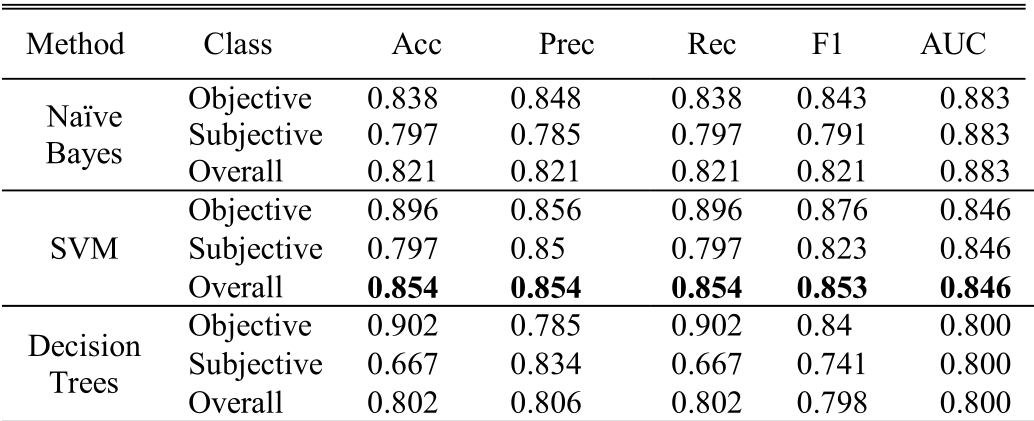
Key Insights: Subjective vs. Objective Behaviors
By applying the classifier to a massive dataset of 10,000+ information-seeking tweets, the authors uncovered fascinating behavioral differences:
- Length & Context: Subjective questions are consistently longer. Users feel the need to provide more "contextual baggage" (e.g., "I'm looking for a book for my 5-year-old who likes space") when asking for opinions.
- Response Speed: Objective questions are answered faster. Why? They are often tied to real-time events (e.g., "When does the game start?") where the information value expires quickly.
- The Paradox of Strangers: Despite users saying they prefer asking friends for subjective advice, strangers were actually more likely to respond to subjective questions. Subjective answers require less "expert authority" and more "personal opinion," lowering the barrier to entry for a random passerby.
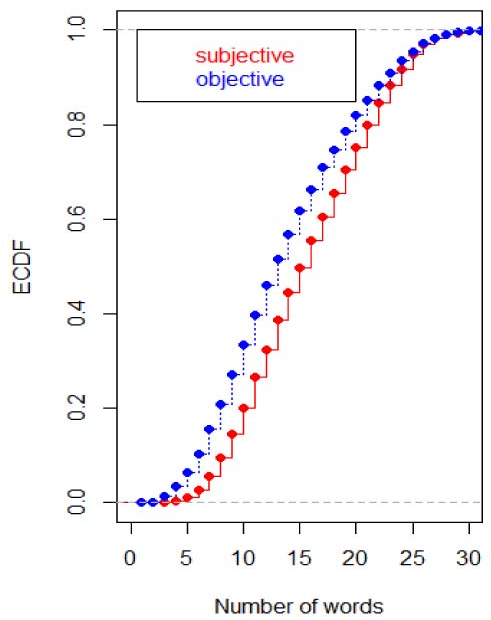 Figure: Objective questions lean heavily on "When" and "Who," while subjective ones use "Where" and highly descriptive adjectives.
Critical Analysis & Conclusion
This work provides a vital bridge between social computing and NLP. While the accuracy (85.4%) is impressive for 2016-era techniques, the limitations are clear: the model relies on human-engineered features rather than latent semantic embeddings (like those used in today's Transformers).
Future Outlook: The next evolution of this research involves Automated Routing. Imagine a Twitter bot that sees an objective question and immediately pings a Knowledge Graph/Search Engine, but transforms a subjective question into a "poll" for your most active followers. This paper proves that the intent is there in the text; we just need to listen.
Takeaway for Practitioners: If you are building a Q&A platform, don't just categorize by topic (e.g., "Tech," "Food"). Categorize by intent. A user asking "How to bake a cake" needs a tutorial; a user asking "What is your favorite cake" needs a conversation.