
Beyond Nodes and Edges: A Multiagent Coordination Blueprint for Social Networks
Understanding Social Networks From a Multiagent Perspective
2013-10-04
Summary
Problem
Method
Results
Takeaways
Abstract
This survey paper proposes a novel multiagent perspective to analyze social networks, categorizing them into cooperative, noncooperative, and multiplex networks. It establishes a mapping between social network behaviors and multiagent coordination mechanisms, identifying multiagent computing as a superior paradigm for modeling autonomous, self-organizing social entities.
## Executive Summary
**TL;DR**: This paper redefines social network analysis not as a branch of static graph theory, but as a dynamic **Multiagent System (MAS)**. By categorizing networks into **Cooperative, Noncooperative, and Multiplex** classes, the authors present a comprehensive survey of how coordination mechanisms—the "glue" of multiagent systems—can explain complex social phenomena like rumor spreading, community formation, and resource competition.
**Background**: Traditionally, we view social networks as fixed graphs. However, this paper argues for an **actor-structure crossing view**, where the intelligence of the actor is just as important as the connections themselves. This work moves the field from simple structural analysis to a more profound understanding of *autonomous coordination*.
## The Motivation: Why Graph Theory Isn't Enough
For decades, social network analysis (SNA) was dominated by two camps:
1. **Structure-Oriented**: Analyzing "Small World" or "Scale-Free" properties by treating people as uniform dots in a graph.
2. **Actor-Oriented**: Focusing on individual psychology while largely ignoring the surrounding network "piping."
Modern networks (Twitter, LinkedIn, Research Collaborations) are too fast and too "smart" for these views. The authors argue that **Multiagent Computing** is the natural successor because social actors are essentially autonomous agents that negotiate, learn, and evolve.
## Methodology: The Three Pillars of Social Coordination
The paper organizes the intersection of MAS and Social Networks into three functional categories:
### 1. Cooperative Social Networks
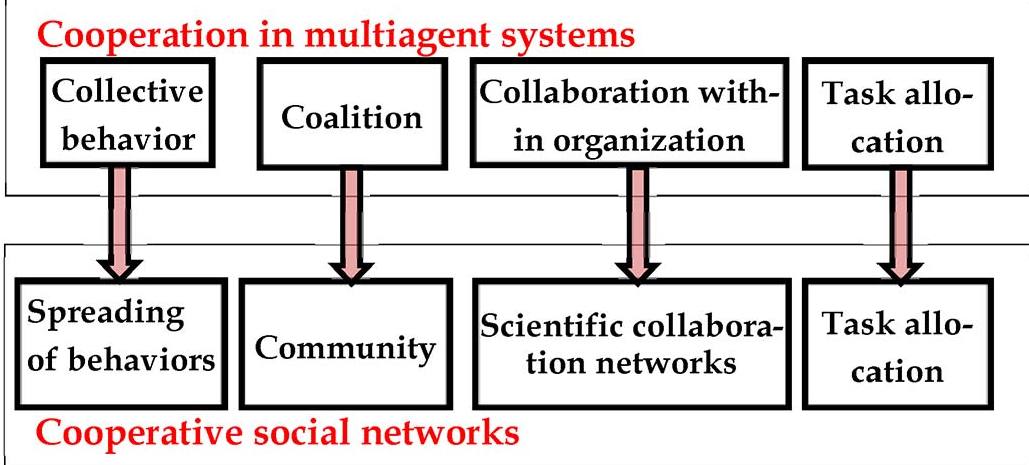
In these environments, actors share common goals. The authors map social behaviors to MAS mechanisms:
* **Behavior Spreading**: Equivalent to the **Alignment Rule** in MAS, where agents synchronize strategies based on neighbors.
* **Community Detection**: Re-envisioned through **Coalition Formation**, where agents autonomously decide to join groups based on utility.
* **Task Allocation**: Models how resources are distributed across a network, using formulas to balance physical and social distances.
### 2. Noncooperative Social Networks
When actors are self-interested, the network becomes a battlefield of strategies.
* **Social Games**: Using **Prisoner’s Dilemma** to study how cooperation can still emerge in lattices vs. random graphs.
* **Undependable Networks**: A critical look at "malicious" agents. The paper highlights a **reputation-based task allocation** model where past behavior dictates future resource access.
### 3. Multiplex Social Networks (MSNs)
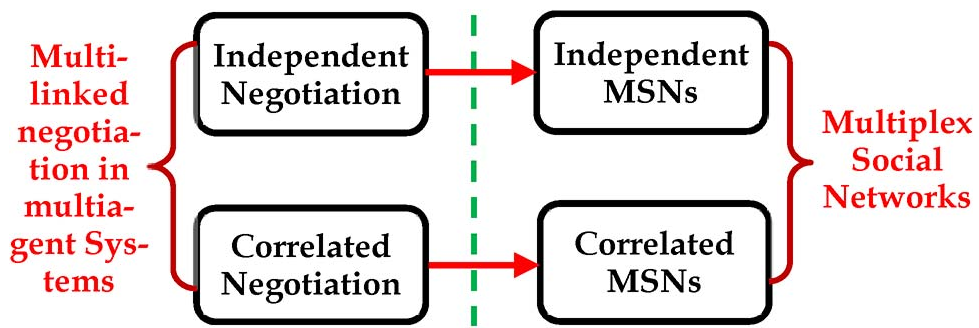
Real humans don't have one link; they have many (Family, Work, Friends). The authors apply **Multi-linked Negotiation** theory to these layered architectures.
* **Independent vs. Correlated**: In correlated networks, a failure in one layer (the "work" network") can trigger a catastrophic cascade in another (the "social" network).
## Critical Results & Scaling
The survey reveals a key technical insight: **Social structure affects spreading differently based on interaction types.**
* **Single Interaction (e.g., Viruses)**: Spreads faster in *Small-World* networks.
* **Multiple Interactions (e.g., Complex Opinions)**: Spreads faster in *Highly Clustered* networks due to social reinforcement.
The paper also provides a formula for **Contextual Resource Negotiation**, weighting the relative importance of physical distance ($pd_{ij}$) and social distance ($sd_{ij}$):
$$ \xi_i (k) = \lambda_p \Phi_i (k) + \lambda_s \Psi_i (k) $$
This allows for a hybrid approach to load balancing in complex software/human systems.
## Deep Insight: Limits and The Future
While the MAS perspective is powerful, the authors offer a sobering reminder: **Social networks are natural phenomena, while MAS are artifacts.** We cannot simply impose rigid agent rules on human behavior.
**Key Takeaways for Future Research**:
* **Group Collusion**: Most models look at individual "bad actors." We need to study how groups collude in social networks (malicious coalitions).
* **Cross-Layer Transfer Learning**: How does coordination learned in a scientific network transfer to a scientist's LinkedIn behavior?
* **Fault Tolerance**: Moving beyond "preventing" bad connections to building networks that are inherently resilient to node failure via replication strategies.
In conclusion, this survey marks a transition in the field: the "Social Network" is no longer just a map to be read, but a multiagent engine to be simulated and optimized.