
Bridging the Gap: How Structural Hole Spanners Move and Talk in LBSNs
Understanding Structural Hole Spanners in Location-Based Social Networks: A Data-Driven Study
This study investigates Structural Hole Spanners (SHS) in Location-Based Social Networks (LBSNs) using a massive Foursquare dataset of 62.6 million users. By analyzing spatiotemporal and linguistic behaviors, the researchers developed an XGBoost-based classification model that identifies SHS with an F1-score of 0.821 and an AUC of 0.879.
TL;DR
In the world of social networks, Structural Hole Spanners (SHS) are the "brokers" who connect otherwise isolated communities. This paper presents the first large-scale data-driven study of SHS behavior using the entire Foursquare ecosystem (62M+ users). The findings reveal that these "bridge" users aren't just socially unique—they travel further, explore more diverse locations, and communicate with higher complexity.
The "Broker" Advantage: Problem & Motivation
In sociology, the Structural Hole Theory suggests that people who bridge the gap between groups have a competitive advantage; they control the flow of information and gain access to diverse ideas.
While we understand their mathematical importance (low network constraint), we know very little about their real-world behavior. How do they move in the physical world? Do they explore more? Existing research usually relies on small, sampled graphs, which often misses the "big picture" of a global network like Foursquare.
Methodology: Mapping the Social Connectors
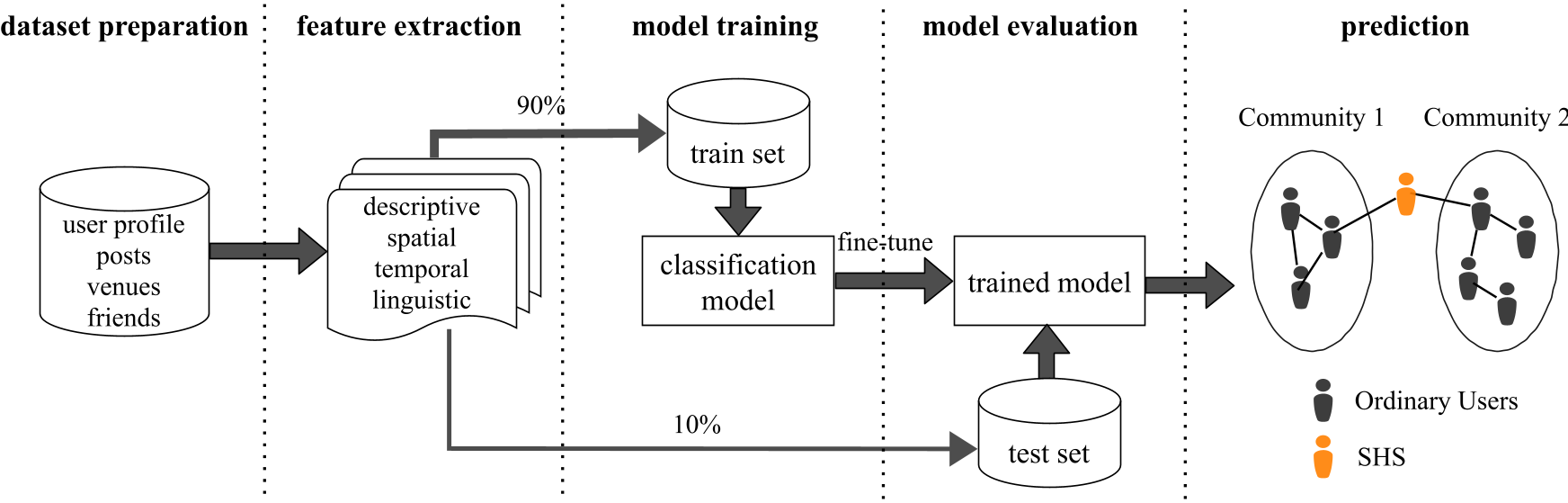
The researchers deployed 40 distributed crawlers on Microsoft Azure to capture the profile data, friend lists, and "tips" (UGC) of the entire Foursquare population.
1. Labeling via Network Constraint
The team used Burt’s Constraint Metric to identify SHS. A user with low constraint has a diverse friend group that isn't interconnected, acting as a "bridge" over a structural hole.
2. Behavioral Feature Engineering
The study analyzed four dimensions:
- Descriptive: Gender, post frequency, and photo usage.
- Spatial: Entropy of venue categories (how diverse are their check-ins?) and travel distance.
- Temporal: Posting patterns throughout the day and week.
- Linguistic: Vocabulary diversity and emotional sentiment using LIWC.
Insights: How SHS Differ from Ordinary Users
The empirical analysis yielded several striking "SOTA" insights into the behavior of social bridges:
- Mobility Diversity: SHS have a venue category entropy over 4 times higher than ordinary users. They don't just visit the same coffee shop; they are "explorers" who move between diverse physical environments.
- Travel Intensity: SHS travel significantly longer distances between posts (avg. 224km+ vs. 93km).
- Linguistic Richness: Their posts are 1.7x longer, and they use a much wider variety of words (higher word entropy), suggesting they act as sophisticated information relayers.
Performance: Identifying SHS Without the Social Graph
A major challenge in modern apps is that friend lists are often private. Can we find SHS just by looking at their check-ins and tips?
Using the XGBoost algorithm, the authors proved this is possible. The model achieved an AUC of 0.879, proving that "where and when you post" is a strong proxy for "who you know."

As shown in the table above, XGBoost outperformed traditional models like Random Forest and SVM in detecting these critical users. Interestingly, the most important feature for prediction was Time Entropy, indicating that the "randomness" or flexibility of a user's schedule is a primary indicator of their bridging role in society.
Deep Insight & Conclusion
This study bridges the gap between digital social capital and physical behavior. The takeaway is clear: Structural Hole Spanners are not just nodes on a graph; they are the "active sensors" of a city. Their high mobility and diverse interests mean they are the first to discover new trends and the key to spreading information across different social circles.
Limitations & Future Work: The study is based on 2015 data; the evolution of LBSNs into "Super Apps" may have changed these dynamics. Future research should look into whether these SHS behaviors remain consistent across different cultures and newer platforms like TikTok or Xiaohongshu.