
Deciphering the Digital Footprints of Travelers: A Topic-Modeling Approach to LBSNs
Towards understanding traveler behavior in Location-based Social Networks
This paper investigates traveler behavior in Location-Based Social Networks (LBSNs) using a Foursquare dataset from Pittsburgh. It introduces a multi-faceted analysis framework combining empirical spatio-temporal studies, User Entropy for diversity measurement, and Latent Dirichlet Allocation (LDA) to extract human-centric mobility patterns and "hot spots."
TL;DR
This research moves beyond general location studies to focus specifically on travelers—users far from home with unique mobility needs. By analyzing Foursquare data through the lenses of Spatio-temporal evolution, User Entropy, and Latent Dirichlet Allocation (LDA), the authors reveal how travelers explore new cities and how these patterns can revolutionize personalized location recommendations and urban planning.
Background: Why Travelers Matter
In the ecosystem of Location-Based Social Networks (LBSNs) like Foursquare or Facebook Places, not all "check-ins" are weighted equally. A local user checking into their neighborhood gym is a routine; a traveler checking into a landmark is a discovery. Most prior work failed to isolate these two groups. This paper argues that understanding the specific "why" and "when" of traveler movements is the key to solving the Cold Start problem for recommendation systems in new cities.
Problem & Motivation: The Gap in Urban Analysis
The authors identify a critical flaw in current research: reliance on filtered data (like Twitter-linked check-ins) and a lack of distinction between local and non-local behaviors. Travelers typically seek "Hot Spots" and famous landmarks, whereas locals follow fixed routines. Understanding this distinction is vital for:
- Urban Design: Placing visitor information centers where travelers actually congregate.
- Recommendation Accuracy: Suggesting venues that align with a visitor’s "lifestyle topic" (e.g., Sports vs. Academia).
Methodology: Entropy and Latent Topics
The paper employs two sophisticated quantitative tools to move from raw data to actionable insights:
1. User Entropy: Measuring Exploration
The authors use User Entropy () to quantify the diversity of a traveler's journey. If a traveler visits many different venues in equal proportions, their entropy is high. The study found that as check-in counts increase, so does entropy, suggesting that travelers are inherently "explorers" rather than creatures of habit.
2. LDA: Trajectories as Language
By treating a user's entire visit history as a "document" and each venue as a "word," the authors used Latent Dirichlet Allocation (LDA) to uncover hidden themes in Pittsburgh's urban structure.
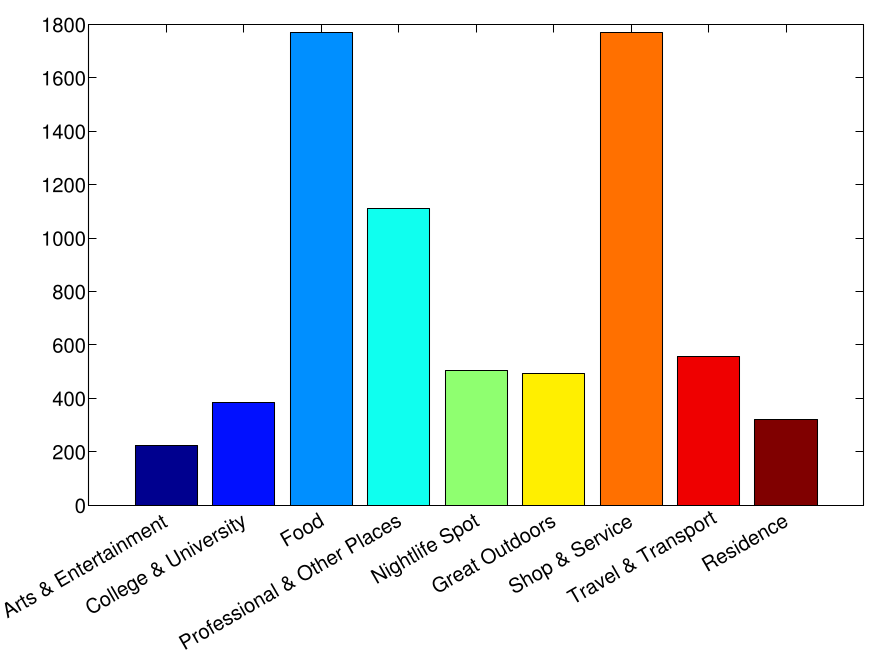 Fig 1: The distribution of check-ins across top venue categories highlights the dominance of Food and Travel/Transport for travelers.
Key Findings: The Spatio-Temporal Pulse of the City
The research provides a fascinating chronological look at how travelers "consume" a city:
- Temporal Shifts: Weekday activity peaks late (8 PM), while weekend activity spikes early (2 PM).
- Spatial Evolution: Travelers don't just stay in the center; check-in patterns show a "flow" moving from Downtown toward the North and South neighborhoods over three-hour intervals.
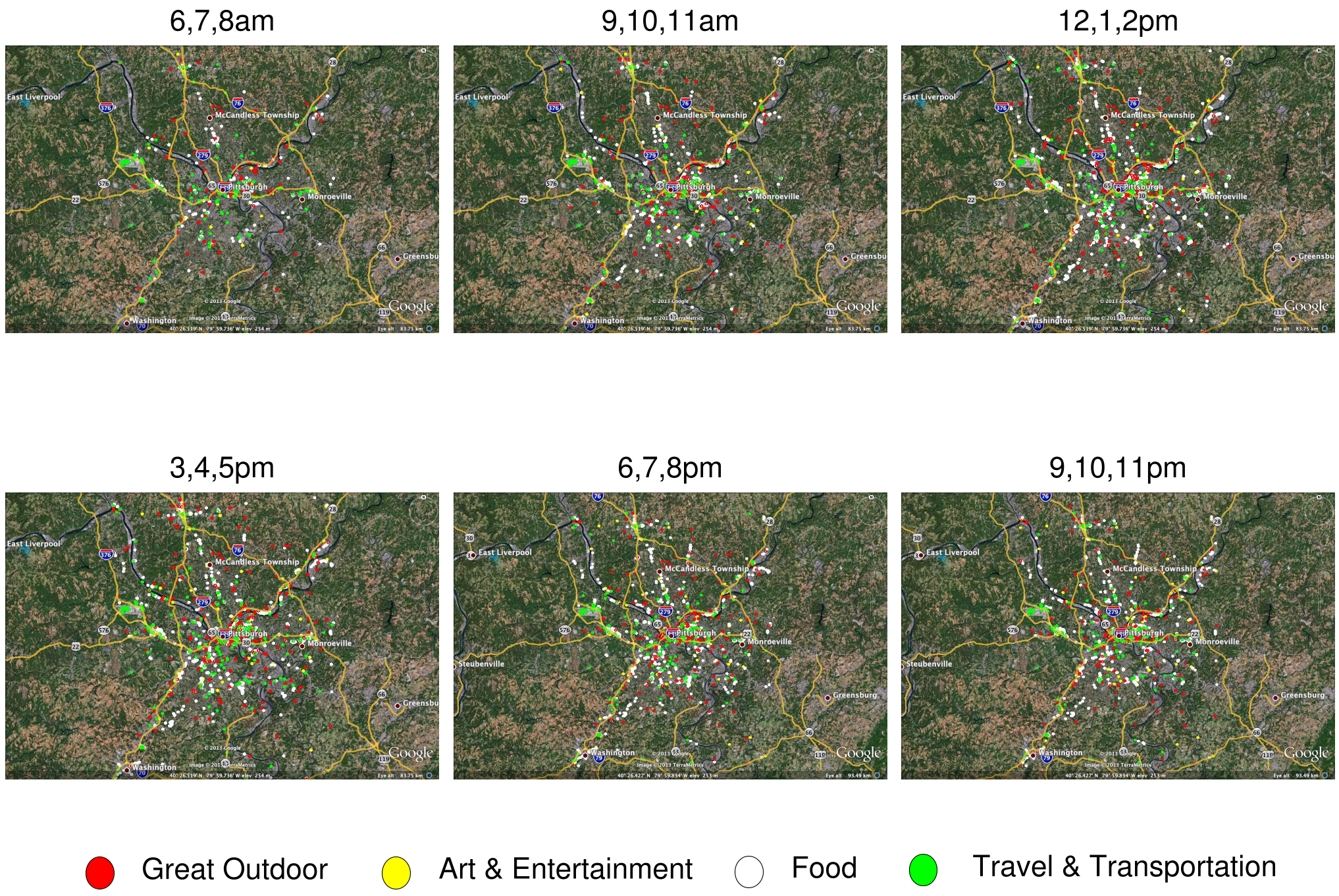 Fig 2: The evolution of venues in key categories (Food, Arts, Transportation) illustrating the rhythmic spread of traveler activity throughout the day.
The Semantic Topics
The LDA model successfully identified clusters that "make sense" of a traveler's intent:
- The Sports Topic: High correlation between the Airport, Hotels, and Hockey Arenas (CONSOL Energy Center).
- The Academic Topic: Clusters around Carnegie Mellon University (CMU) and local bars/coffee shops, indicating high-density movement between research sites and social venues.
Critical Analysis & Conclusion
Takeaway
The paper proves that travelers exhibit high-diversity behavior that can be modeled as "Latent Topics." For developers, this means if a user checks into one venue within a "Sports Topic," the system should immediately recommend other venues within that specific latent cluster (hotels, sports bars) rather than just the nearest location.
Limitations & Future Work
While groundbreaking in its use of native Foursquare data, the study is limited to a single city (Pittsburgh). The "Traveler" definition—based solely on hometown distance—might miss "business travelers" who visit frequently and act more like locals. Future research should integrate the functionality of venues with spatial features to create a 3D-map of urban interest.
Summary: By bridging the gap between raw GPS data and human semantic intent, the authors provide a blueprint for the next generation of intelligent, context-aware travel assistants.