
The Anatomy of Digital Trust: Why We Believe (or Disbelieve) What We Read on Twitter
Understanding Trust in Social Media: Twitter
This paper investigates the determinants of perceived trustworthiness on Twitter through a structured survey using simulated user profiles. The authors quantify how specific linguistic markers, profile aesthetics, and interaction metrics influence whether users are viewed as trustworthy or labeled as bots/trolls.
TL;DR
Trust on social media is less about how many "Likes" a post has and more about how "human" the user feels. A recent study from the University of East Anglia reveals that users rely on linguistic quality, profile pictures, and perceived personality to judge credibility. While aggressive political accounts trigger instant skepticism, "wholesome" content—like a cat tweeting—remains the gold standard for trustworthiness.
Contextualizing Trust in the Age of Misinformation
We live in an era where the boundary between human discourse and bot-generated propaganda is increasingly blurred. This research situates itself at the intersection of psychology and data science, moving beyond what is being said to who appears to be saying it. The authors argue that if we can pinpoint the personality traits that lead to information sharing, we can better understand the viral mechanics of fake news.
The "Fake User" Experiment
To understand how we perceive strangers online, the researchers didn't just observe; they engineered. They created a spectrum of 10 fictional Twitter personas using "Tweetgen" to ensure visual authenticity. These included:
- The Political Extremist: High engagement but highly controversial.
- The Bot/Troll: Repetitive and suspicious behavior.
- The "Mundane" User: Posting light-hearted, non-confrontational content (e.g., a "cat account").
Methodological Blueprint
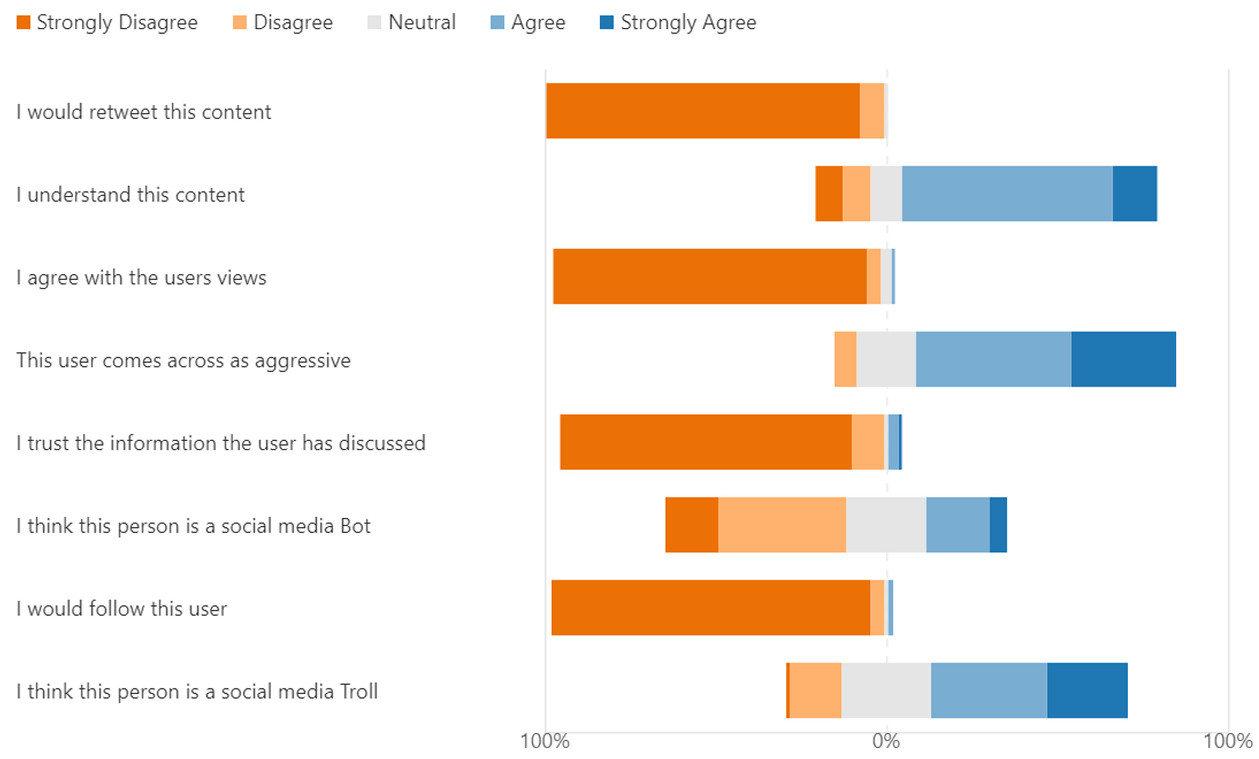 The study utilized a Likert scale (pictured above) to quantify participant reactions across dimensions of trust, sharing intent, and bot-identification.
Why Method Matters: Beyond the Numbers
The study’s core insight comes from its qualitative feedback. While many AI models focus on interaction counts, this paper found that humans are surprisingly sensitive to "Digital Decorum."
- Grammar as a Shield: Participants frequently cited poor spelling and grammar as indicators of low credibility or bot-like behavior.
- The Profile Picture Paradox: Users preferred "genuine-looking" photos (even if fake) over stock images or empty avatars. An avatar functions as a visual shorthand for accountability.
- Echo Chambers: One revealing participant comment noted they "trust users who share the same views," confirming that trust is often an extension of confirmation bias.
The Results: Who Wins the Trust War?
The contrast in trust levels was stark. "Sully," the persona designed with aggressive right-wing views, was rejected by 94.5% of participants. Conversely, a cat account was deemed the most trustworthy.
Key Factors in Perception
 The Word Clouds above illustrate that 'Likes' and 'Retweets'—the metrics platforms prioritize—were often secondary to specific 'Content' and 'Profile Picture' cues in the eyes of the users.
Critical Insight: The "Halo" and the "Hate"
The study validates the existence of a "Negative Halo Effect" on social media. Once a user exhibits an aggressive or highly opinionated stance, their overall credibility across all topics collapses.
However, the study also reveals a vulnerability: we are so conditioned to look for "human" flaws (like personality or humor) that we might trust a well-crafted bot simply because it mimics the "mundane" better than a controversial human does.
Conclusion & Future Look
The preliminary results suggest that trust is a fragile ecosystem built on aesthetics and linguistic competence.
Future Work: The authors propose a "Deception Deep-Dive." If we populate an entire feed with bots that act "mundane" and "light-hearted," can we effectively hide a misinformation campaign in plain sight? As social media continues to evolve, understanding these psychological levers is no longer just academic—it's a matter of digital survival.
Academic Takeaway
- Trust Priorities: Content Quality & Image > Social Proof (Likes/RTs).
- Bot Detection: Users are getting better at spotting bots (65.3% accuracy), but "personality" remains a major distractor.
- Linguistic Bias: Grammar and spelling are now informal "security certificates" in digital discourse.