
To Approach Humans? A Unified Framework for Socially Aware Robot Navigation
15500_To Approach Humans A Unified Framework for Approaching Pose Prediction and Socially Aware Robot Navigation.
This paper introduces a unified framework for socially aware robot navigation and pose prediction. By modeling a Dynamic Social Zone (DSZ) using socio-spatio-temporal features, it enables mobile robots to approach both individuals and groups, whether stationary or moving, in a manner that respects human proxemics and comfort.
TL;DR
Navigating around humans is one thing; approaching them for interaction is another. This paper presents a unified framework that combines human state estimation, group detection, and pose prediction. By defining a Dynamic Social Zone (DSZ), the robot doesn't just avoid collisions—it respects the psychological boundaries of individuals and groups, ensuring it arrives at the right spot at the right time.
Context: Beyond Obstacle Avoidance
In traditional robotics, humans are often treated as "cylinders" or "moving obstacles." However, as social robots (guides, delivery bots, companions) enter our lives, "don't hit them" is an insufficient rule. Humans have invisible boundaries—Proxemics—and complex group formations—F-formations.
The core challenge addressed by Truong and Ngo is how a robot can effectively "join" a conversation or "greet" a moving person without being intrusive or creepy.
Methodology: The Dynamic Social Zone (DSZ)
The authors' main contribution is the DSZ, a mathematical model that blends two distinct concepts:
- Extended Personal Space (EPS): An asymmetrical space around a single person, influenced by whether they are sitting, standing, or moving.
- Social Interaction Space (SIS): The shared space between people in a group (e.g., a "circle" of conversation).
The Formula for Social Comfort
The DSZ functions as a "cost map." As the robot gets closer to the human's "O-space" (inner circle) or "P-space" (interaction zone), the cost increases. Specifically, the framework uses 2-D Gaussian functions to model these zones. If a person is moving, the Gaussian "stretches" in the direction of travel, reflecting our heightened sensitivity to things moving into our path.
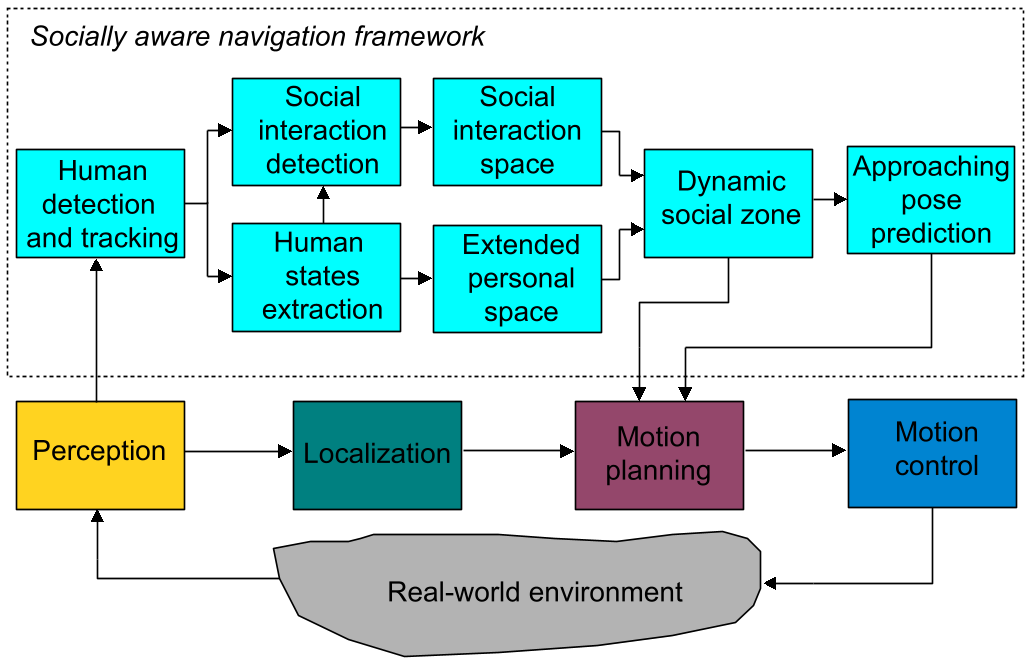 Fig 1: The system architecture integrating human feature extraction with motion planning.
Approaching Moving Targets
For stationary humans, a simple goal point suffices. But for a moving human, the robot must predict an intercept. The authors utilize a Kalman Filter to predict future human states and an "approaching factor" () to determine if the robot's maximum velocity is sufficient to catch the person without breaching their social comfort zone.
Validating Human Safety and Comfort (HSCI)
To prove this works, the authors proposed three indices:
- SII (Social Individual Index): Measures if the robot violates a single person's personal space.
- SGI (Social Group Index): Measures if the robot "breaks through" a group's shared interaction space.
- SDI (Social Direction Index): Measures if the robot approaches from the "front" (where humans prefer to see things coming) rather than the side or back.
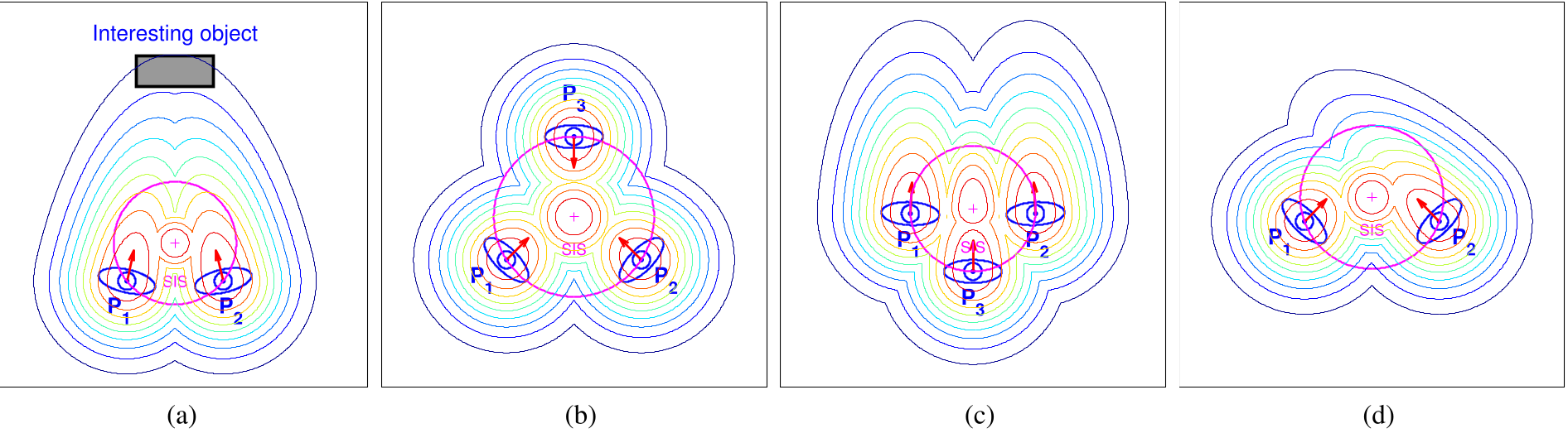 Fig 2: Visualization of the DSZ for different group formations and interactions.
Experimental Performance
The framework was tested in the Gazebo simulator and on a real-world "Eddie" mobile platform.
- Stationary Humans: The robot successfully navigated around obstacles to stop in front of humans at a comfortable distance ().
- Dynamic Humans: For walking humans, the robot didn't follow them from behind (which is socially threatening); it predicted a path to meet them at a 45-degree angle in their field of view.
- Quantitative Success: In all tests, the SII remained below the psychological threshold of 0.14, meaning humans felt comfortable throughout the encounter.
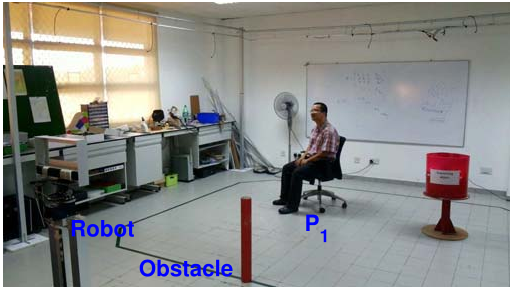 Fig 3: Case studies of the robot approaching stationary and moving groups in real-world environments.
Conclusion and Future Outlook
Truong and Ngo have established a robust baseline for social interaction. However, the authors admit that a constant-velocity Kalman filter is a simplification. Real human movement is erratic.
The future of this work lies in integrating Social Force Models (to handle crowded malls) and Machine Learning (to learn cultural proxemic preferences automatically). For now, the DSZ framework provides the essential scaffolding needed for robots to transition from "avoiding obstacles" to "approaching friends."