
The Unified Gradient Regularization Family: Bridging Adversarial Robustness and Generalization
A Unified Gradient Regularization Family for Adversarial Examples
This paper proposes a unified gradient regularization framework to enhance the robustness of machine learning models against adversarial examples. By formalizing the search for worst-case perturbations as a min-max problem, the authors derive a family of gradient-based penalties, achieving a new SOTA error rate of 0.78% on MNIST (without augmentation) and significantly improved performance on CIFAR-10.
TL;DR
Adversarial examples—tiny, invisible perturbations that can fool AI—are often seen as "bugs" in neural networks. This paper reframes them as a feature of high-dimensional linear behavior and proposes a Unified Gradient Regularization Family. By penalizing the gradient of the loss with respect to the input, the authors provide a mathematically rigorous framework that not only makes models robust but also sets new performance records on standard benchmarks like MNIST and CIFAR-10 without the need for data augmentation.
The Motivation: Why Do Adversarial Examples Exist?
The academic community has long debated why deep networks are so fragile. Some suspect extreme non-linearity, but the authors follow the "Linear View": in high-dimensional spaces, even small linear changes across many dimensions can stack up to create massive changes in the final output.
Previous solutions like "Adversarial Training" (injecting perturbed images into the training set) worked but felt like a "brute-force" heuristic. Other methods that penalized the Jacobian matrix were computationally expensive. There was a desperate need for a unified mathematical framework that could explain these phenomena and solve them efficiently.
Methodology: From Min-Max to Gradient Penalties
The authors formulate the problem of building a robust model as a min-max synchronization:
- Inner Maximization: Find the worst-case perturbation within a small budget that maximizes the loss.
- Outer Minimization: Adjust the model parameters to minimize this maximum loss.
By applying a first-order Taylor expansion, they derive a closed-form solution for the perturbation:
abla \mathcal{L}) \left(\frac{| abla \mathcal{L}|}{\| abla \mathcal{L}\|_{p^*}}\right)^{\frac{1}{p-1}}$$ This leads to a beautiful result: **the adversarial problem is equivalent to adding a gradient norm penalty to the loss function.** ### The Family Members: * **$p = \infty$**: Reduces to the "Fast Gradient Sign Method" (FGSM). * **$p = 1$**: A sparse perturbation where only one pixel is attacked. * **$p = 2$**: The "Standard Gradient Regularization." The authors prove through a second-order expansion that this is mathematically related to training with Gaussian noise, but it is more efficient and instance-specific.  *(Equation showing the unified regularization term: minimizing the loss plus the dual norm of the gradient)* ## Visualizing the "Invisible" One of the paper's most fascinating contributions is the visualization of these perturbations. Previously, these were thought to be random noise. However, when magnified, the authors show that the perturbations have **semantic meaning**. For example, when the model is confused between a '6' and a '5', the gradient perturbation actually erases the parts of the '6' that make it a '6' and adds features of a '5'.  *(Fig: MNIST inputs perturbed by $p=2$ gradient regularization. Note how the shapes are semantically morphed when magnified.)* This explains **Transferability**: adversarial examples generated for one model often fool another because they are actually moving the image toward the manifold of another real class. ## Experimental Results: SOTA without Augmentation The beauty of this method lies in its efficiency. Instead of generating thousands of new images, you simply add one term to your backpropagation. **Key Achievements:** * **MNIST**: Achieved **0.78% error**, the best result in the "permutation invariant" category without data augmentation. * **CIFAR-10**: Improved the baseline Maxout network from 12.93% to **12.28%** error. * **Robustness**: Models trained with this family showed significantly higher resistance to Gaussian noise, proving that gradient regularization builds a "smoother" and more stable decision landscape. 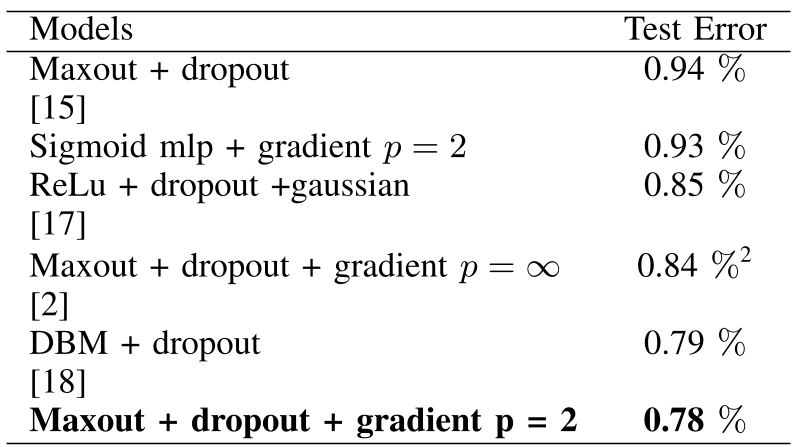 *(Table I: Comparison of MNIST performance showing Gradient $p=2$ outperforming other regularization techniques.)* ## Critical Insights & Future Outlook The paper provides a strong theoretical bridge between adversarial robustness and traditional regularization. It suggests that adversarial examples aren't just a quirk of deep learning, but a fundamental property of how we process high-dimensional data. **Limitations**: While the first-order approximation is efficient, it might not capture the full complexity of highly non-linear "manifold-style" attacks. Additionally, while computational costs are lower than full Jacobian penalties, computing the gradient w.r.t the input still roughly doubles the training time per iteration. **Future Impact**: This work paves the way for "Certified Robustness," where we can mathematically guarantee that a model won't change its prediction within a certain $L_p$ ball. It also suggests that the best way to improve generalizability is to ensure the model's loss is "flat" with respect to its input space.