
Universal User Patterns: Decoding the DNA of Facebook Social Games for Education
Universal User Pattern Discovery for Social Games: An Instance on Facebook
This paper explores "Universal User Pattern Discovery" for Facebook-based social games by analyzing simulation and social utility genres. It utilizes the Verbs–Goals–Network triangulation method to extract common game frameworks, aiming to establish a foundation for developing social-network-based educational tools.
TL;DR
Social games are more than just a distraction; they are complex systems of interaction. This paper deconstructs the mechanics of Facebook's most popular genres—Simulation and Social Utility games—using a triangulation method. By identifying universal patterns like "Verbs" and "Goals," the authors provide a blueprint for turning addictive social loops into effective educational tools.
Problem & Motivation: The Untapped Potential of Play
Despite the explosion of Web 2.0 and social platforms, using games as a "teaching tool" remains an emerging and often misunderstood field. Most educational games fail because they lack the "flow" and "social property" found in commercial hits like Restaurant City or Happy Harvest.
The authors argue that to build successful Game-Based Learning (GBL) environments, we must first understand the "Game Flow" of existing social successes. The challenge lies in the diversity of social games—how do we find a "universal pattern" in a sea of different genres?
Methodology: The Triangulation of Verbs and Goals
The core of this research relies on Aki Järvinen’s Triangulation Method. Instead of looking at graphics or themes, the authors analyze the "Game Mechanics" through a structural lens:
- Verbs: The actions players take (e.g., steal, gift, visit, cook).
- Goals: The ends players want to reach (e.g., level up, collect items).
- Network Play: The social dynamic between the service, individual, and community.
The Analytical Framework
The researchers mapped out flowcharts for three Simulation games and three Social Utility games to extract a shared "Social Property."
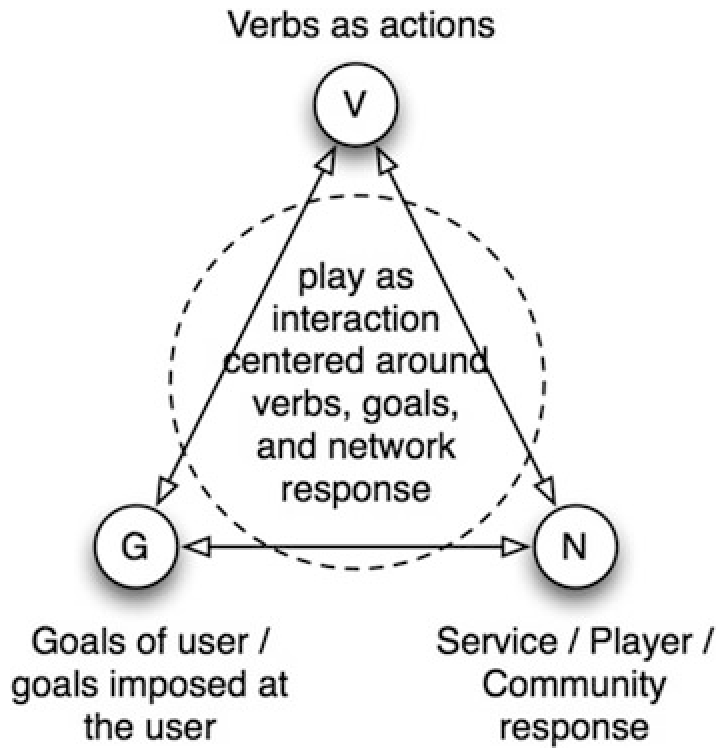 Figure 1: The Verbs–Goals–Network play model used to define social game mechanics.
Five Pillars of Social Game Design
The study identifies five "Universal Features" that define the user experience in social environments:
- Social Context & Behavior: Unlike traditional MMOs where you play with strangers, social games rely on real-world "Social Graphs." Competition is kept as a non-zero-sum game—you can "steal" from a friend, but restrictions prevent total loss, preserving the social relationship.
- Virtual Currency: Driven by "Virtual Economy" demands, providing the backbone for item transactions.
- Experience Points (XP) as Social Status: XP isn't just a number; it is a function of social behavior. Visiting friends earns points, turning the social network into a "labor" system for rewards.
- Item Collection Systems: Items (badges, cars, rare fish) represent status and achievement, though unlike XP, they carry the "risk" of being stolen by friends.
- Tasks: These provide structured "verbs" and "goals," adding a sense of fulfillment and direction to the player's session.
Experiments & Comparative Insights
The paper categorizes Facebook games into two distinct archetypes:
- Simulation Games (e.g., My Fishbowl): Focus on operation, resource management, and intermittent competition (stealing treasures).
- Social Utility Games (e.g., Hugged): Stripped-down mechanics focusing almost entirely on "Emotional Communication" through messages and rankings.
The authors conclude that simulation games offer more robust "Game-Based Learning" potential because they integrate Competition, Challenge, and Tension into socializing—the three ingredients required for high "playfulness."
Critical Analysis & Conclusion
Takeaway
The true value of this paper lies in its Inductive Bias toward social context. It shows that for a game to be "social," it must leverage pre-existing interpersonal relationships rather than trying to build new ones from scratch. For educational designers, the message is clear: Social behavior must be the primary source of XP.
Limitations & Future Work
The study is focused heavily on the Facebook ecosystem of the late 2000s/early 2010s. Modern social games (like Genshin Impact or mobile "Social Casino" games) have evolved more complex monetization and "Gacha" mechanics that aren't fully captured here. Future research will need to analyze how these universal patterns shift across different platforms (mobile vs. web) and how "Cooperative Games" can be scaled for massive online classrooms.
Final Thought: Understanding the "flow" of a game isn't just about entertainment—it's about finding the "verbs" that make learning as addictive as a Facebook farm.