
Universally Accessible mHealth: Bridging the Digital Divide for Aging Populations
Universally Accessible mHealth Apps for Older Adults: Towards Increasing Adoption and Sustained Engagement
This paper introduces a specialized evaluation framework for mHealth applications based on Universal Design (UD) principles, specifically targeting older adults. It proposes the Universal Design Mobile Interface Guidelines (UDMIG) and an adapted 21-item heuristic tool to increase adoption and sustained engagement in health-tracking behaviors.
TL;DR
Mobile health (mHealth) apps possess immense potential for geriatric care, yet they are frequently abandoned due to poor interface design that ignores age-related declines. This paper proposes a robust evaluation framework rooted in Universal Design (UD), providing 21 specific heuristics to ensure that health technology is not just functional, but accessible and engaging for older adults.
Background: The High Stakes of High Abandonment
As the global population ages, mHealth apps for fitness, nutrition, and medication management have become vital tools for independent living. However, there is a stark "use gap": while 42% of older adults own smartphones, their adoption of mHealth apps remains as low as 10%.
The authors argue that the root cause isn't a lack of interest, but a design failure. Most apps are built for younger "digital natives," characterized by:
- High Cognitive Load: Complex workflows that tax working memory.
- Poor Contrast/Visibility: Small fonts and low-contrast palettes.
- Inflexible Interactions: Reliance on complex gestures or precision motor control.
Methodology: The Universal Design Framework
The core of this research is the adaptation of the Universal Design Mobile Interface Guidelines (UDMIG). The authors move beyond standard usability heuristics (like Nielsen’s) to focus on four high-level pillars specifically tuned for seniors.
1. The Expert Heuristic Tool
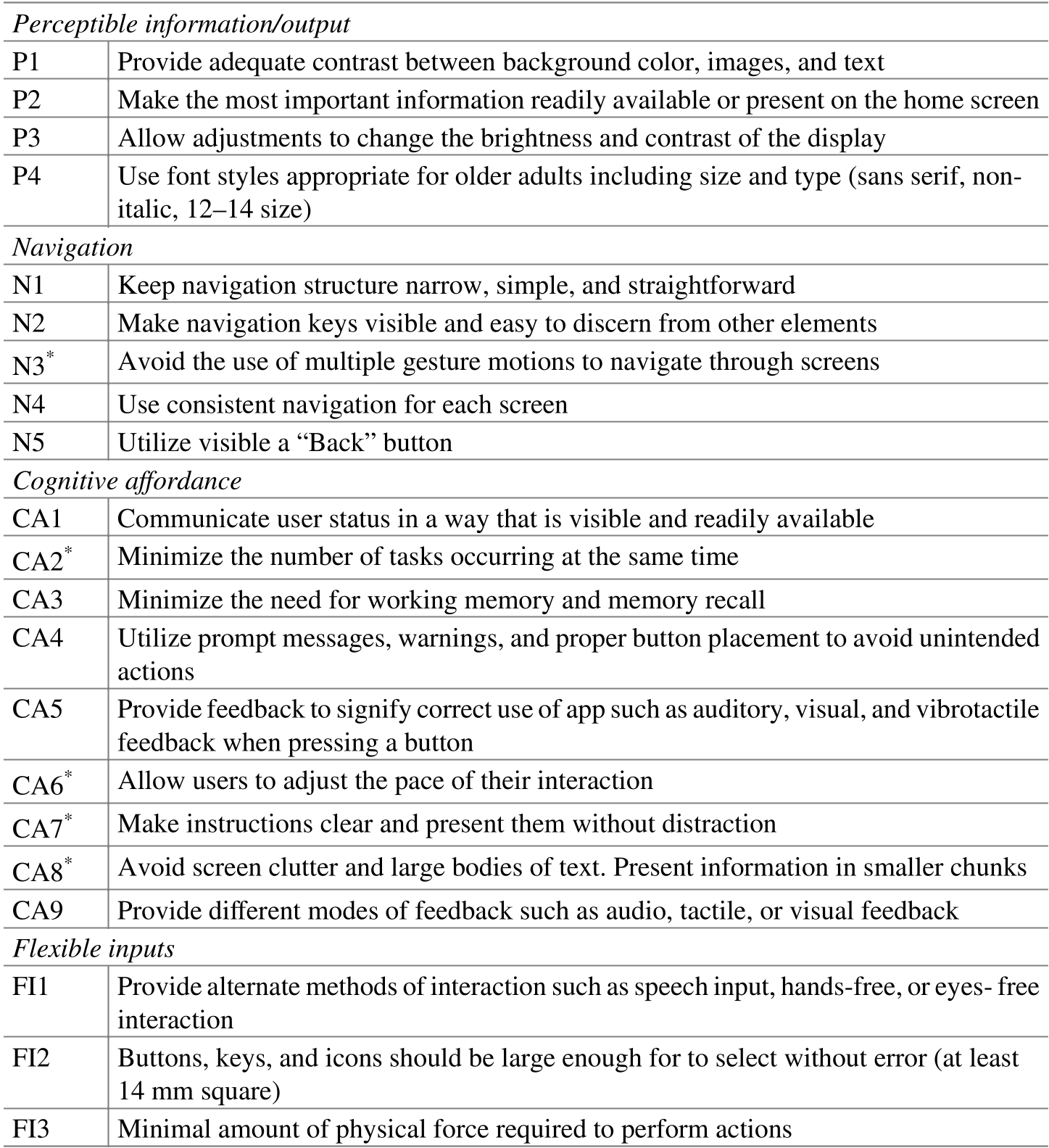
For researchers and designers, the paper outlines 21 heuristics. Key innovations include:
- Perceptible Information: Mandating sans-serif fonts (12-14pt) and high-contrast visuals.
- Cognitive Affordance: Minimizing simultaneous tasks and providing clear, multi-modal feedback (audio + tactile + visual).
- Flexible Inputs: Ensuring touch targets are at least 14mm square to accommodate dexterity challenges.
2. User Perception Metrics
Usability isn't just about technical performance; it’s about perceived usefulness. The authors adapted a Likert-scale survey that translates UD principles into user-facing questions (e.g., "I can easily reverse my actions if I make a mistake").
Experimental Insight: From UI to Behavior Change
The paper positions usability as a precursor to the Technology Acceptance Model (TAM). The logic is simple: if an app is universally accessible, the "Perceived Ease of Use" increases. According to TAM, this directly boosts "Perceived Usefulness," which is the strongest predictor of whether an older adult will sustain use over months or years.
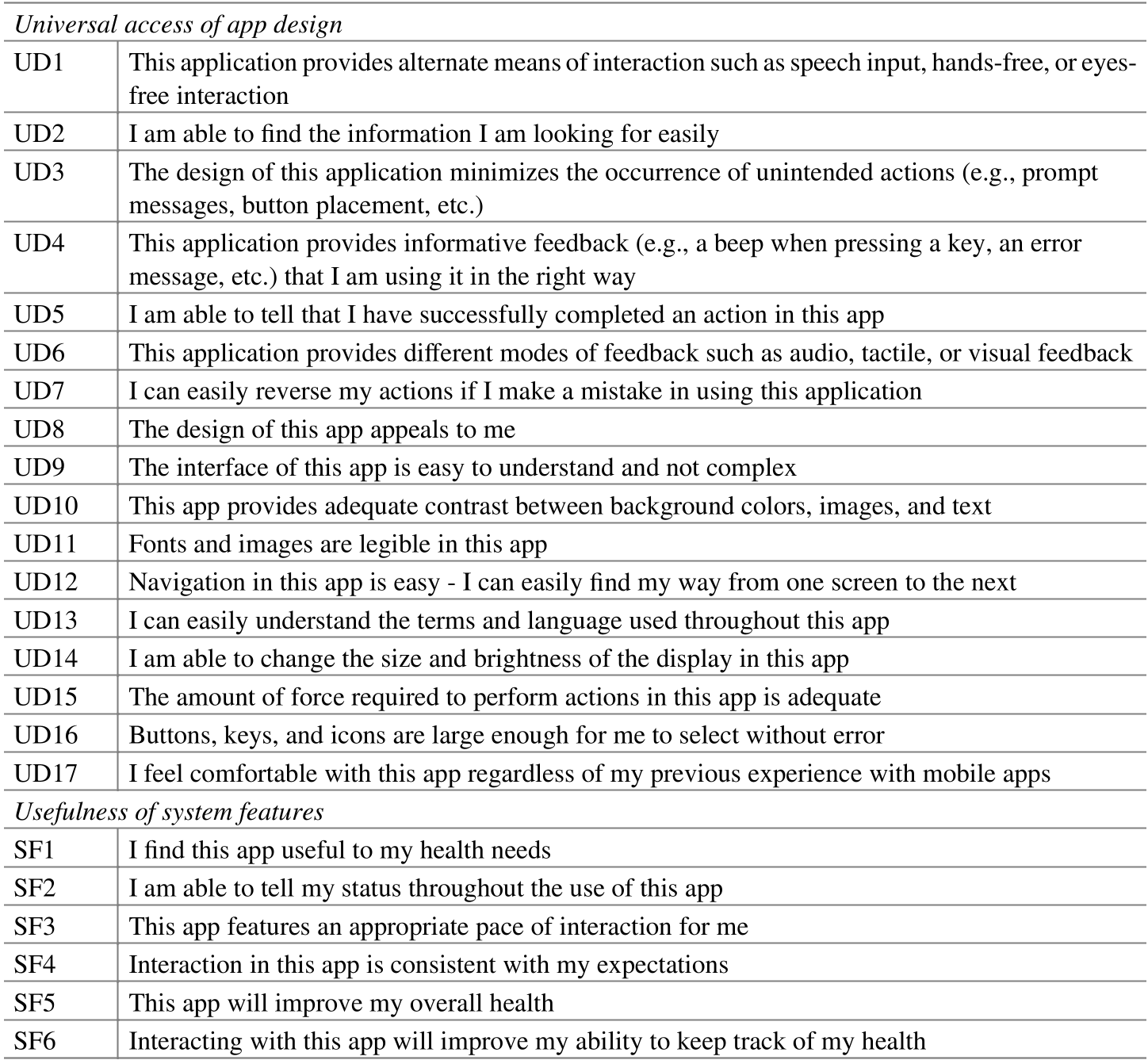
By evaluating existing fitness apps, the authors found that even popular programs often suffer from "screen clutter" and "unfamiliar iconography," which act as barriers to entry for those who could benefit most from activity tracking.
Critical Analysis: Beyond the Interface
While the paper provides an excellent blueprint for how to design, it also acknowledges a critical paradox: Universal Design is not just for the impaired. By designing a "non-stigmatizing" product that works for a 70-year-old with low vision and arthritis, designers inadvertently create a superior product for a 25-year-old using the app in bright sunlight or while multitasking.
Limitations: The current study focuses heavily on the structure of the interface. Future research needs to investigate the content—i.e., whether the motivational strategies (gamification, social sharing) satisfy the psychological needs of older adults in the same way they do for younger cohorts.
Conclusion
This work serves as a call to action for the HCI community. As mHealth moves from a "luxury" to a "necessity" in healthcare, universal accessibility must become the industry standard. By utilizing the UDMIG framework, developers can move past the 3-month abandonment "death zone" and create tools that truly support sustained health-related behavior change.