
Beyond Facebook: Institutionalizing Social Capital via the University Social Network (USN)
University social network benefits analysis and proposed framework
This paper proposes a formal framework for a University Social Network (USN) designed to institutionalize social learning. By analyzing survey data from over 700 Croatian students, the authors advocate for a dedicated platform that bridges the gap between informal social media usage (like Facebook) and formal Higher Education Institution (HEI) information systems.
TL;DR
Higher Education Institutions (HEIs) are currently "data-blind" to the massive amount of social learning happening on platforms like Facebook and WhatsApp. This paper argues for the creation of an official University Social Network (USN)—a framework that integrates social capital directly into the academic infrastructure to improve student performance, researcher collaboration, and institutional transparency.
The "Social Learning" Gap
Most universities rely on Moodle or similar Learning Management Systems (LMS). While effective for distributing PDFs and collecting assignments, these systems are "siloed" by course. They do not capture the organic, cross-departmental, and peer-to-peer interactions that drive modern education.
The authors' survey reveals a striking reality: students are already using social networks to study, but these interactions are "off the grid." By ignoring this, universities miss out on Educational Data Mining opportunities that could help identify struggling students or highly influential peer-mentors before it's too late.
Methodology: The USN Framework
The core of the proposal is a shift from "Course-Centric" to "Network-Centric" architecture. The USN is defined by two primary components:
1. Multi-Dimensional Nodes
In a standard social network, a node is a person. In the USN framework, a node can be:
- Individuals: Students, Ph.D. candidates, Faculty, Alumni.
- Groups: A specific class, a research laboratory, a student club, or an ad-hoc project team.
2. Flexible Privacy Tiers
Privacy is the biggest hurdle for institutional social networks. The authors propose a four-tier model:
- Private: 1-on-1 mentorship or peer chats.
- Group: Limited to a specific course or lab.
- HEI-Level: Cross-departmental updates visible to all university members.
- Public: Showcasing scientific achievements to the world (Recruitment/Impact).
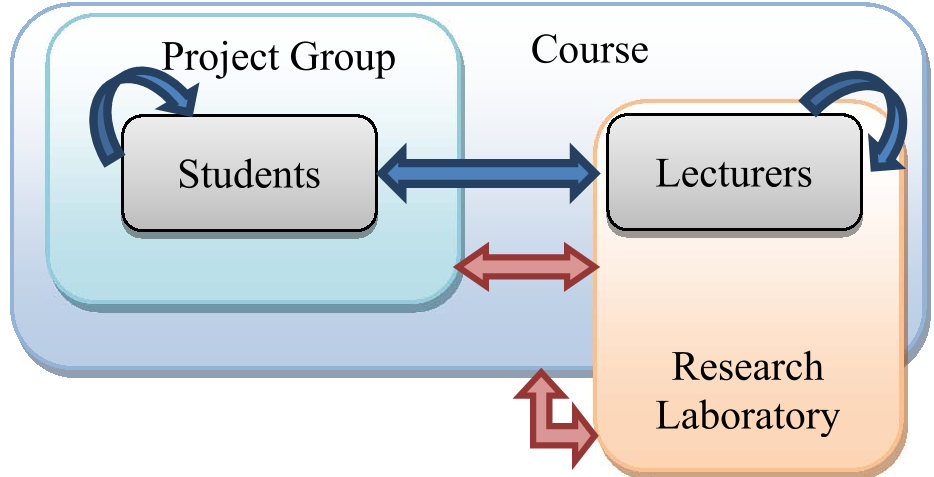 Figure 1: The proposed organizational structure of nodes and communication flow within the USN.
Evidence: Does Socializing Actually Raise Grades?
The authors conducted a survey of 740 students in Croatia to validate their approach. Using Chi-Square (χ²) testing, they found definitive links between social habits and academic success:
- The Communication Effect: Students who characterized themselves as "communicative" were significantly more likely to have a higher WAG (Weighted Average Grade) (p < 0.05).
- The Facebook Correlation: Most students with grades between 3.41 and 4.40 (on a 5-point scale) were active in Facebook study groups with 6-12 colleagues.
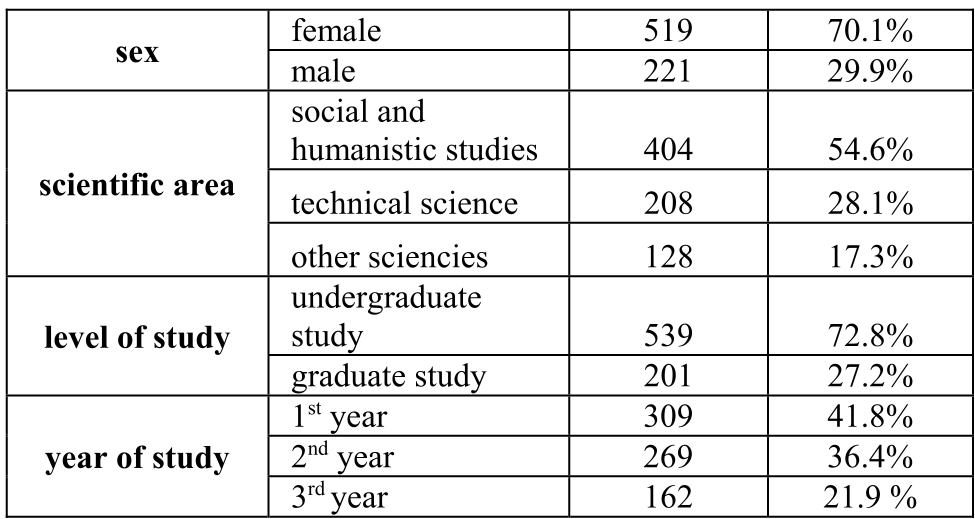 Table 1: Diversity of the survey sample across gender, scientific area, and level of study.
Stakeholder Benefits (Why it Works)
The framework doesn't just benefit the students. It creates a "Social Capital" loop:
- Teachers: Can identify which concepts are causing the most confusion by observing group discussions.
- Researchers: Gain visibility and find collaborators across different faculties.
- Alumni: Stay connected to the "Expertise Groups," providing a pipeline for current students to enter the workforce.
Critical Analysis & Future Outlook
While the proposal is robust, the paper acknowledges a major challenge: Adoption Resistance. Students might feel that an "Official" university social network is "too formal" compared to the freedom of Facebook.
The Takeaway: To succeed, a USN must not feel like a "Work Tool" (like Slack or Moodle) but as a "Community Hub." The true value lies in the Social Graph; if a university can map the influence and expertise of its members, it can transform from a mere "content provider" into a self-sustaining knowledge ecosystem.
For future work, the integration of Data Mining on these USN interactions could allow for real-time "Centrality Analysis," identifying the key students who act as information bridges within the university.