
UFSS: Bridging the Gap Between Link Information and Discriminative Features in Social Media
Selecting discriminative features in social media data: An unsupervised approach
The paper introduces UFSS (Unsupervised Feature Selection for Social media), a novel framework that integrates link information and user attributes for high-dimensional social network data. It employs graph partitioning and an iterative optimization of an -norm regularized objective function to achieve state-of-the-art performance in feature relevance and discriminative power.
In the era of social media, data is no longer just a collection of independent points; it is a complex web of interactions. Traditional feature selection methods—designed for "flat" datasets—frequently stumble when faced with the high-dimensional, linked nature of platforms like Flickr or X (formerly Twitter). In their paper, Selecting discriminative features in social media data: An unsupervised approach, Elham Hoseini and Eghbal G. Mansoori introduce UFSS, a framework that treats social links not as noise, but as the key to unlocking feature relevance.
TL;DR
UFSS is an unsupervised feature selection framework that leverages user relationships (links) to guide the selection of discriminative attributes. By combining spectral graph partitioning with a sparse mapping matrix (-norm), it identifies the most informative features without requiring costly manual labels, outperforming existing SOTA methods like LUFS and UDFS.
The Problem: The I.I.D. Fallacy
Most feature selection algorithms assume data is Independent and Identically Distributed (I.I.D.). In social media, this is demonstrably false. Users who are linked (friends, followers, or co-group members) are statistically more likely to share similar interests and attributes.
Existing unsupervised methods suffer from:
- Ambiguity: Without labels, what makes a feature "good"?
- Missing Links: They ignore the rich "social context" provided by network topology.
- Redundancy: They fail to account for the correlation between millions of user-filled tags and attributes.
Methodology: How UFSS Works
UFSS operates on a clever intuition: if we don't have labels, we can "create" them by looking at how users are clustered in the network.
1. Graph Partitioning (The Social Context)
The authors first use spectral factorization on the link matrix to divide users into partitions. These partitions serve as pseudo-labels, providing a latent structure that guides the feature selection process.
2. The Objective Function
The core of UFSS is a sophisticated objective function that balances three elements:
- Fit: Minimizing the difference between the feature-mapped space and the graph partitions.
- Sparsity: Using the -norm to ensure only the most significant rows (features) in the mapping matrix are kept.
- Discrimination: Maximizing the "Between-Class Scatter" and minimizing "Total Scatter" to ensure features can effectively separate different user groups.
 Fig 1: Example of linked social data illustrating how users (u) and features (f) interact within a network.
Experimental Performance
The researchers tested UFSS against heavyweights like LUFS, Laplacian Score, and UDFS on two real-world datasets:
- BlogCatalog: A directory of blogs categorized by topic.
- Flickr: An image-sharing site where user groups serve as ground truth.
Key Results:
- Superior Accuracy: On the Flickr dataset, UFSS achieved an NMI (Normalized Mutual Information) near 0.98, while the closest competitor (Laplacian Score) trailed significantly as feature counts increased.
- Stability: Unlike other methods that fluctuate wildly based on the number of selected features (), UFSS maintains high performance consistently.
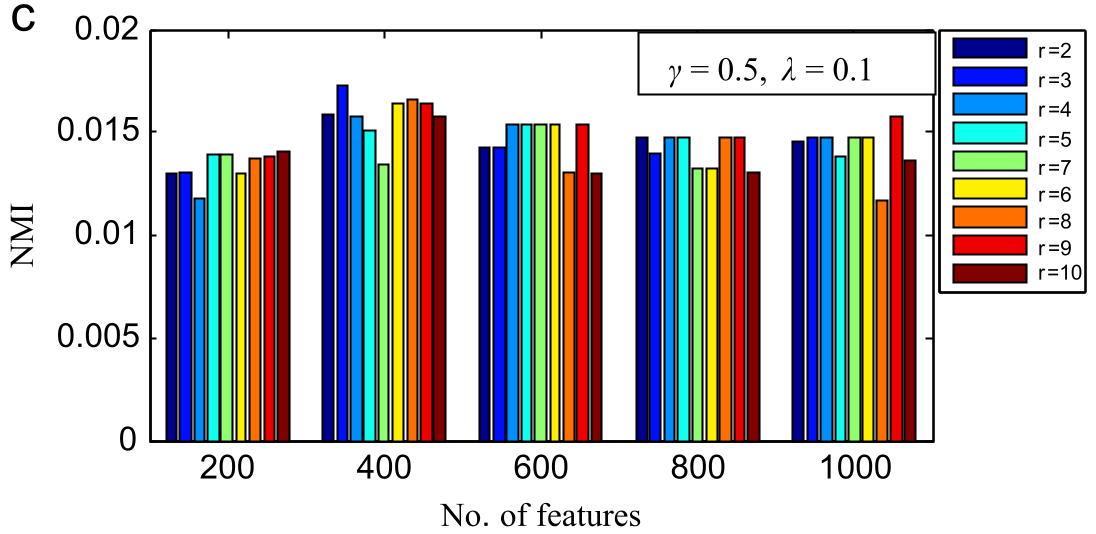 Fig 2: Performance (NMI) on Flickr dataset across different parameter settings for λ (sparsity) and γ (discrimination).
Convergence and Efficiency
One common critique of iterative feature selection is computational cost. However, the authors provide a mathematical proof of convergence and demonstrate that UFSS converges in roughly 40 iterations, making it feasible for large-scale social media analysis.
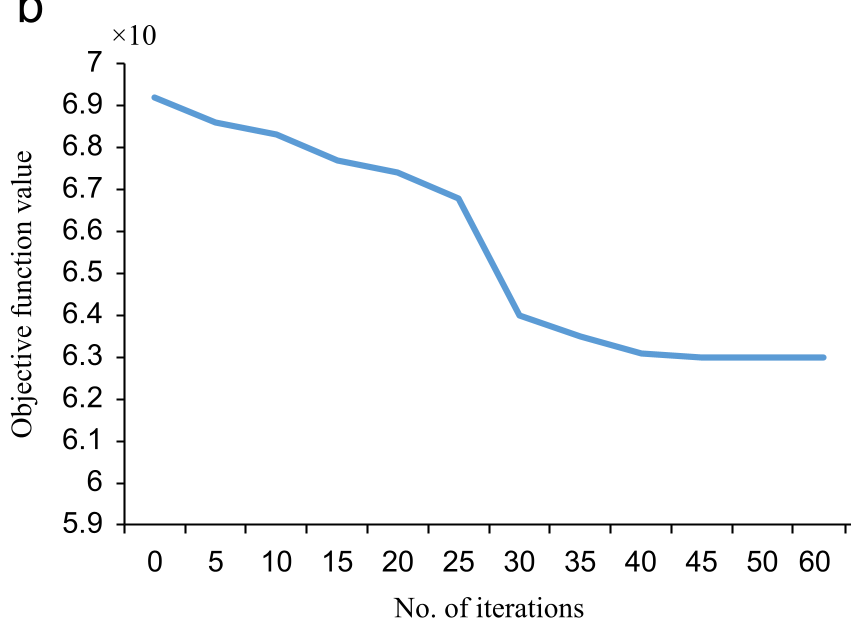 Fig 3: Objective function convergence for BlogCatalog and Flickr.
Critical Insight & Conclusion
The true value of UFSS lies in its departure from the "feature-only" mindset. By treating the social graph as a regularizer for feature selection, it successfully handles the sparse and noisy nature of user-generated content.
Limitations: Currently, UFSS uses "hard" graph partitioning (each user belongs to exactly one cluster). In real-world social networks, users often belong to multiple overlapping communities. The authors suggest that soft partitioning could be a promising avenue for future development.
Final Takeaway: For AI practitioners dealing with graph-structured data, UFSS provides a robust blueprint for dimensionality reduction that respects the underlying physics of social interaction.