
Unsupervised Fuzzy Logic: A Training-Free Breakthrough in Speech Emotion Recognition
Unsupervised Fuzzy Inference System for Speech Emotion Recognition using audio and text cues (Workshop Paper)
This paper introduces an unsupervised Fuzzy Inference System (FIS) based on the Mamdani model for Speech Emotion Recognition (SER), integrating audio features (pitch, energy) with textual sentiment scores. The system achieves state-of-the-art accuracy on the SAVEE (52.67%) and RAVDESS (52.52%) datasets without requiring any training phase.
TL;DR
Researchers have developed a novel unsupervised Mamdani Fuzzy Inference System (FIS) that recognizes emotions by fusing audio prosody with textual sentiment. Unlike traditional Deep Learning models that require heavy training, this system uses 11 expert-defined fuzzy rules to outperform supervised SOTA methods like LSTMs and SVMs on the SAVEE and RAVDESS datasets, particularly shining in cross-dataset scenarios where standard AI typically fails.
Problem & Motivation: The Supervised Trap
Speech Emotion Recognition (SER) is notoriously difficult because the same sentence can be uttered with entirely different emotional weights. Existing solutions generally fall into two camps:
- High Overhead: Supervised models (MLP, CNN, LSTM) require massive annotated datasets and significant GPU time.
- Brittle Generalization: A model trained on one recording environment (e.g., SAVEE) often suffers a "performance collapse" when tested on another (e.g., RAVDESS) due to dataset bias.
The authors argue that human emotion is inherently fuzzy. Terms like "high pitch" or "negative sentiment" aren't binary; they exist on a spectrum. By using Fuzzy Logic, they aim to resolve the ambiguity of natural language and vocal tones without the need for a training phase.
Methodology: The Core Fusion
The system extracts three primary features:
- Acoustic: Average Pitch () and Average Energy ().
- Linguistic: A sentiment score () calculated via lexicons like VADER or SentiWordNet.
The Mamdani FIS Architecture
The engine of the paper is the Mamdani Fuzzy Inference System. It processes these inputs through four stages:
- Fuzzification: Converting crisp inputs into fuzzy sets (Low, Medium, High).
- Rule Evaluation: Applying 11 novel "IF-THEN" rules. For instance:
- IF pitch is High AND energy is High AND text is Low, THEN emotion is Angry.
- Aggregation: Combining the "firing strengths" of all rules.
- Defuzzification: Converting the fuzzy result back into a crisp emotion label (Angry, Sad, Neutral, Happy).
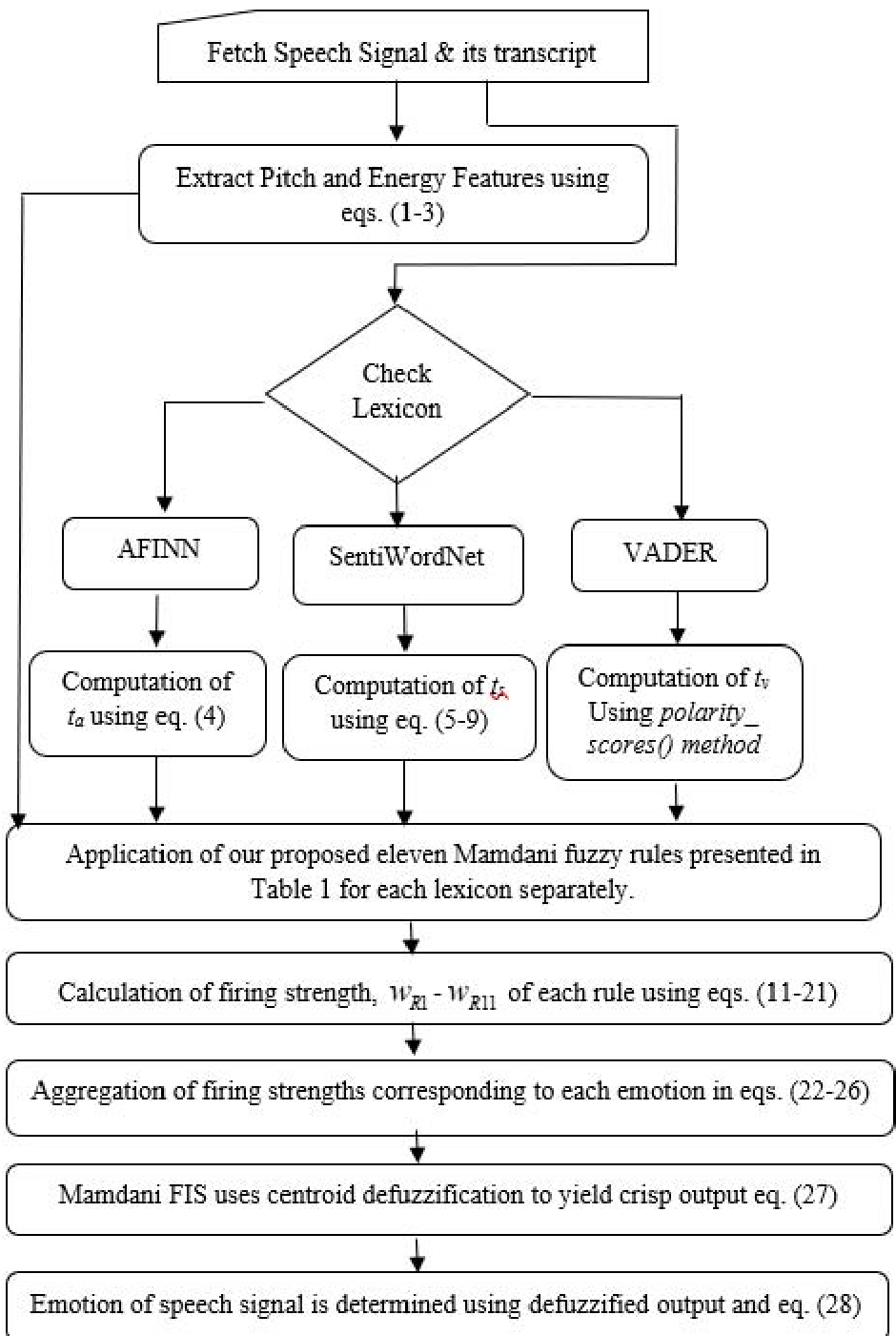 Fig 1: The dual-stream pipeline merging audio and text into the Fuzzy Inference engine.
Experiments & Results: Winning Without Training
The authors compared their FIS against six supervised heavyweights (Linear SVM, Gaussian SVM, Random Forest, MLP, and LSTM).
Key Performance Wins
- Superior Accuracy: The FIS achieved 52.67% on SAVEE, beating Random Forest (46.17%) and crushing LSTM (23.33%).
- The Cross-Dataset Miracle: In perhaps the most striking result, when an MLP was trained on SAVEE and tested on RAVDESS, its accuracy dropped to a useless 0.89%. The proposed FIS, being rule-based and unsupervised, maintained its performance (~52%) across both datasets without any retraining.
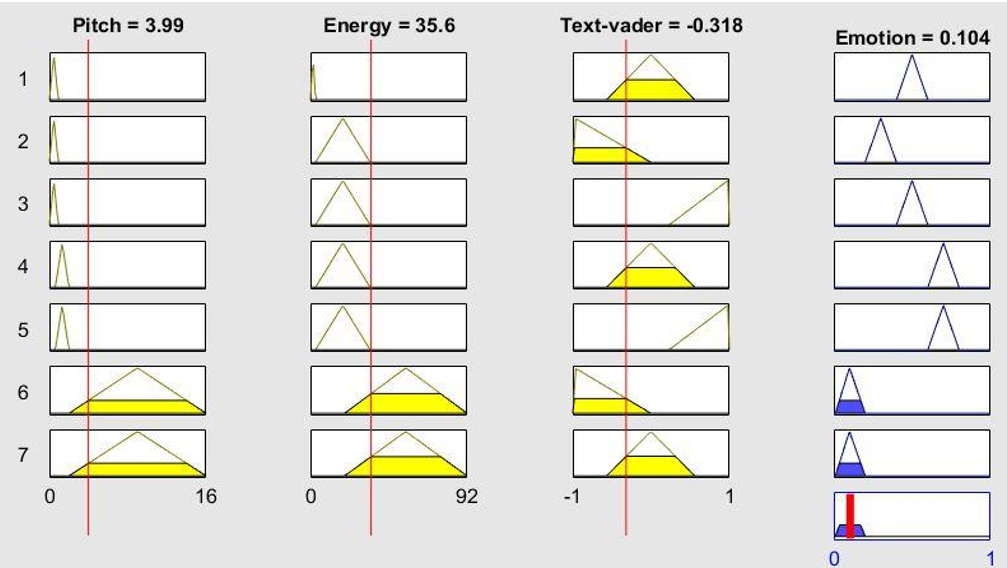 Fig 2: A case study showing how the FIS correctly identifies "Angry" from a specific audio sample.
Ablation Insight
The study confirmed that Multimodal Fusion is non-negotiable. Using "Only Speech" or "Only Text" resulted in significantly lower accuracies (~45% and ~20% respectively) compared to the combined ~52% score.
Critical Analysis & Future Outlook
Takeaway: This work is a wake-up call for the AI community. It proves that in domains where data is scarce or "fuzzy," a well-architected expert system can still outperform "black-box" Deep Learning. Its zero-shot capability makes it ideal for real-time edge devices (like smart assistants) that cannot afford high-latency inference or frequent retraining.
Limitations: While the system is robust, the current 11 rules are hand-crafted. Future iterations could benefit from Neuro-Fuzzy approaches, where the rules are fine-tuned via data without losing the interpretability of the fuzzy logic. Additionally, the system currently only tackles four primary emotions; expanding this to complex states like "frustration" or "sarcasm" will require more granular linguistic features.
Future Work: The authors plan to tackle "language disparities," such as social media slangs and code-switching (mixed languages), which are current blind spots for standard sentiment lexicons.