
PSIPD: Unveiling Urban Gems via Unsupervised Physical-Social Aware Sensing
Unsupervised Interesting Places Discovery in Location-Based Social Sensing
The paper introduces PSIPD (Physical-Social-aware Interesting Place Discovery), an unsupervised framework designed to identify "interesting" urban locations (e.g., museums, parks) using Location-Based Social Network (LBSN) data. By reformulating the discovery task as a Maximum Likelihood Estimation (MLE) problem, the system jointly estimates user travel experience and place interestingness without requiring labeled training data.
TL;DR
Discovering "interesting" places in a city usually requires massive labeled data or complex recommendation engines. This paper introduces PSIPD, a purely unsupervised framework that treats city discovery as a Maximum Likelihood Estimation problem. By factoring in how close places are (physical dependency) and who knows whom (social dependency), it outperforms supervised baselines, boosting precision by up to 33%.
The Blind Spots of Current POI Discovery
Most of us rely on apps to find the "best" spots in a new city. Behind the scenes, these apps typically use supervised learning. However, this creates two major hurdles:
- The Cold Start Problem: If a user hasn't checked in before, the system has no "ground truth" to provide personalized results.
- Ignored Dependencies: Current models often treat every check-in as an isolated event. They fail to realize that if you visit an aquarium, you're statistically likely to visit the planetarium next door (Physical Dependency), or that your travel tastes are influenced by your social circle (Social Dependency).
The authors argue that previous heuristic models assumed a linear relationship between experience and visits—essentially saying "more check-ins equals more interest"—which is often far from the truth in noisy, real-world data.
Methodology: The Power of EM in Latent Spaces
The core of the PSIPD (Physical-Social-aware Interesting Place Discovery) scheme is a rigorous analytical framework using the Expectation-Maximization (EM) algorithm.
1. Modeling the Dependencies
Instead of treating check-ins as independent variables, the model constructs:
- User-Place Matrix (UP): The raw observation of who visited where.
- Physical Dependency (PD): Joint distributions of places clustered by geographic proximity.
- Social Dependency (SD): A friendship matrix representing the social fabric of the users.
2. The MLE Framework
The problem is framed as finding the parameters (user experience and place interestingness) that maximize the likelihood of the observed check-ins.
- E-Step: Calculates the probability of a place being "interesting" (the latent variable ) based on current user experience estimates.
- M-Step: Updates user travel experience scores and the global "interestingness" prior based on the findings in the E-step.
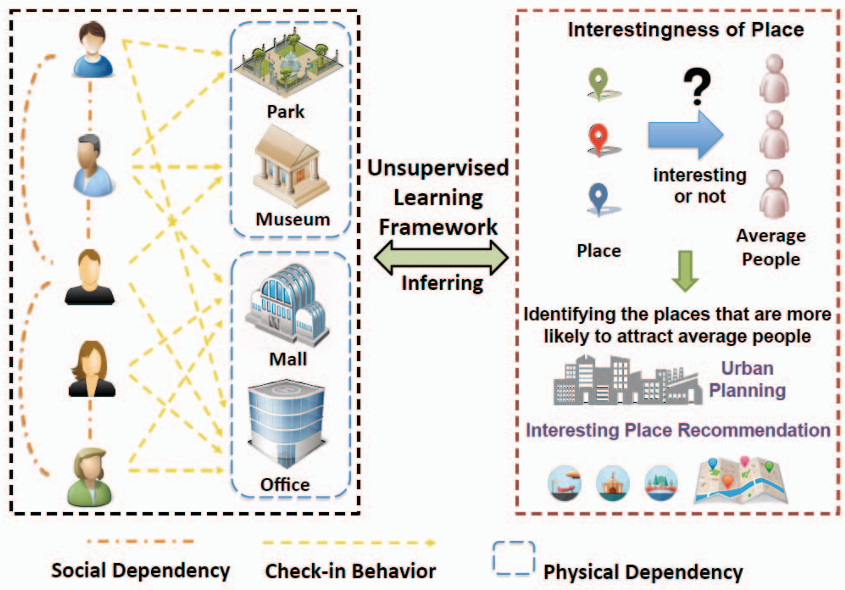 Figure 1: The PSIPD Framework structure, bridging Physical and Social spaces into a unified MLE model.
Experiments: Real-World Validation
The authors tested the scheme using historical data from Brightkite and Gowalla, focusing on the San Francisco area. They compared the full model (PSIPD-PS) against two variants (Physical-only and Social-only) and several heavy-weight baselines like HITS and GeoSoCa.
Key Performance Gains:
- Precision & Recall: In both datasets, the social-physical fusion (PSIPD-PS) consistently outperformed others. It isn't just about more data; it's about the structure of the data.
- Ranking Quality: Using NDCG (Normalized Discounted Cumulative Gain), the model showed that its top-ranked suggestions were significantly more likely to be verified "interesting" sites compared to traditional frequency-based voting.
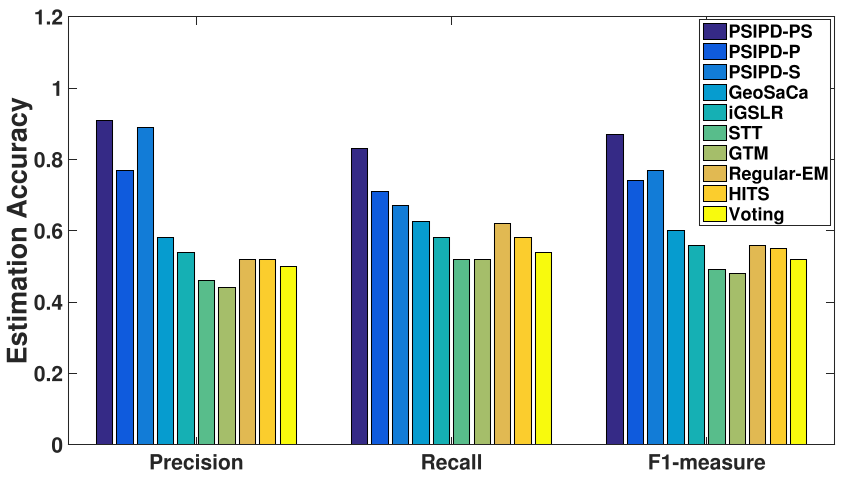 Figure 2: Performance comparison on Brightkite. Notice the significant gap between the PSIPD variants and standard baselines.
Critical Insights & Future Work
The success of PSIPD lies in its ability to treat noise as a signal. In social sensing, data is often sparse and unreliable. By enforcing physical and social constraints, the model effectively "denoises" the check-in data.
Limitations:
- Binary Assumption: Currently, the model treats "interestingness" as a binary state (Yes/No). In reality, interest levels are a spectrum.
- Dynamic Context: While it tracks changes over time via new data, it doesn't explicitly model the temporal decay of a place's popularity (e.g., a seasonal pop-up shop).
Future Outlook: The shift toward unsupervised discovery is crucial for privacy-preserving and decentralized social networks where central training sets are unavailable. Future iterations could integrate Natural Language Processing (NLP) to analyze the sentiment of check-in comments, adding a third "Semantic" layer to the existing physical and social dimensions.