
SVM+NLP: Enhancing Key-phrase Extraction via Linguistic Depth and Document Structure
Unsupervised key-phrases extraction from scientific papers using domain and linguistic knowledge
The paper introduces SVM+NLP, an unsupervised key-phrase extraction method for scientific documents. It combines Support Vector Machines (SVM) with deep linguistic features from the Stanford NLP parser to significantly outperform the state-of-the-art KEA system.
TL;DR
Researchers have developed a hybrid unsupervised method called SVM+NLP that moves beyond simple word counts. By leveraging the Stanford NLP Parser to understand the syntactic role of words and focusing on the structural "hotspots" of scientific papers (like titles and headers), this approach achieves a massive 27%-77% performance boost over the classic Bayesian KEA system.
Background: The Digital Library Challenge
In an era of exponential academic growth, manual categorization of millions of papers is impossible. While "author keywords" exist, they are often missing (absent in 95% of the authors' crawled dataset). The real challenge lies in unsupervised extraction—identifying the "implicit" key-phrases that human experts use to categorize a paper, even when they aren't explicitly labeled.
The Problem: The "Bag of Words" Limitation
Prior works often treat a scientific paper as a flat "bag of words." This ignores two critical facts:
- Contextual Role: A word’s importance changes if it’s a noun in the title versus a verb in a footnote.
- Structural Significance: Scientific papers have rigid structures. A phrase appearing in the "Conclusion" or "Section Header" is statistically more likely to be a key-phrase than one buried in the "Methodology" body text.
Methodology: Fusing SVM with Syntactic Trees
The core innovation of the SVM+NLP method is the integration of Penn Treebank tags and syntactic depth into the feature vector.
1. The Feature Set
Instead of relying only on TF-IDF, the authors constructed a 10-feature vector for every candidate phrase:
- Statistical: TF, IDF, and phrase length.
- Structural:
PART-OF-TEXT(where the phrase was found). - Linguistic (The Secret Sauce): For the first three tokens of a phrase, the model records their POS tags and their depth in the syntactic tree generated by the Stanford Parser.
2. Strategic Search
While TF and IDF are calculated using the entire document to ensure statistical accuracy, the SVM only "searches" for candidates within the titles, references, and section headers. This heuristic significantly reduces computational noise and targets high-value areas.
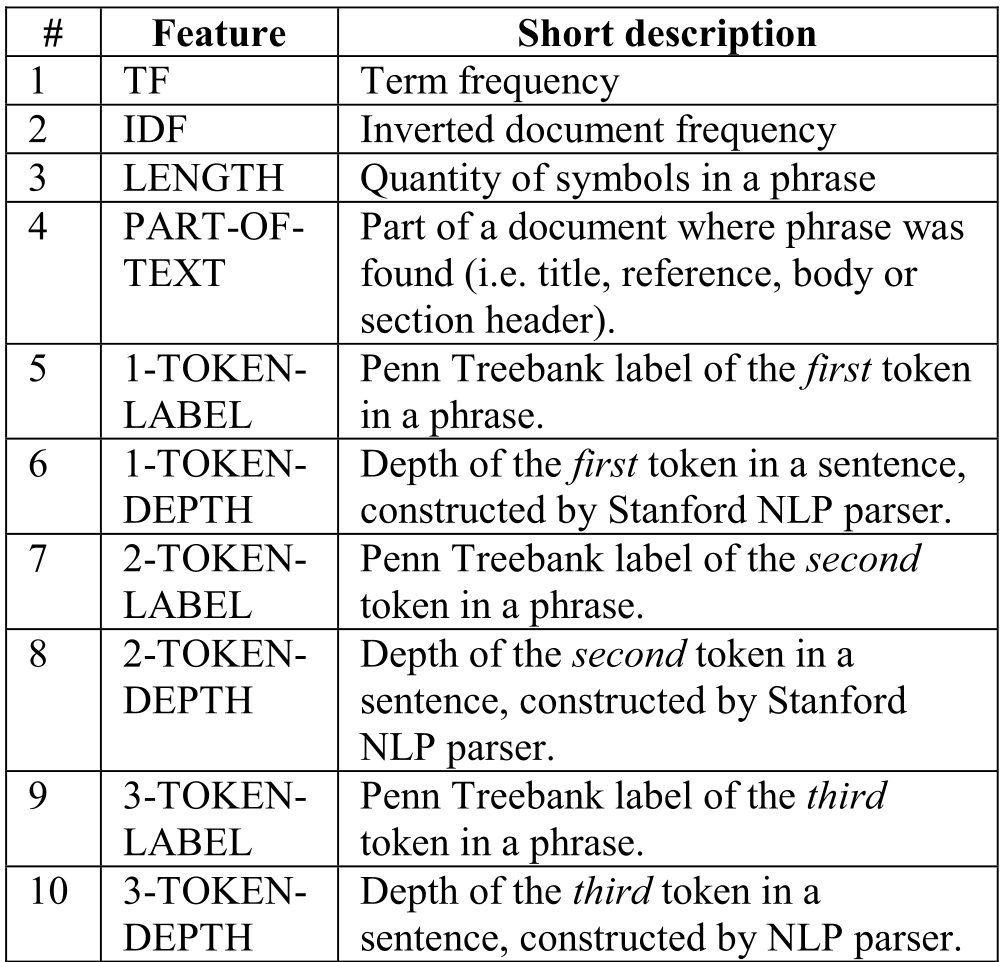 Table: The 10-dimensional feature set used for SVM training.
Experiments & Results: Stability Matters
The authors tested their method on 400 ACM papers, comparing it directly against the industry-standard KEA algorithm.
Key Findings:
- Superior Accuracy: SVM+NLP maintained an F-Measure of ~19.5% across different evaluation sets.
- Stability: Unlike KEA, which showed wild fluctuations in Precision and Recall (up to 323% dispersion), SVM+NLP remained consistent.
- Linguistic Impact: An ablation study showed that removing the NLP features (tags and tree depth) caused performance to crater (F-Measure dropped significantly), proving that grammar matters.
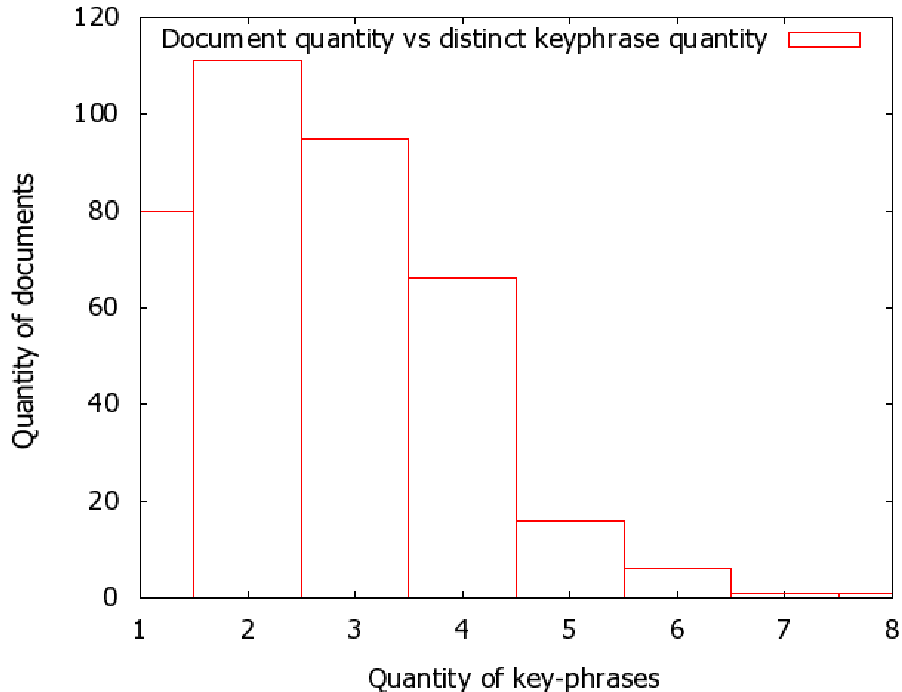 Figure: Distribution of unique expert-assigned key-phrases found within document texts.
Critical Insight: Why it Works
The success of this work lies in its Inductive Bias. By encoding the "Physical Intuition" that key-phrases are usually Noun Phrases found at shallow depths of a syntactic tree and located in prominent headers, the SVM can distinguish between a topical keyword like "Support Vector Machines" and a generic verb phrase like "can perform fast."
Conclusion & Future Outlook
While the SVM+NLP method is a major step forward for unsupervised extraction, it still struggles with semantic gap—it cannot find a key-phrase if the exact words never appear in the text (the "Key-phrase Assignment" problem).
The future of this field lies in moving from Syntactic analysis to Semantic analysis, potentially using manifold learning or latent space embeddings to assign topics that the author implied but never explicitly wrote.
Metadata Reference
- Dataset: 400 ACM Computer Science papers.
- Baseline: KEA (Bayesian).
- Key Tech: SVM (RBF Kernel), Stanford NLP Parser.