
Unsupervised Emotion Detection: Leveraging Word Embedding Geometry for Affective Computing
Unsupervised learning of fundamental emotional states via word embeddings
This paper introduces a completely unsupervised framework for detecting Ekman's six basic emotions (Anger, Disgust, Fear, Happiness, Sadness, Surprise) from short texts. By leveraging Word2Vec embeddings and cosine similarity, the authors map sentence-level vectors to emotion-specific vectors to quantify emotional intensity.
TL;DR
This paper proposes a zero-shot, unsupervised approach to classify short texts into Ekman's six basic emotions. By representing both sentences and emotional states as vectors in a shared semantic space (using Word2Vec), the authors calculate "emotional percentages" through cosine similarity. The method thrives in fine-grained emotion estimation, outperforming several established baselines on the SemEval 2007 "Affective Text" task without requiring a single training label.
Problem & Motivation: The Bottleneck of Labeled Data
In the era of social media, understanding public sentiment is vital for brands, politicians, and researchers. However, most high-performing models depend on supervised learning, which requires massive, manually labeled datasets. Labeling text for complex emotions like "Surprise" or "Disgust" is far more subjective and labor-intensive than simple binary (positive/negative) tagging.
The authors identify a gap: can we use the inherent semantic structure of language—captured by Word Embeddings—to detect emotions without oversight? They hypothesize that the "contextual geometry" of words like "war," "death," or "joy" in a high-dimensional space can act as a natural proxy for the emotions they evoke.
Methodology: From Words to Emotional Vectors
The core intuition lies in the linearity of word vectors. If , then a sentence vector (the mean of its word vectors) should logically gravitate toward the vector of its dominant emotion.
The Pipeline
- Preprocessing: Traditional tokenization and stopword removal, with a twist—emoticons are replaced with their representative emotion words, and punctuation (like "!" or "?") is preserved to maintain emotional intensity.
- Vectorization: Each word is mapped to a 300-dimensional vector using a model trained on Google News.
- Sentence Aggregation: The sentence vector is calculated as the sum of its constituent word vectors .
- Similarity Analysis: The system calculates the cosine similarity between the sentence vector and the vectors representing the six target emotions (e.g., the vector for the word "anger").
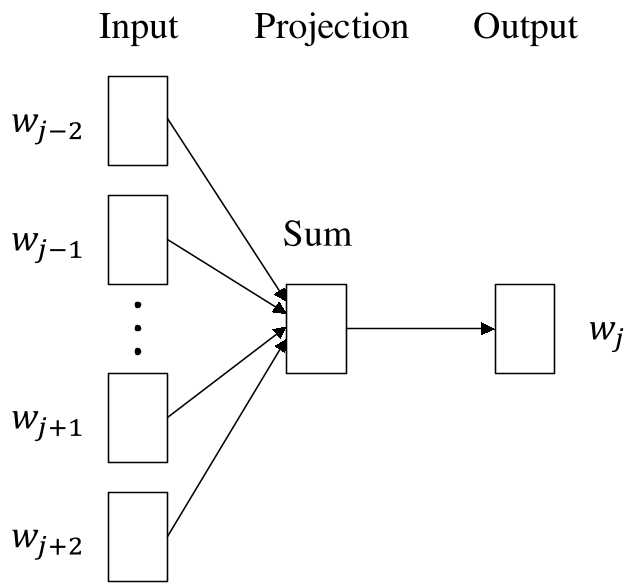 Fig 1: The CBOW and Skip-gram architectures used to generate the underlying word embeddings.
Probability Normalization
To transform raw similarity scores into a readable "percentage," the authors normalize the results so that the sum of all emotional scores for a sentence equals one, allowing for a "soft" interpretation of the text's emotional makeup.
Experiments & Results
The authors evaluated their model on two distinct datasets: a curated Twitter dataset (keyword: "Christmas") and the SemEval 2007 news headlines.
Fine-Grained Accuracy
In the SemEval task, the method was compared against eight other systems (including supervised Naive Bayes and rule-based systems). The results were striking:
- Pearson Correlation: The embedding-based method achieved the best performance in "fine-grained" evaluation for 3 out of 6 emotions.
- The "Fear" Factor: It significantly outperformed all other models in detecting "Fear," suggesting that the semantic context of fear-related words is particularly well-captured in the Google News corpus.
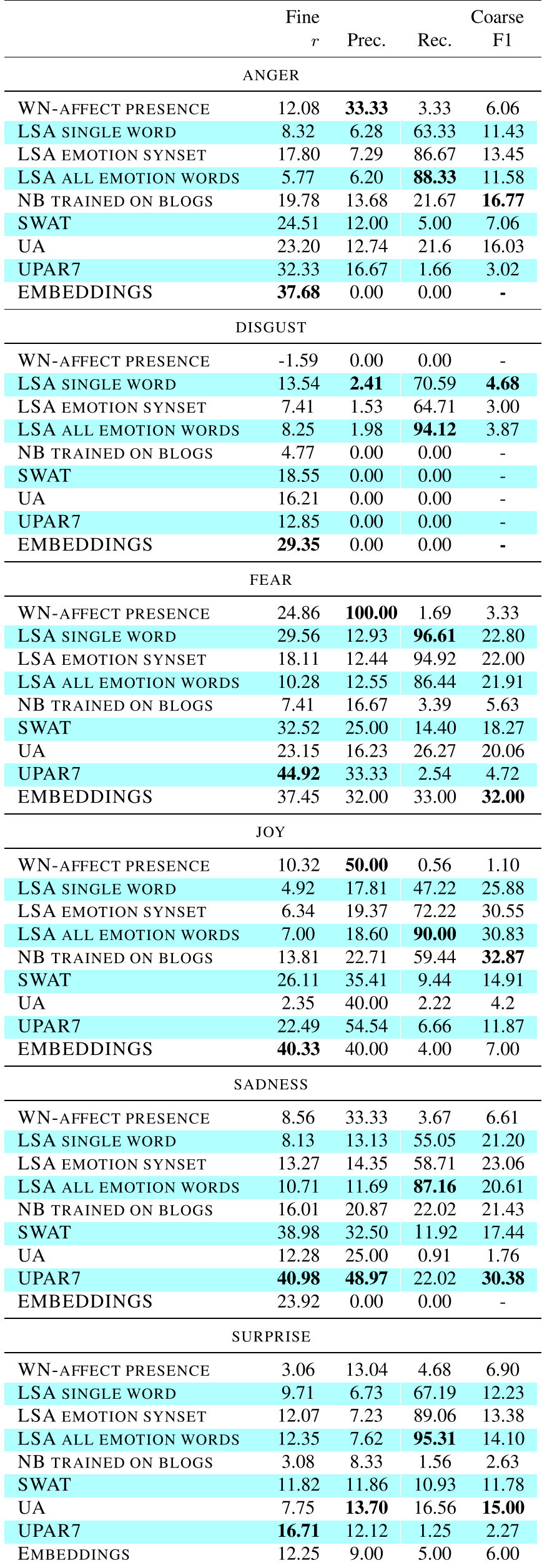 Table 1: Detailed comparison showing the embedding method's strength in fine-grained (Fine r) correlation.
Limitations
While the model excelled at identifying a dominant emotion and correlating with human scores, it struggled with multilabel classification (Coarse F1). This suggests that while the "direction" of the vector is accurate, the threshold for determining "presence" vs. "absence" of an emotion in a binary sense remains a challenge for unsupervised similarity-based models.
Critical Analysis & Conclusion
The true value of this work is its universality. Because it relies on general-purpose embeddings, it requires no domain-specific tuning. It treats emotions as fundamental directions in human language geometry.
Takeaways:
- Vector Geometry as Logic: The success of the method confirms that emotional affect is deeply embedded in the distribution of words.
- Efficiency: This approach is computationally "cheap" compared to fine-tuning Large Language Models (LLMs), making it ideal for edge computing or high-volume stream processing.
Future Outlook: The authors suggest that specialized "sentiment-aware" embeddings could further improve results, moving beyond general semantic similarity to specifically capture the affective "vibe" of terms.