
ESSA: Harnessing Social Media "Noisy Signals" for Unsupervised Sentiment Analysis
Unsupervised sentiment analysis with emotional signals
This paper introduces ESSA, a novel unsupervised sentiment analysis framework that leverages ubiquitous emotional signals in social media. By integrating post-level and word-level "emotion indication" (e.g., emoticons, lexicons) and "emotion correlation" (e.g., consistency theory, textual similarity) into a Matrix Tri-Factorization model, it achieves state-of-the-art performance on Twitter datasets without manual labeling.
Executive Summary
In the era of social media, sentiment analysis is no longer just about processing formal reviews; it involves deciphering a chaotic stream of emoticons, slang, and evolving expressions. ESSA (Emotional Signals for Sentiment Analysis) is a landmark paper that addresses this by moving beyond rigid lexicons.
TL;DR: The authors transform ubiquitous "noisy" signals—like emoticons and word co-occurrences—into mathematical constraints within a Matrix Tri-Factorization framework. This allows the model to "learn" sentiment in a completely unsupervised manner, outperforming traditional baselines by nearly 18% in accuracy.
The Motivation: Why Lexicons Fail the "Twitter Test"
Traditional sentiment analysis usually relies on lexicon-based methods (matching words against a dictionary) or supervised learning (requiring thousands of hand-labeled tweets). Both struggle on social media:
- Informal Language: Dictionaries don't include "coooool" or "smh".
- Cold Start Problem: Labeling data for every new event (e.g., a specific political debate) is prohibitively expensive.
- Context Blindness: Words change polarity depending on the domain.
The authors' insight? Social media users already provide "pseudo-labels" via emoticons (emotion indication) and follow social laws like consistency theory (emotion correlation). If you use a happy face, your words are likely positive; if two words appear together in a short tweet, they likely share the same sentiment.
Methodology: The ESSA Framework
The core of ESSA is Orthogonal Nonnegative Matrix Tri-Factorization (ONMTF). Unlike standard clustering, which just groups similar documents, ESSA adds "guidance" through four specific emotional signals.
1. The Core Architecture
The model factorizes the post-word matrix into three components: (post-sentiment), (word-sentiment), and (the sentiment-word relationship).
 Note: The framework integrates signals at both the post level (top-left) and word level (bottom-right).
2. Modeling the Signals
- Emotion Indication (Indictive Bias): It forces the learned matrix to be close to an "indication matrix" if an emoticon is present.
- Emotion Correlation (Manifold Regularization): It uses Graph Laplacians to ensure that if two posts are textually similar, their sentiment labels in are close.
Experiments & Results
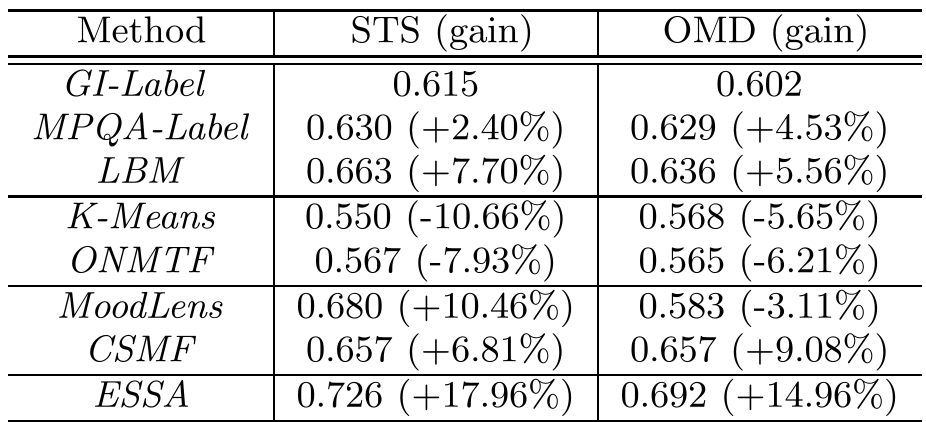
The authors tested ESSA against two Twitter datasets: STS (Stanford Twitter Sentiment) and OMD (Obama-McCain Debate).
SOTA Comparison
ESSA doesn't just win; it dominates. Compared to the widely used GI-Label approach, ESSA improved accuracy by 17.96% on the STS dataset. It also beat MoodLens, which only uses emoticons, proving that a unified approach is superior to relying on a single signal.
The "Knockout" Study
By "knocking out" different signals (setting their weights to zero), the authors discovered:
- Word-level indication is the most powerful single signal.
- Combination is Key: Removing any signal leads to a performance drop, confirming that indicators (emoticons) and correlations (co-occurrence) are complementary.
Critical Insight: Beyond Content
The brilliance of ESSA lies in its departure from the i.i.d. (independent and identically distributed) assumption. Traditional NLP treats every tweet as an isolated island. ESSA treats social media as a Relational Network, where sentiment flows between words and posts.
Limitations & Future Work
While ESSA is powerful, it treats signals with fixed weights. In reality, some emoticons are sarcastic, and some word co-occurrences are coincidental. Future iterations could benefit from Attention Mechanisms to dynamically weight these signals based on context.
Takeaway for the Industry
For developers building sentiment engines for live feeds: Stop relying solely on dictionaries. By tapping into the metadata (emoticons) and the graph structure of text, you can build highly accurate, domain-specific models without ever hiring a human annotator.