
Unsupervised Social Spammer Detection: Leveraging the Beta Mixture Model
An Unsupervised Approach for Identifying Spammers in Social Networks
This paper introduces a novel unsupervised framework for detecting spammers in social networks by analyzing link structure. Using Communication Reciprocity (CR) as a feature, it employs a Beta Mixture Model (BMM) with EM optimization and ICL-BIC selection to differentiate between legitimate users and spammers, matching the performance of supervised SVM baselines.
Executive Summary
TL;DR: This paper presents a fully unsupervised approach to identifying spammers in social networks by analyzing communication reciprocity. By fitting a Beta Mixture Model (BMM) to network interaction scores, the system automatically clusters "malicious" nodes without requiring any labeled training data, achieving results comparable to state-of-the-art supervised Support Vector Machines (SVM).
Academic Context: Most spam detection systems are "hungry" for labels. This work shifts the paradigm toward Unsupervised Learning, proving that the inherent link structure of a network—specifically how often people reply to messages—is enough to distinctively flag spammers with high precision.
Problem & Motivation: The Bottleneck of Labeled Data
Supervised methods like MailNet or Random Forest classifiers are effective but limited by the "labeling wall." In dynamic social environments, spammers evolve daily, making it expensive and slow to gather ground-truth labels.
The author's core Insight is rooted in social psychology and network topology. Legitimate users engage in reciprocal interactions (they reply to each other), whereas spammers engage in a "broadcast" pattern: sending thousands of messages with near-zero response rates. This creates a distinct statistical signature in the network's link structure.
Methodology: The Power of Communication Reciprocity
The framework operates in two primary stages:
1. The Metric: Communication Reciprocity (CR)
CR measures the probability of a node receiving a response from its neighbors. Where are accounts node messaged, and are accounts that messaged . For spammers, tends toward zero.
2. The Statistical Engine: Beta Mixture Model (BMM)
Why use the Beta Distribution? Unlike Gaussian distributions, the Beta distribution is defined on the interval and is incredibly flexible—it can be U-shaped, J-shaped, or skewed. This makes it perfect for modeling "scores" or "probabilities."
The author employs the EM (Expectation-Maximization) Algorithm to fit the mixture:
- E-step: Calculate the posterior probability that a user belongs to a specific cluster (spammer vs. legitimate).
- M-step: Update the shape parameters () of the Beta distributions to maximize the likelihood of the observed data.
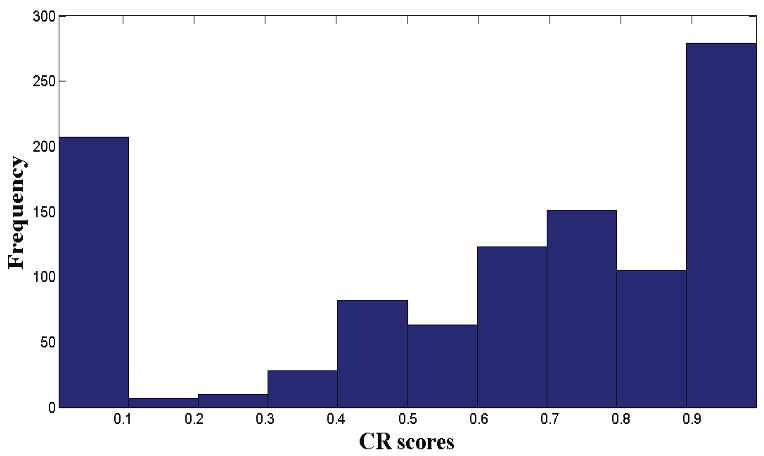 Fig 1: The BMM successfully fits the bimodal nature of social interactions, isolating the "spammer spike" near zero.
Experiments & Results
The method was tested against simulated spam in the URV email network and real-world data from Yahoo! Answers.
SOTA Comparison
In a head-to-head battle with MailNet (Supervised SVM), the unsupervised BMM showed remarkable resilience. As the number of spammers increased, the BMM maintained an average Accuracy of 93%, actually yielding a lower False Positive Rate (4.6%) than the supervised baseline (6.08%).
Real-World Validation: Yahoo! Answers
The author analyzed 167,455 accounts and identified ~32,000 spammers. To verify accuracy without labels, they analyzed the content quality of the flagged accounts.
- Finding: 70% of legitimate users had high-quality content scores, while the identified spammers consistently produced low-quality/junk content, validating the topological detection.
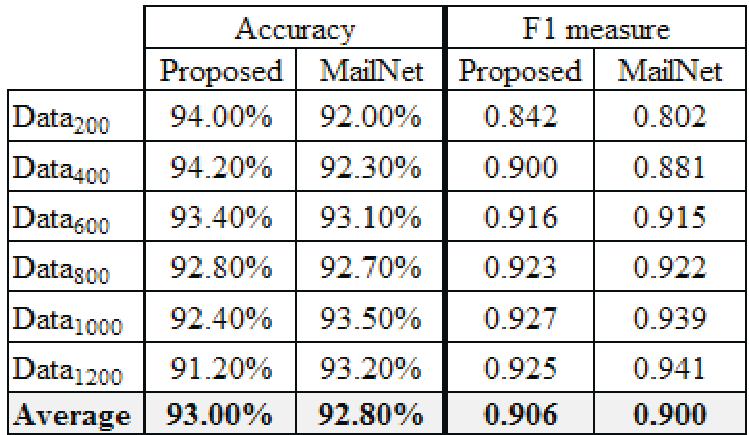 Fig 2: Consistency of BMM vs. MailNet across different spam densities.
Critical Analysis & Conclusion
Takeaway
The success of this method proves that reciprocity is a fundamental law of human social interaction. When an agent violates this law (by not receiving replies), it is statistically distinct enough to be captured by a mixture model without a single human label.
Limitations
The primary weakness lies in "Sophisticated Spammers." If a spammer manages to elicit even a 10-20% reply rate (through social engineering or "spam-each-other" rings), their CR score might migrate into the legitimate user component, leading to False Negatives.
Future Outlook
The author suggests a multi-modal approach: combining this topological BMM with textual "alienness" measures. Future platforms could use this as a "first-pass" filter to flag suspicious accounts for deeper content inspection.