
UUBP: Making Smart Homes "Human" Through Neural Networks and Artificial Forgetting
An Unsupervised User Behavior Prediction Algorithm Based on Machine Learning and Neural Network For Smart Home
This paper introduces the Unsupervised User Behavior Prediction (UUBP) algorithm designed for smart homes. It combines an Artificial Neural Network (ANN) for self-organized initialization with a unique forgetting factor mechanism to achieve high-accuracy behavior forecasting from historical device operation data.
TL;DR
Researchers have developed the Unsupervised User Behavior Prediction (UUBP) algorithm, a system that learns your home habits without being told what to look for. By combining a self-organizing Neural Network with a "forgetting factor" based on human psychology, it identifies your most recent routines while gracefully letting go of old habits.
Background: Within the IoT landscape, "intelligence" is often just remote control or simple "if-this-then-that" rules. High-level intelligence requires a system to anticipate user needs. UUBP moves the needle from "reactive" to "predictive" by mining mass historical data autonomously.
The "Static Data" Trap
Prior Work in behavioral modeling usually treats every data point—whether it happened yesterday or three years ago—with equal weight. This is a fundamental flaw. If you used to wake up at 7:00 AM for work but recently retired and now wake up at 9:00 AM, a standard K-means algorithm will "pollute" your current profile with three years of irrelevant 7:00 AM data.
Furthermore, traditional clustering requires a human to specify the number of clusters (). How is a system supposed to know how many distinct "behaviors" a user has across 10 different devices?
Methodology: The Architecture of Memory
The UUBP algorithm breaks the mold through two primary innovations:
1. Self-Organized Initialization via ANN
Instead of guessing the number of behaviors, UUBP uses a 5-layer Artificial Neural Network (ANN).
- Auto-encoding: The first three layers act as an auto-encoder to reduce dimensionality and filter noise.
- Competitive Learning: The final layers use a competitive "Winner-Take-All" approach to naturally group similar behaviors into clusters without manual input.
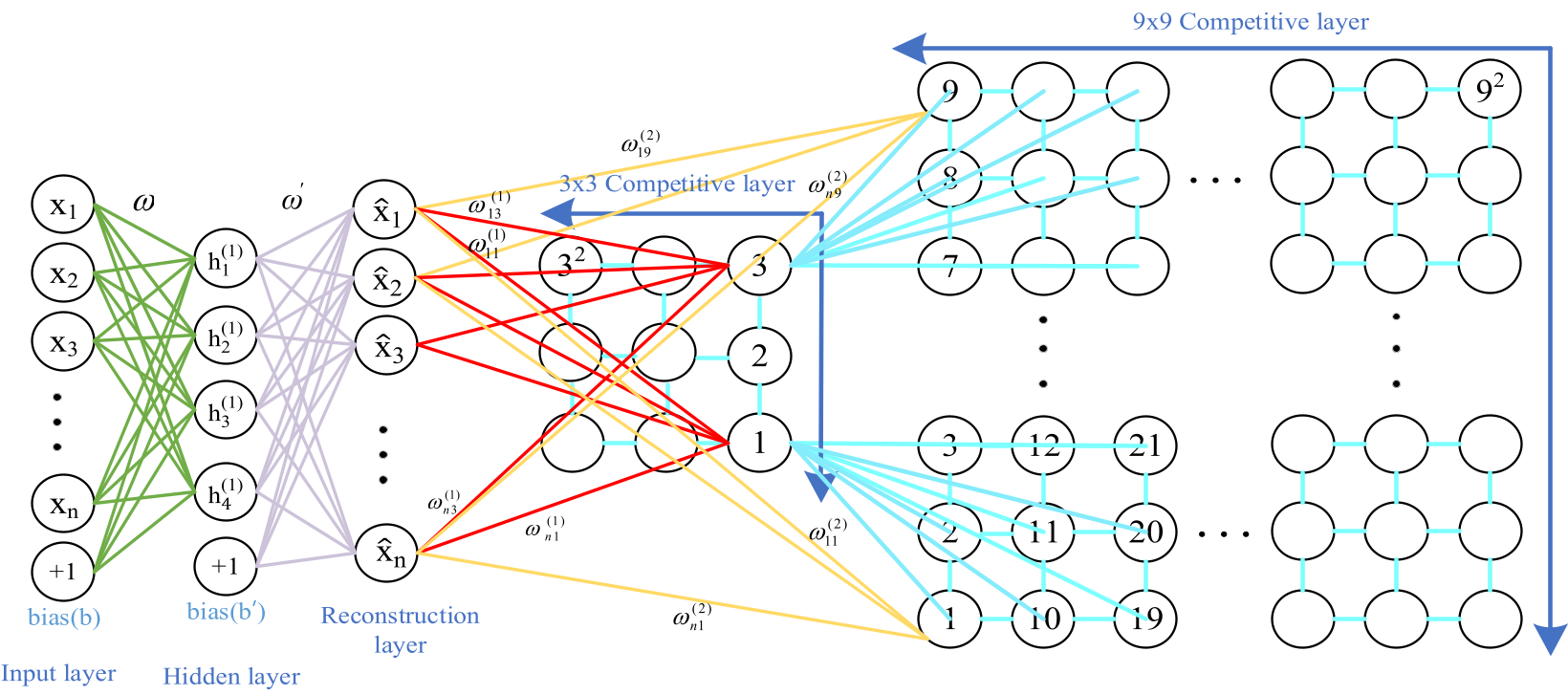 Figure: The proposed ANN framework featuring reconstruction and competitive layers.
2. The Ebbinghaus Forgetting Factor
To solve the problem of stale data, the authors integrated the Ebbinghaus Forgetting Curve. They proposed an Equal Probability Model (a series of concentric rings representing time periods).
- The Logic: Recent records are assigned to outer rings with higher "probability parameters" (), resulting in a larger weight in the centroid calculation.
- The Physics: As time passes, older records effectively "evaporate" from the model's decision-making process, ensuring that the predicted behavior (e.g., turning on the toaster) aligns with current lifestyle habits.
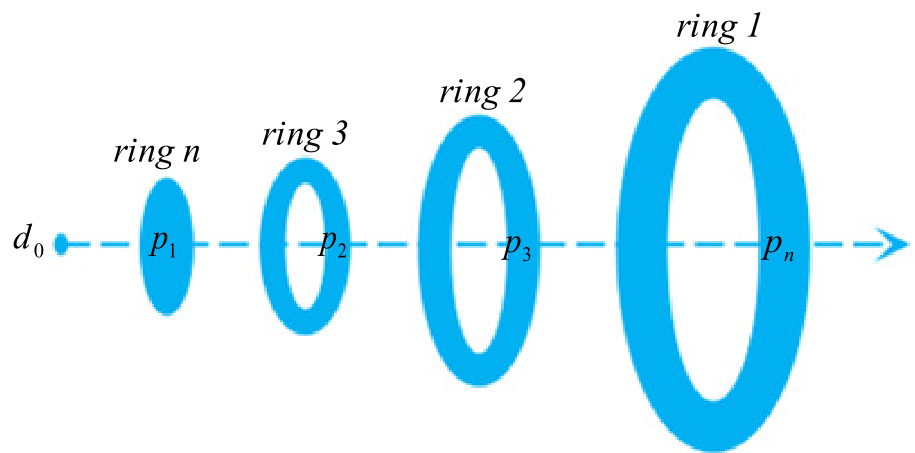 Figure: The Equal Probability Model used to calculate temporal weights.
Experimental Results: SOTA Performance
The team tested UUBP against K-means, SOMNN, and DBSCAN using nearly 60,000 real operation records. They utilized three critical metrics:
- Compactness Index (CP): How tightly grouped the behaviors are.
- Separation Index (SP): How distinct different behaviors are from one another.
- Davies-Bouldin Index (DB): The overall efficiency of the clustering.
UUBP achieved the lowest DB index across all test cases (Research Center, Test Room, and Exhibition Hall), proving that it creates the most logically sound behavioral profiles.
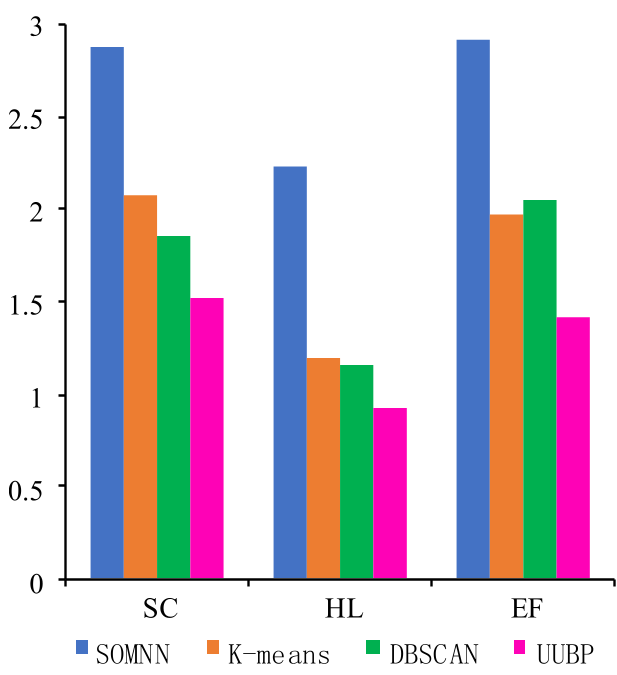 Figure: Comparison of CP values highlighting UUBP's superior compactness.
Critical Insight & Future Outlook
Takeaway: The move from "static mining" to "temporal mining" is non-negotiable for personalized AI. UUBP proves that unsupervised models can be both autonomous (no required) and adaptive (forgetting factor).
Limitations: Currently, UUBP looks at devices in isolation. The authors admit the next frontier is associative behavior mining. A truly smart home shouldn't just know you use the toaster at 9:00 AM; it should know that after you use the toaster, you almost always turn on the coffee maker and then the shower. Mining these "activity chains" is the next step toward a seamless "confidant" AI.
Conclusion
By mimicking the human brain's ability to prioritize the "now" while letting go of the "then," UUBP provides a robust framework for the next generation of context-aware smart homes.