
PathCloak: Leveraging DSRC Radios to Render Connected Cars Untraceable
Making Connected Cars Untraceable via DSRC Radios
This paper introduces PathCloak, a cooperative location privacy framework for connected cars. It utilizes DSRC (Dedicated Short-Range Communication) to exchange kinematic data between vehicles, enabling them to generate mutually obfuscating "false pathlets" that prevent central servers from tracking user trajectories while maintaining high traffic data utility.
TL;DR
Connected vehicles are a privacy nightmare—frequent location updates to traffic servers allow for precise trajectory tracking even if IDs are anonymized. PathCloak resolves this by using short-range DSRC radios to let nearby cars "swap" plausible fake paths. In real-world Seoul road tests, it achieved a tracking success ratio of less than 1% while preserving the utility of traffic data (90%+ accuracy).
The Tracking Paradox: Why Anonymity is Not Privacy
Modern traffic applications (Waze, Google Maps) require high-frequency GPS updates to estimate congestion. Even if you change your network ID every second (e.g., via Tor), a server can use a "footstep-following" attack. By analyzing the time-series of coordinates, advanced spatial-temporal recurrent neural networks (ST-RNN) can reconstruct your path with high confidence.
Existing solutions like Mix-zones require vehicles to be at the exact same place at the exact same time—a rare event. False Trips, on the other hand, flood the server with 100x noise to protect one user, destroying the data's utility for urban planning.
Methodology: The Art of Cooperative Confusion
PathCloak's "Aha!" moment is the use of the vehicle's two network interfaces simultaneously:
- DSRC (Local): A short-range radio (300m-400m) used to find a "privacy partner."
- LTE/5G (Cloud): Used to report location data to the server.
How Pairing Works
When Vehicle A and Vehicle B are within DSRC range, they analyze each other's kinematics (speed, heading). If they determine their paths can plausibly converge in the near future (the window), they initiate a PathCloak operation.
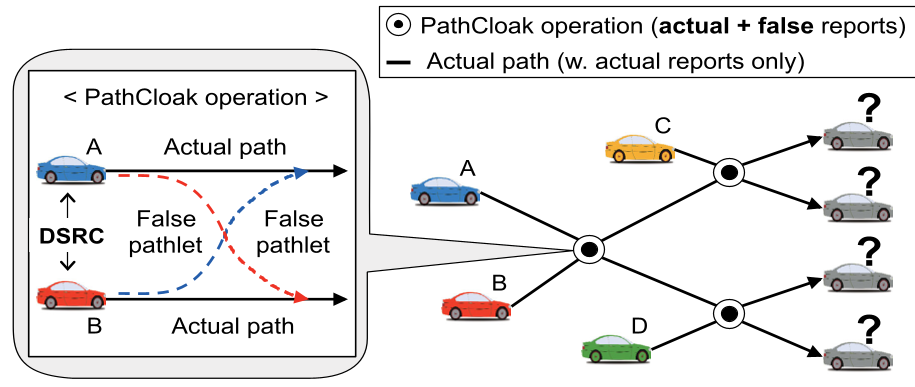
Each vehicle then reports two locations to the server:
- The Actual Path: Its real physical location.
- The False Pathlet: A plausible route generated for its partner, ending at a "Convergence Point" .
To the server, it looks like two paths split and merged, making it mathematically ambiguous which vehicle went where.
Real-World Feasibility: Seoul Road Experiments
The authors didn't just simulate; they built a prototype using Raspberry Pis and DSRC units. They tested 8 different driving "Experiment Sets," ranging from perpendicular approaches to U-turns.
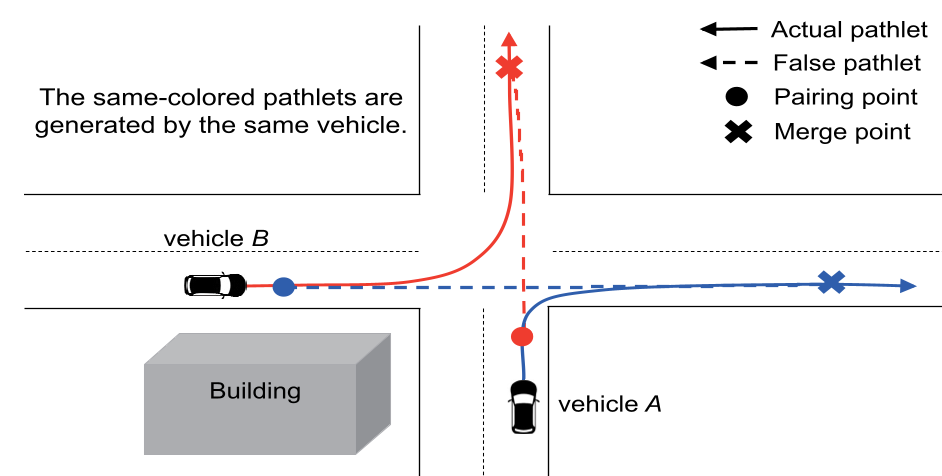
- Success Rate: In most scenarios (like making right turns or moving straight), the pairing rate was above 80%.
- Speed Matters: High speeds and low speed differences between cars actually improved the pairing success, as it makes path convergence more predictable.
- Infrastructure Impact: In Non-Line-of-Sight (NLOS) intersections (buildings blocking signals), the pairing rate dropped because the DSRC "window of opportunity" was too short.
Results: Privacy meets Utility
The researchers tested PathCloak against an adversary using ST-RNN (Spatial-Temporal Recurrent Neural Networks), the gold standard for trajectory prediction.
- Entropy: In medium-to-high density traffic, a 20-minute drive yielded over 7 bits of entropy, meaning a tracker would be confused between 128 possible locations.
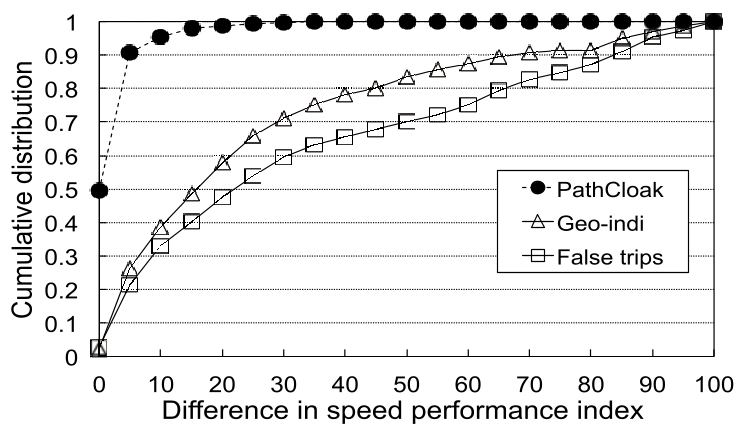
- Utility Preservation: Unlike previous noise-heavy methods, PathCloak resulted in only a 5% difference in traffic congestion estimation compared to raw, unprotected data.
Critical Insight & Future Outlook
The genius of PathCloak lies in its incentive structure. A selfish user might refuse to generate fake paths for others, but doing so would actually expose their own path (as the "confusion" is mutual). This "mutual defense" ensures cooperation.
However, the system currently assumes vehicles are following a navigation route. It also doesn't yet account for traffic light timing—a smart tracker might notice a "fake" car passing a red light. Integrating computer vision to synchronize fake pathlets with real-world traffic signals is the next logical step for this research.
In conclusion, PathCloak demonstrates that the DSRC hardware already being mandated for safety can be the ultimate tool for reclaiming privacy on the open road.