
Urban Emotions: Bridging Bio-Sensors and Crowdsourcing for Human-Centric Urban Planning
Urban Emotions—Geo-Semantic Emotion Extraction from Technical Sensors, Human Sensors and Crowdsourced Data
The paper introduces "Urban Emotions," a human-centered framework for extracting geo-semantic emotion data using a trans-disciplinary approach. It combines technical bio-sensors (wristbands), human sensors (People as Sensors LBS), and crowdsourced data (Twitter) to provide real-time emotional insights for urban planning.
TL;DR
The "Urban Emotions" project proposes a multi-layered framework to capture how citizens feel about their urban environment. By synchronizing wristband bio-sensors with a "People as Sensors" app and applying semi-supervised learning to Twitter data, the researchers have created a way to map the emotional pulse of a city, providing urban planners with a qualitative layer of data never before available in real-time.
Motivation: The Missing Human Element in Smart Cities
For decades, the "Smart City" concept has focused on technical nodes—traffic flow, energy grids, and digital infrastructure. However, the authors argue that a city is an "actuated multi-dimensional conglomerate" where citizens are the central sensors.
The core problem is that technical sensors (measuring heart rate or skin conductance) are "trigger-blind": they know when you are excited or stressed (an emotional spike), but they don't know why. Conversely, social media data is context-rich but often geographically sparse or textually messy. The motivation here is to close the loop between the "what" (biometrics) and the "why" (contextual feedback).
Methodology: The Urban Emotions Framework
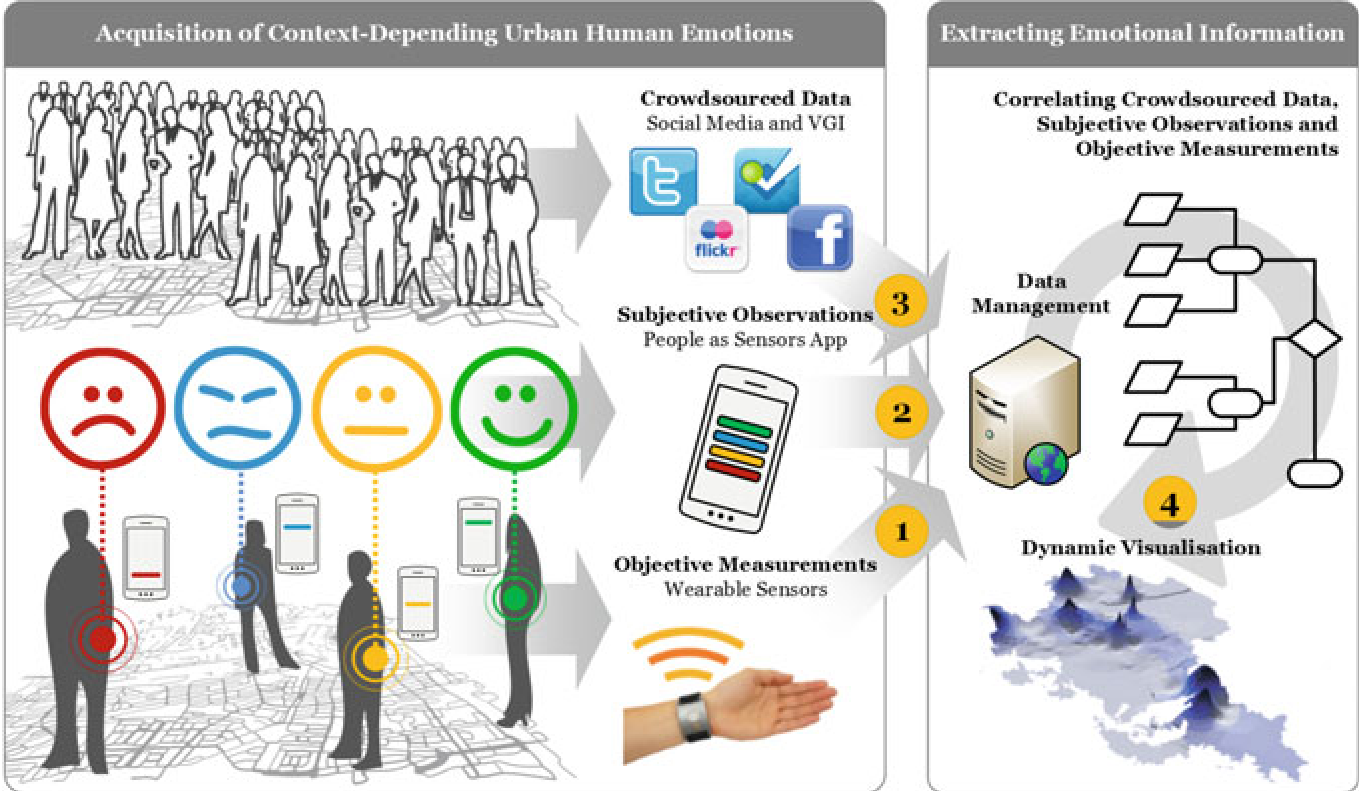
The methodology is structured into a four-step pipeline that integrates heterogeneous data sources:
- Detection: Using wristbands to measure physiological parameters (skin conductance, heart rate).
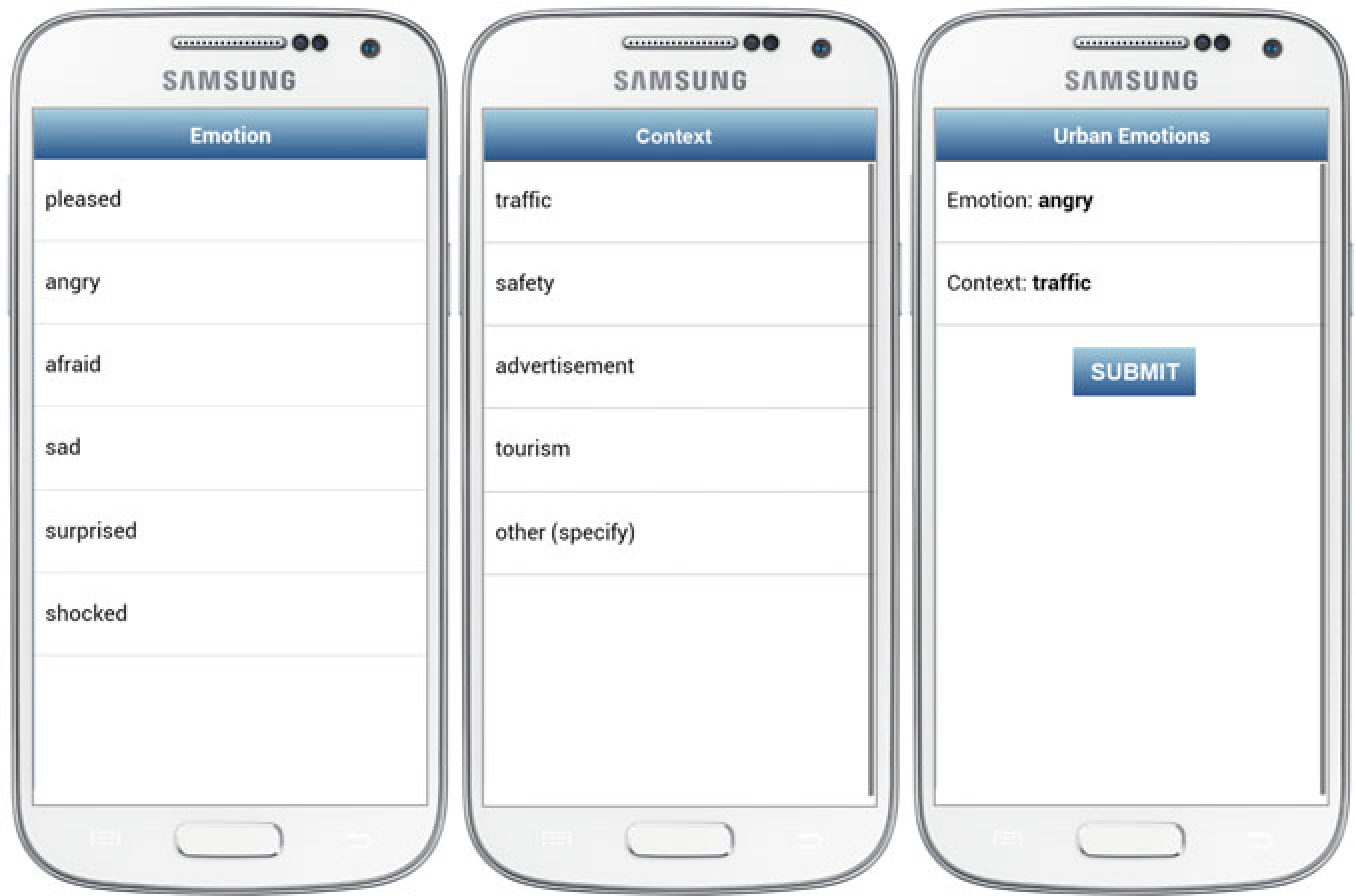
- Ground-Truthing: When a spike is detected, the "People as Sensors" LBS app prompts the user to input the specific emotion (e.g., Fear, Joy) and the context.
- Extraction: Harnessing Twitter data using a trans-disciplinary algorithm.
- Correlation: Mapping these data points to assist urban decision-making.
Graph-Based Semi-Supervised Learning (SSL)
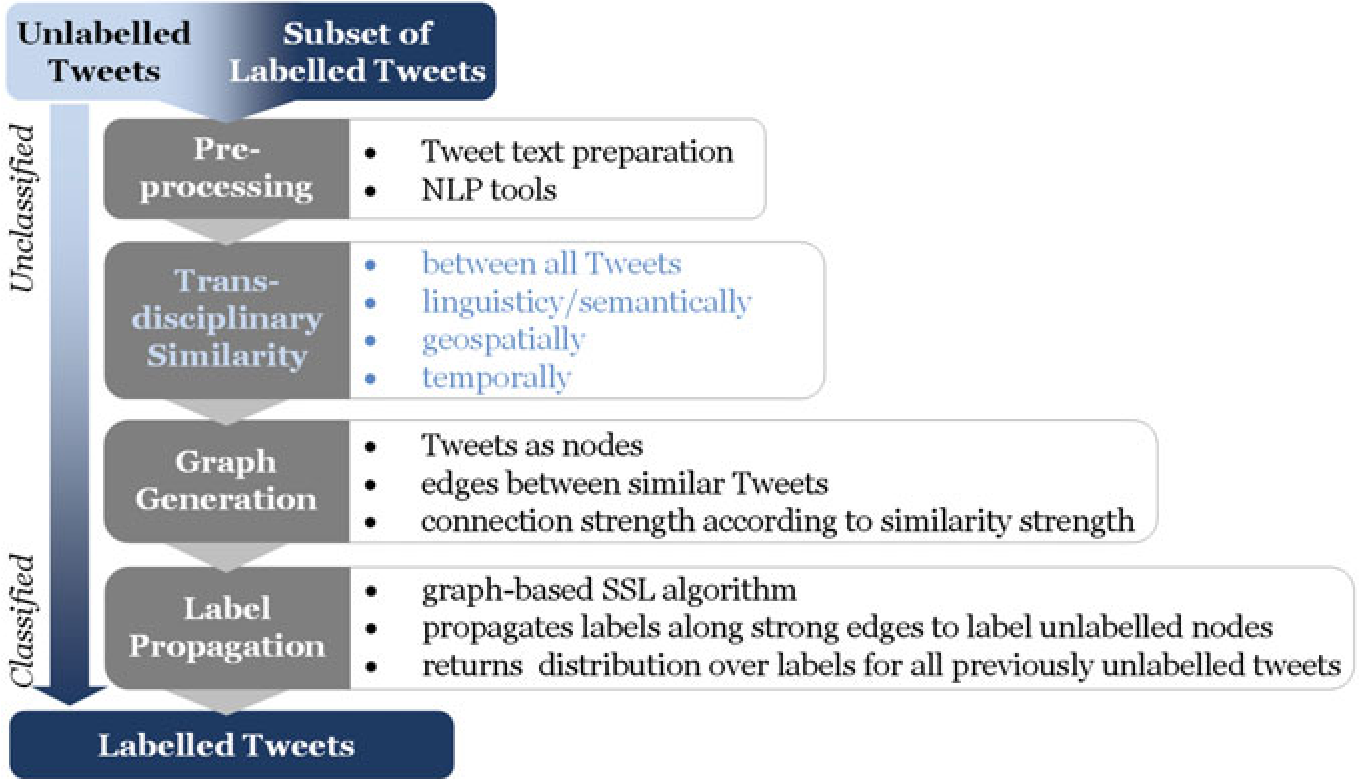
The most technical innovation lies in the emotion extraction from Twitter. Instead of relying on massive labeled datasets (Supervised Learning), the authors use the Modified Adsorption (MAD) algorithm.
The algorithm builds a graph where nodes are Tweets and edges represent Similarity. Most CL approaches only look at semantic similarity. This paper applies Tobler’s First Law of Geography: "Everything is related to everything else, but near things are more related than distant things." By factoring in geographic and temporal distance alongside semantic content, the model can accurately propagate labels from a few "seed" tweets to thousands of unlabeled ones.
Experiments: Real-World Stress Tests
The framework was tested during two high-emotion events:
- New York Fashion Week 2014
- Boston Marathon 2013
By analyzing georeferenced tweets within these specific bounding boxes (BBOX), the authors proved they could detect "emotional hot spots." For instance, they could identify areas of fear or anger during the Boston Marathon bombing aftermath or joy during major public events.
Results & Impact
The study highlights that "Mental Maps"—once drawn by hand—can now be generated through digital traces. The integration of Ekman’s Six Basic Emotions (Joy, Anger, Fear, Sadness, Surprise, Disgust) provides a standardized lexicon for planners to evaluate if a new park designs evoke "Joy" or if a specific intersection induces "Fear."
Critical Analysis & Conclusion
Takeaway: Urban planning is no longer just about concrete and steel; it’s about the "well-being" of the citizen layer. The integration of SSL and GIS creates a scalable way to monitor urban health.
Limitations:
- In-situ Assumption: The method assumes people tweet exactly where and when they feel something. In reality, there’s often a lag.
- Demographic Bias: Twitter users represent a specific demographic, possibly skewing the "emotional profile" of a neighborhood.
Future Work: The authors aim to refine the "People as Sensors" UI with a "color wheel" for complex emotions and expand to diverse crowdsourced repositories beyond Twitter.
By treating humans as the ultimate urban sensors, "Urban Emotions" offers a blueprint for a future where cities are built not just for efficiency, but for psychological comfort.