
Urbiflock: Rethinking Social Connectivity in a Pervasive World
Urbiftock: An experiment in Dynamic Group Management in Pervasive Social Applications
The paper introduces Urbiflock, a distributed object-oriented framework for pervasive social applications. It leverages the AmbientTalk language to manage Dynamic User Groups via intensional descriptions and provides the TOTAM messaging system for context-aware, multi-hop communication in mobile ad hoc networks (MANETs).
TL;DR
Urbiflock is a mobile framework designed to move social networking away from static profiles and into the physical realm. By treating user groups as dynamic, rule-based entities rather than simple lists, it allows mobile devices to automatically form social clusters (e.g., "nearby badminton players") and communicate via decentralized, multi-hop messaging in ad hoc environments.
Status: Academic prototype and framework for pervasive social computing.
The Problem: Social Networks are "Static Reports"
Most social media platforms (Facebook, etc.) are effectively digital diaries. They require manual intervention: you add a friend, you join a group, you post a status. This model fails in Pervasive Social Applications, where users are physically moving and connectivity is intermittent.
Prior works (like MyNet or BT Communities) suffered from three critical gaps:
- Discovery Gap: Difficulty in finding users "on the move" without central servers.
- Organization Gap: Relegating groups to simple, manual lists (the "Buddy List" problem).
- Communication Gap: The inability to route messages through a changing topology of moving handsets.
Methodology: Semantic & Composite Groups
Urbiflock’s core innovation is moving from extensional lists (listing every member) to intensional descriptions (defining the criteria for membership).
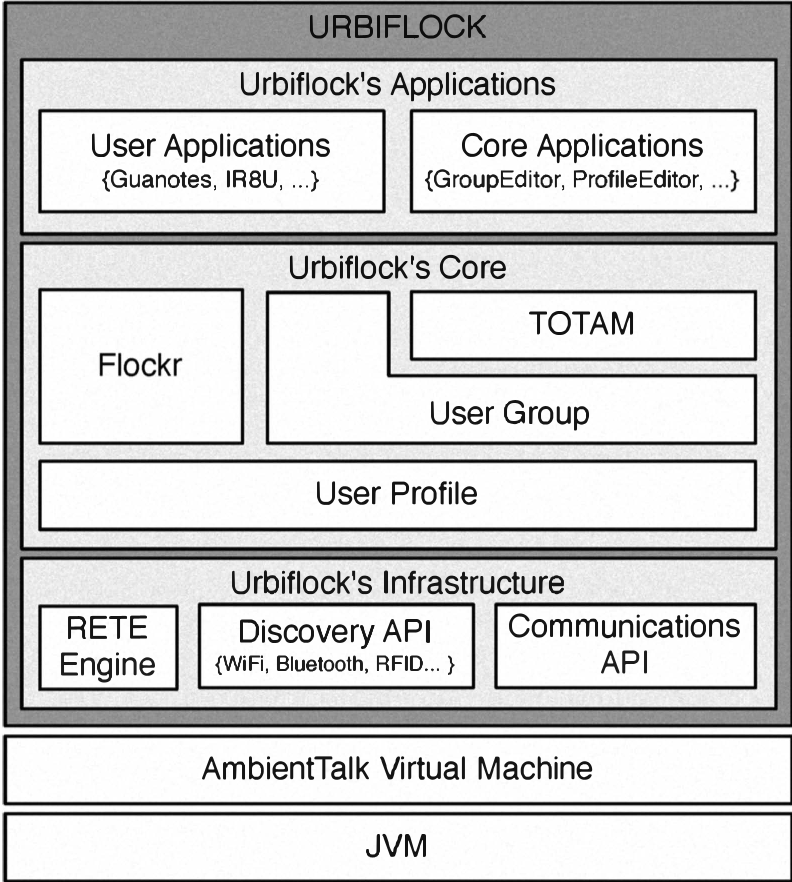
1. The Architecture
The framework is built on AmbientTalk, an actor-based language specifically designed for the "noise" and connectivity drops of mobile ad hoc networks.
2. Group Composition
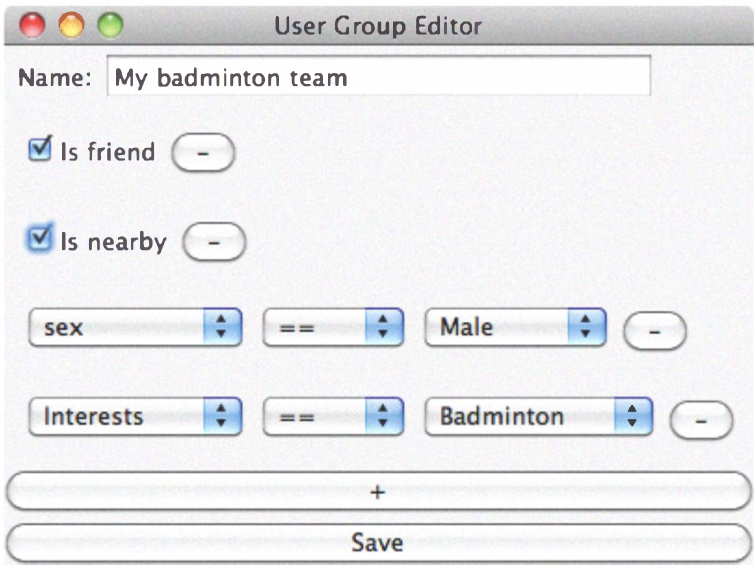
Urbiflock allows users to define groups using Boolean logic (AND, OR, NOT). For example:
- Group A: "People interested in Dutch courses" (Profile-based).
- Group B: "People within 10 meters" (Proximity-based).
- Urbiflock Composite: creates a dynamic group that updates automatically as you walk through a university campus.
Guanotes: Dynamic Propagation at Work
To test the framework, the authors developed Guanotes, a pervasive version of a Facebook "Wall."
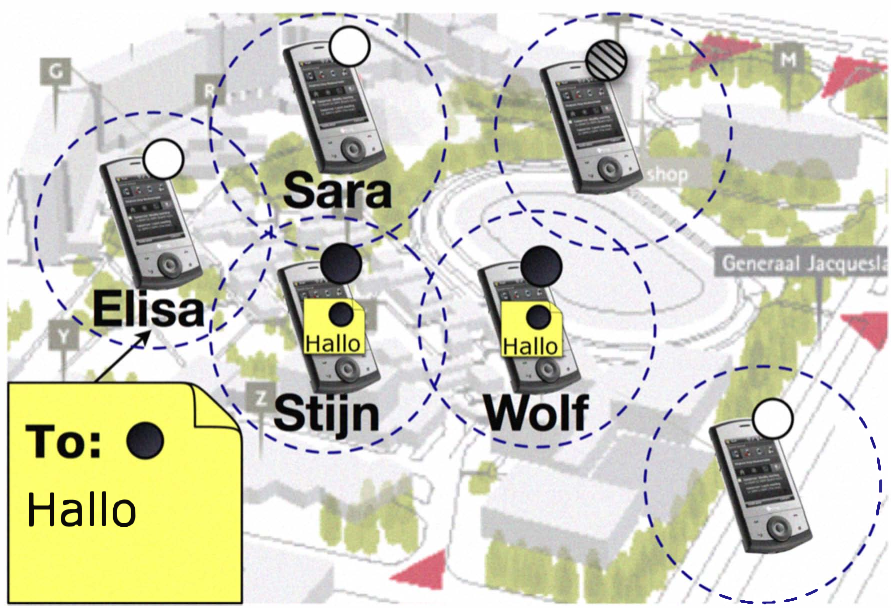
Unlike standard broadcasting which floods a network, Guanotes uses the TOTAM (Tuples on the Ambient) infrastructure. A message (tuple) is only "carried" and "routed" by devices that belong to the target group.
Scenario Illustration: If Elisa wants to send a message to "nearby males," her device checks the profiles of surrounding peers. Even if a peer is two hops away (not in direct range), the message propagates through intermediate devices—but only those that fit the social group filter. This ensures privacy and drastically reduces network congestion.
Experiments & Results
The authors implemented Urbiflock on HTC Touch Cruise phones (legacy hardware relative to today, but significant for the era of pervasive research).
Key Findings:
- Dynamic Sync: The RETE engine successfully updated group memberships in real-time as discovery APIs detected new profiles via Bluetooth/Wi-Fi.
- Selective Routing: Guanotes effectively used social context as a routing metric. In a 6-node campus scenario (Figure 4), the message reached "Wolf" via "Stijn" because they both met the group criteria, while skipping "Sara" for routing to maintain group-specific propagation.
Critical Analysis & Conclusion
Urbiflock’s strength lies in its Subjective Definition of groups. There is no "global" nearby group; "nearby" means whatever you define it to mean (same room vs. same building).
Limitations:
- Scalability: While the multi-hop logic works for small clusters, the authors noted that campus-wide deployment would be necessary to test the limits of the RETE engine's memory/CPU usage on mobile devices.
- Battery/Privacy: Constant profile scanning and ad hoc routing are notoriously heavy on battery life, and "leaking" profile descriptors for group matching presents a privacy challenge that requires robust encryption.
Final Takeaway
Urbiflock anticipates a world of "Edge Socializing," where our phones are not just windows to a central server, but active participants in the physical social space around us.