
Decoding Sina Weibo: How URL Analysis Unmasks the "Water Army" and Bot Networks
Understanding User Behavior through URL Analysis in Sina Tweets
This paper presents a comprehensive empirical study of user behavior on Sina Weibo through the lens of URL analysis, utilizing a dataset of over 1.3 million tweets. The authors propose a taxonomy to identify and classify abnormal commercial behaviors, specifically distinguishing between "Advertisers" (Robots/Manual) and the "Water Army" (Paid/Reward posters).
TL;DR
Social media behavior is often a digital mirror of physical-world intentions. This research dives into 1.3 million Sina Weibo tweets to show that URLs are the "smoking gun" of commercial manipulation. By analyzing how links are shared, the authors categorize the mysterious "Internet Water Army" and automated robots that dominate promotional discourse in the Chinese digital ecosystem.
Background: The Mirror of the Cyber-World
With over 300 million users at the time of the study, Sina Weibo is more than a microblog; it is a massive data hub. While most users share life updates or news, a significant sub-population uses the platform for "commercial intent." Unlike prior works that focus on sentiment or follower counts, this paper argues that the destination of a URL tells you the true purpose of a user.
Methodology: From 't.cn' to the Truth
Sina Weibo automatically shortens all links to the t.cn domain. This masks the destination and strips away semantic meaning. To solve this, the researchers built a "S to L" (Short to Long) resolution tool.
The Technical Pipeline:
- Extraction: Matching the HTTP header
http://t.cn/. - Resolution: Using the HTTP 301 (Moved Permanently) redirection mechanism to find the final landing page.
- Aggregation: Grouping subdomains (e.g.,
tmall.comandtaobao.com) to identify the corporate entities behind the links.
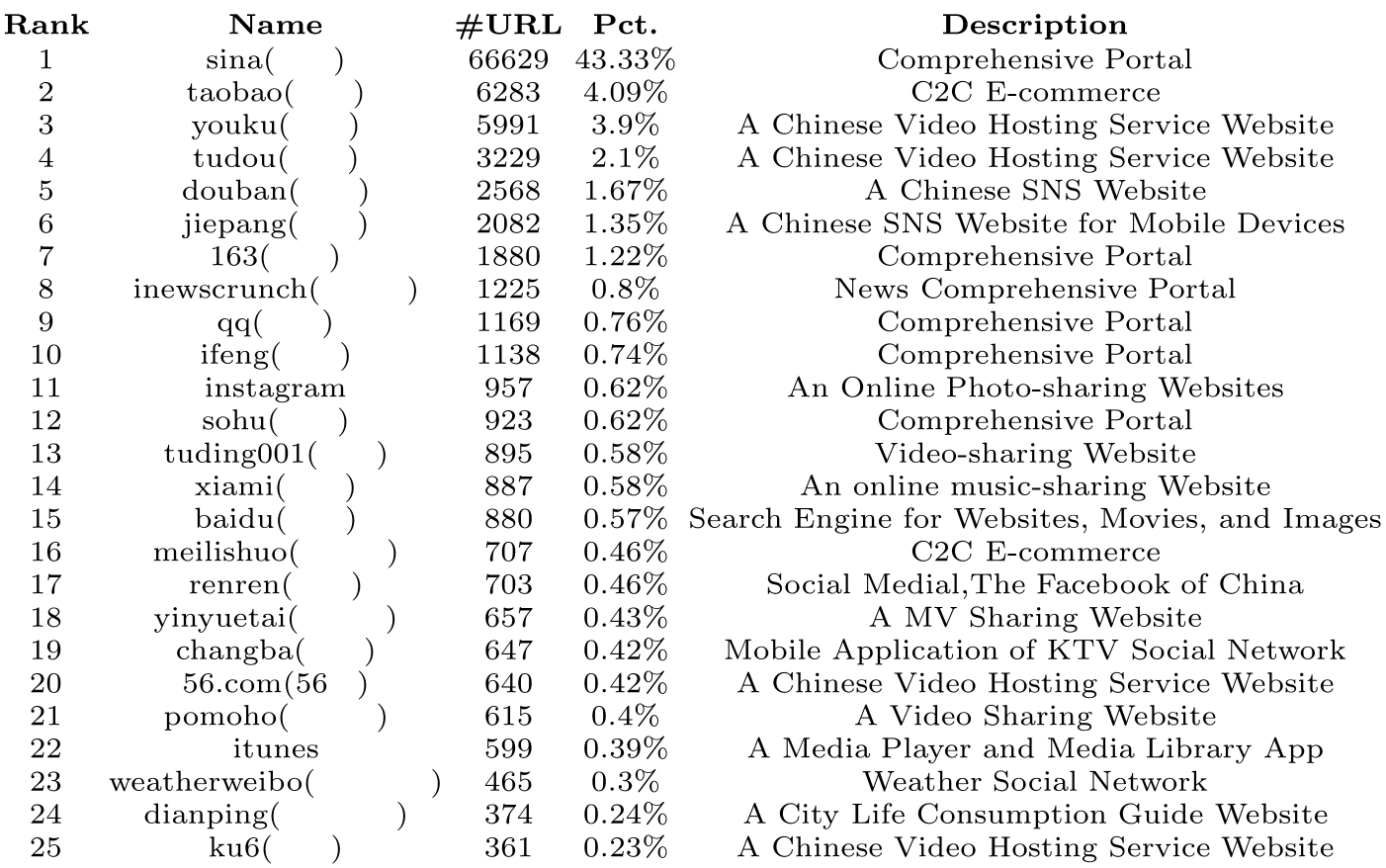
As shown in the table above, after Sina’s own services, Taobao dominates the URL landscape, highlighting the platform’s role as a massive billboard for C2C e-commerce.
Deep Dive: Categorizing Abnormal Behavior
The most striking part of the research is the classification of users with commercial intents. The authors define a matrix based on four dimensions: Users, Contents, URLs, and Time-span.
1. The Advertisers (Robots vs. Manual)
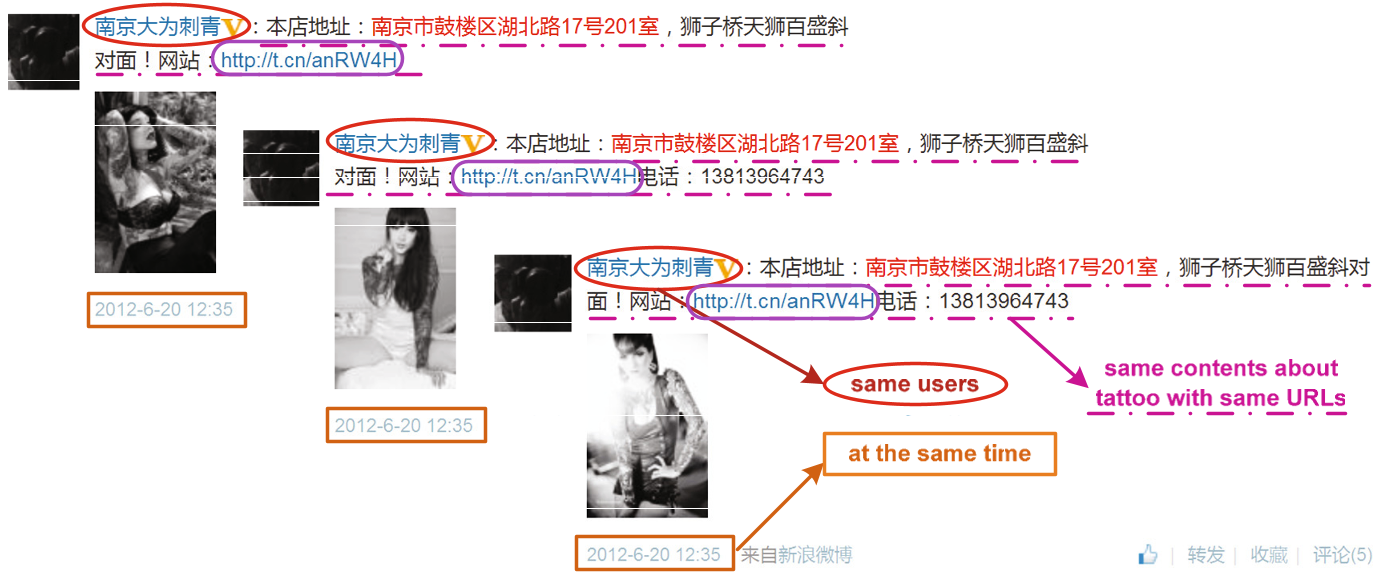
- Robots: These are high-frequency accounts. They post the same content with the same URL at the same time (often in bursts).
- Manual Posters: Individual shop owners who manually paste links. Their timing is more "human" (random), but their content remains repetitive.
2. The Internet Water Army (Paid vs. Reward)
The "Water Army" is a uniquely Chinese phenomenon of "paid posters" (Shuijun).
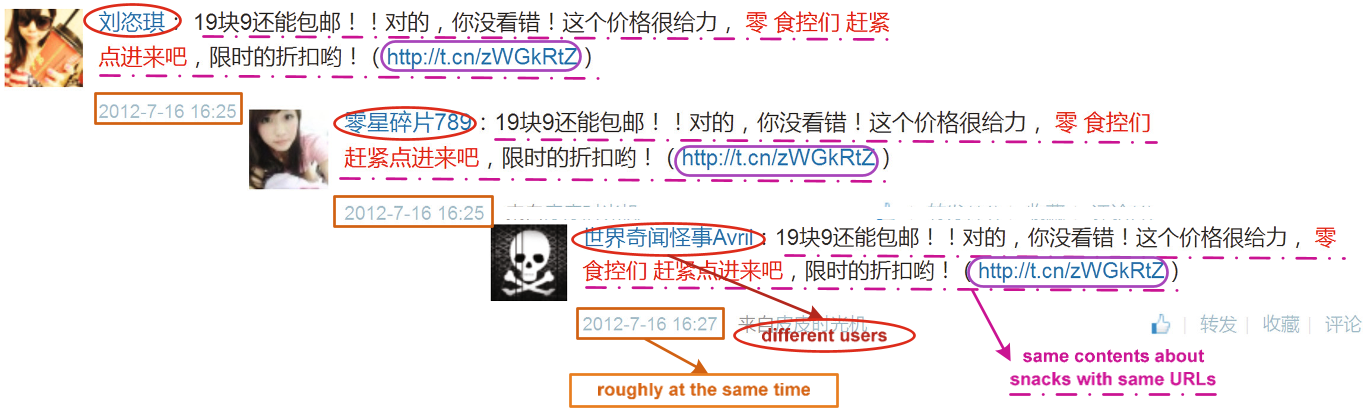
- Paid Posters: Different accounts posting the identical content/URL in a very short window. This is the hallmark of a coordinated campaign to "trend" a topic.
- Reward Posters: These are real users incentivized by "lottery" or "reward" tweets (e.g., "Retweet to win a trip to London"). While the users are different, the URL remains the focus.

Case Studies & Visual Evidence
The authors provide concrete evidence of these behaviors. In Fig 4, we see a tattoo shop in Nanjing acting like a Robot, posting the same advertisement multiple times at the exact same second.
Conversely, the Water Army (Fig 6) shows multiple different user accounts (likely controlled by a single agency) promoting a food company simultaneously to create an illusion of "organic" popularity.
Conclusion & Insights
The study concludes that URL analysis is an essential pillar of social network forensic science. By observing the Category of URLs, researchers can even track societal interests—such as the spike in sports-related URLs during the 2012 London Olympics.
Key Takeaways for Future Defense:
- Timing is everything: Simultaneous posts across different accounts are the strongest indicator of a coordinated "Water Army."
- E-commerce Dominance: E-commerce links are the primary driver of spam on Sina Weibo, suggesting that platform moderators should focus their heuristics on
taobao.comandmeilishuo.compatterns.
While the paper provides a solid descriptive framework, the authors acknowledge that the next step is building automated, robust detection models that can keep pace with increasingly sophisticated "Water Army" tactics that attempt to mimic human randomness.