
User-Adaptive Models: Personalized AI Without the Data Burden
User-adaptive models for activity and emotion recognition using deep transfer learning and data augmentation
This paper proposes User-Adaptive Models (UAM) for activity and emotion recognition using deep transfer learning and random oversampling. By fine-tuning the adaptive layers of a pre-trained General Model (GM) with minimal personal data, the authors achieve State-of-the-Art performance for personalized human-interactive systems.
TL;DR
Human behavior—how we walk, talk, and express emotion—is deeply individual. A "one-size-fits-all" AI model often fails to capture these nuances. This paper introduces User-Adaptive Models (UAM), which combine the broad knowledge of a general population model with the specific nuances of an individual using Deep Transfer Learning and Data Augmentation. The result? A significant performance boost (up to 14% F-score) using only a fraction of personal training data.
The Personalization Paradox
In fields like healthcare and sports monitoring, we face a paradox:
- General Models (GM) are ready to use immediately but lack accuracy because they ignore individual differences (e.g., a 20-year-old’s gait vs. a 70-year-old’s).
- User-Dependent Models (UDM) are highly accurate but require weeks of data collection before they even start working.
The authors solve this by asking: Can we use a little bit of personal data to steer a general model in the right direction?
Methodology: Transfer Learning & Layer Partitioning
The core innovation lies in the architectural split of the neural network. The model is divided into:
- Fixed Layers: These acts as universal feature extractors, learning the general "physics" of movement and sound from a large pool of users.
- Adaptive Layers: These are the "personality" weights. Only these layers are updated when a new user provides a small amount of labeled data.
To combat the "small data" problem, the authors employed Random Oversampling (RO). By duplicating the few available samples from the target user, they allowed the network to "rehearse" individual patterns without forgetting the general ones.
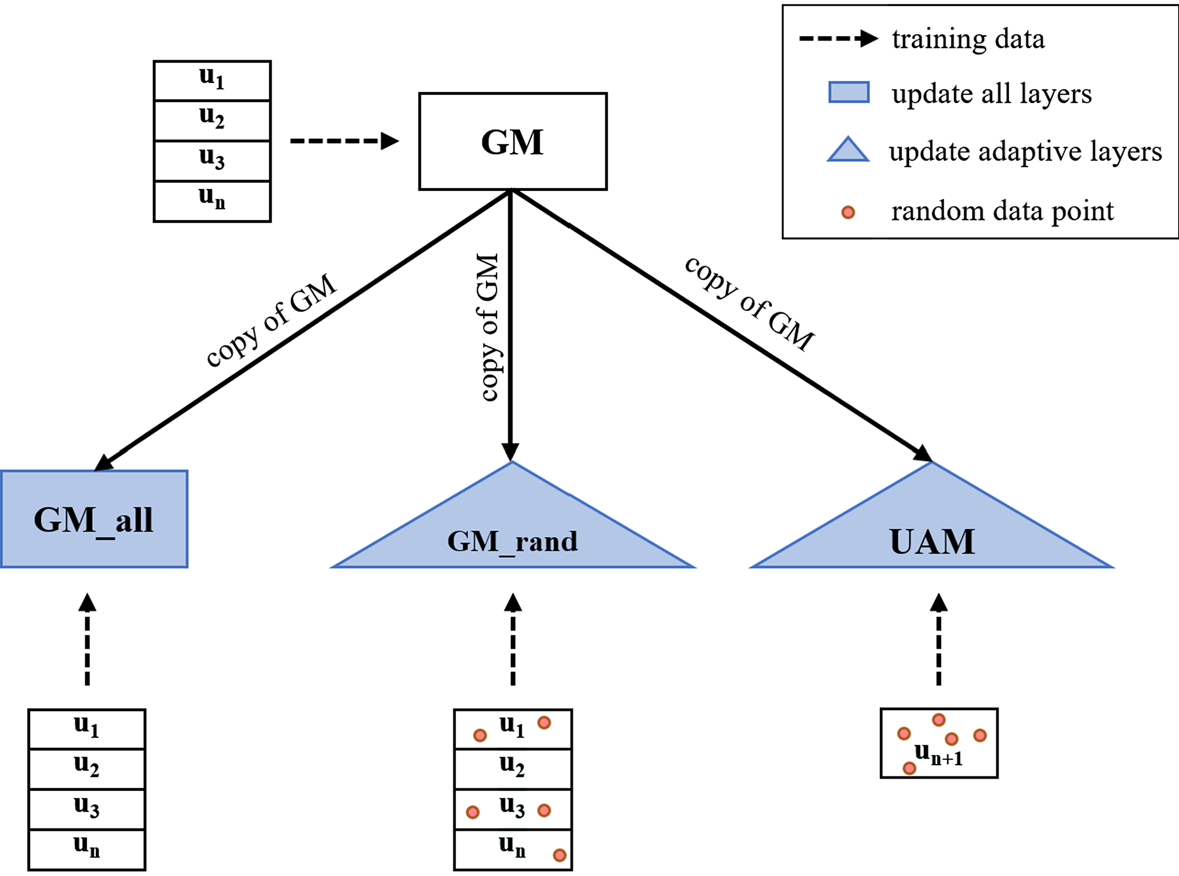 Figure: The workflow of transforming a General Model into a UAM via individual adaptation data.
Two Domains, One Solution
The method was rigorously tested across two distinct modalities:
- Activity Recognition: Utilizing accelerometer data to distinguish between walking, jogging, and sitting.
- Emotion Recognition: Analyzing audio features from speech to identify states like anger, joy, and sadness.
Performance Highlights
- Accuracy Gains: In both datasets, the UAM outperformed generic models, with a median accuracy increase of 7.8% for activity and 9.5% for emotion.
- Gender Insights: The study found that while gender significantly impacts generic model performance (e.g., models trained on women perform poorly on men), the adaptation process is robust enough to overcome these demographic gaps.
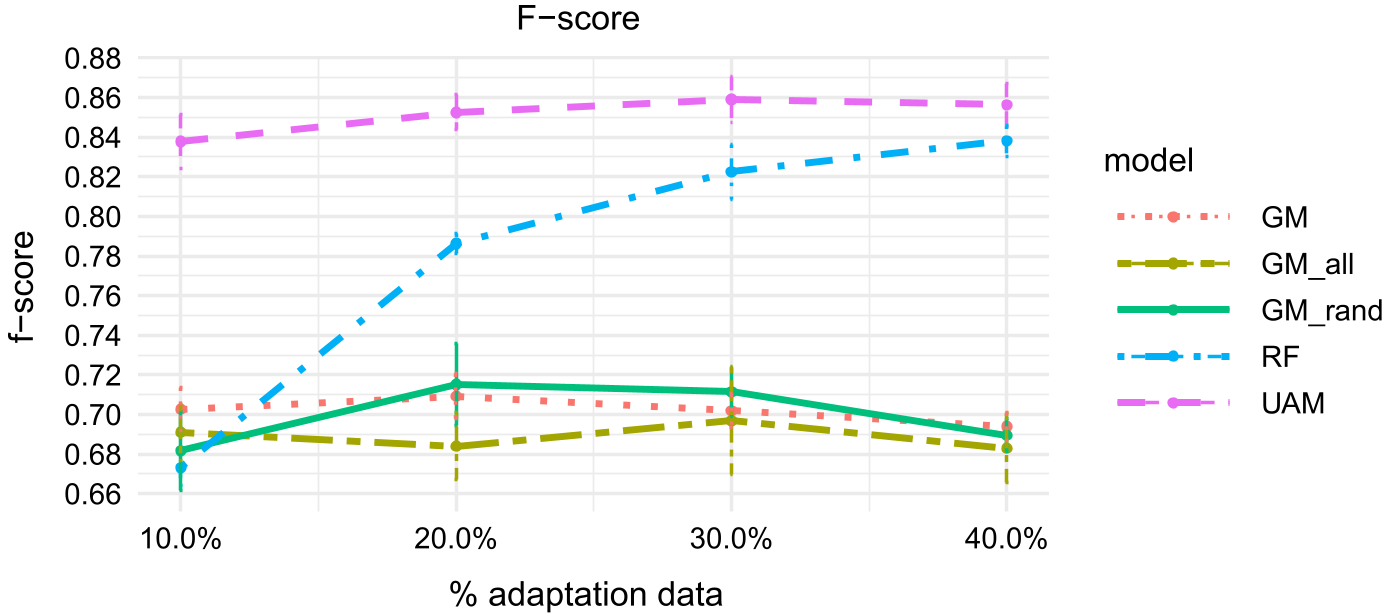 Figure: Comparison of F-scores across different model types. Notice the clear superiority of the UAM (top line) as more adaptation data is added.
Critical Insight: The Danger of "Borrowed" Adaptation
An interesting finding was that a UAM tailored for "User A" performs worse than a generic model when tested on "User B." This confirms that adaptation is a double-edged sword: it sharpens the model for the individual but makes it too specialized for anyone else. This highlights the necessity of truly personalized AI pipelines rather than just "community-based" models.
Conclusion & Future Outlook
This research proves that "calibration" doesn't have to be a months-long ordeal. With just 10% of the typical data requirement, we can achieve high-performance, personalized AI.
The next frontier? Unsupervised adaptation. The authors suggest that future work should focus on methods like Semi-Supervised Learning or GANs, where the model learns your specific habits automatically, without ever asking you to label your own data.
Takeaway for Practitioners
If you are building a human-in-the-loop system, don't build a single static model. Standardize your feature extraction (Fixed Layers) and provide a lightweight mechanism to retrain the output layers (Adaptive Layers) locally on the user's device.