
Boosting Conversions in Point-Earning Apps: A Hybrid Co-Clustering Approach
User behavior analysis and commodity recommendation for point-earning apps
This paper presents a hybrid recommendation framework for point-earning mobile apps, utilizing Co-Clustering with Augmented Matrices (CCAM) and heuristic scoring. By integrating Facebook persona data, app behavior, and web-crawled item features, the system achieves an F-score of 0.802 in product recommendation.
TL;DR
Point-earning apps often struggle with "ghost users"—those who download the app but rarely purchase. This research tackles this extreme data sparsity by fusing Facebook persona data with web-crawled product features. By deploying Co-Clustering with Augmented Matrices (CCAM) and a customized Heuristic Scoring model, the authors boosted recommendation F-scores to 0.802, significantly outperforming traditional collaborative filtering.
Problem & Motivation: The Sparsity Trap
The fundamental challenge in point-earning apps (like Line or MyCard) is that users are primarily motivated by "tasks" (checking in or scanning) rather than shopping. In the dataset studied:
- Only 10.3% of users had any purchase history.
- 83.4% of store check-ins resulted in zero sales.
- More than half of the active users had fewer than 10 clicks over an 18-month period.
Traditional recommendation algorithms like Matrix Factorization or simple Collaborative Filtering (CF) break down in these "cold-start" environments because there aren't enough "dots" to connect users to products.
Methodology: Mining External Signals
To bridge this information gap, the authors moved beyond the internal app logs and looked at two external sources:
- User Side (Facebook Integration): They extracted age, gender, residence, and categories of "Liked" fan pages (e.g., fashion, food, tech).
- Item Side (Web Crawling): Since internal product descriptions were sparse, they used Google Search crawlers and NLP techniques (TF-IDF and TextRank) to extract descriptive keywords for 144 secondary categories and 375 minor categories.
The Core Architecture: CCAM
Instead of simple filtering, they used Co-Clustering with Augmented Matrices (CCAM). This method doesn't just look at who bought what; it builds three parallel matrices:
- User-Item Matrix: Buying history.
- User-Feature Matrix: Facebook personas.
- Item-Feature Matrix: Web-derived keywords.
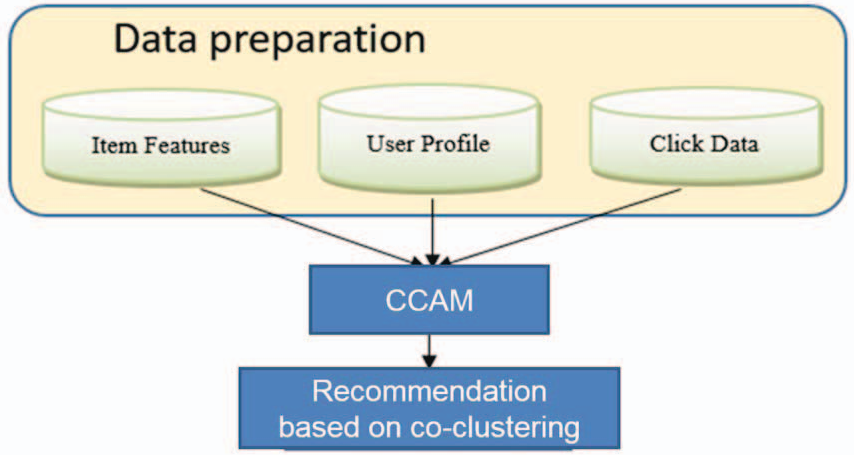 Fig 1: The structure of CCAM integrating three distinct data sources.
Heuristic Scoring: The Secret Sauce
Beyond the clusters, the authors implemented a weighted scoring formula to predict purchase probability: This prioritizes social group trends (What do other "Professional Women" buy?) and periodicity (Is it time for this user to restock?) over simple similarity.
Experiments & Results
The researchers compared their hybrid approach against traditional User-based and Item-based baselines.
- General Performance: On the full set of 8,235 users, the Heuristic Scoring achieved an F-score of 0.756, nearly double that of simple CF.
- Frequent User Performance: For users with 20+ transactions, the score rose to 0.802.
- Feature Impact: Adding web-crawled keywords improved classifier performance significantly, especially in the long-tail of recommendations.
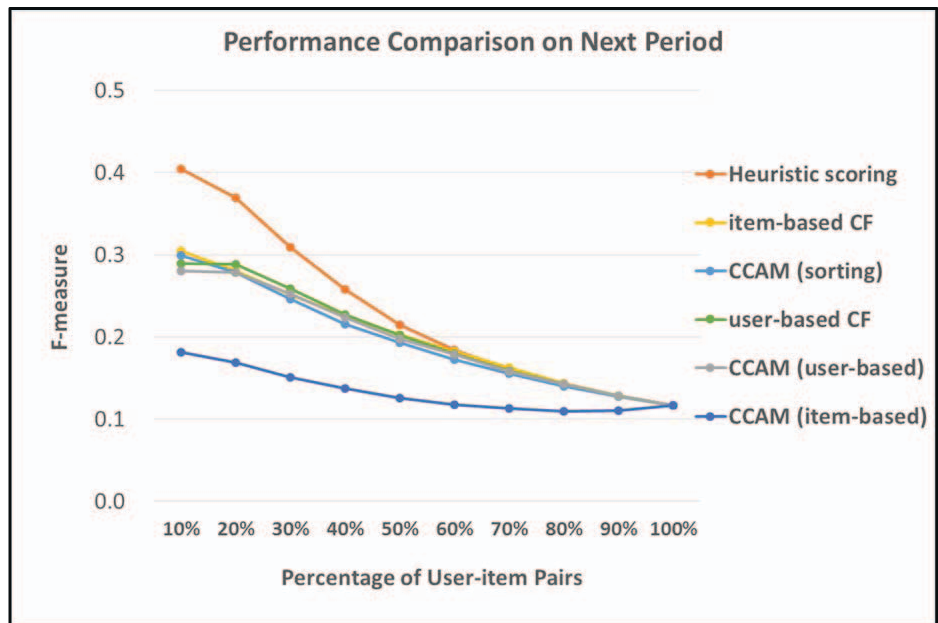 Fig 2: Performance comparison showing Heuristic Scoring outperforming all baselines as the number of recommendations increases.
Critical Analysis & Conclusion
The value of this work lies in its pragmatic approach to the cold-start problem. While many modern researchers jump straight to Deep Interest Networks, this paper demonstrates that in low-data environments, feature engineering (via web crawling) and statistical co-clustering are often more robust.
Limitations: The study notes that when they strictly split data by time (predicting future months based on previous years), performance dropped. This suggests that user interests in point-earning apps are highly volatile and perhaps driven by temporary promotions rather than long-term brand loyalty.
Future Outlook: The next frontier is Sequential Pattern Mining. By understanding the "order" of purchases (e.g., buying a toothbrush often precedes buying face wash in a certain cycle), developers can transform these apps from stagnant task lists into proactive personal shoppers.