
Decoding the Silence: Behavioral Detection in Encrypted Remote Desktop Traffic
User Behavior Detection Based on Statistical Traffic Analysis for Thin Client Services
This paper presents a framework for identifying specific user behaviors within Microsoft Remote Desktop Protocol (RDP) sessions using statistical traffic analysis and Machine Learning (ML). By training a J48 Decision Tree classifier on timing and volume features, the authors successfully categorize encrypted thin-client traffic into classes such as "idle," "browsing," and "document editing."
TL;DR
As the world shifts toward cloud-based virtual desktops, understanding what users are actually doing inside those encrypted RDP (Remote Desktop Protocol) tunnels is vital for network management. This paper utilizes Machine Learning (J48 Decision Trees) to classify user behavior into five categories—idle, document editing, browsing, audio, and video—achieving nearly 90% accuracy in byte classification. The most striking finding? Real-world RDC connections are dormant for over 92% of their duration.
Problem & Motivation: The "Black Box" of Encrypted Bitmaps
Remote Desktop services are notorious for their strict network requirements. Unlike standard web browsing, every click and keystroke must travel to a server, be rendered as a video bitmap, and sent back. In a WAN (Wide Area Network) environment, latency is the enemy of Quality of Experience (QoE).
The technical challenge lies in encryption. Since the traffic is a stream of encrypted bitmaps, network administrators cannot see what applications are running. Is the user just typing a memo (low bandwidth, high latency sensitivity) or watching a 1080p video (high bandwidth)? Existing research often oversimplified these tasks or ignored the "idle" state, which is crucial for capacity planning.
Methodology: The Feature Engineering Approach
The authors propose a supervised learning pipeline focused on the "shape" of the traffic rather than its content.
1. Data Collection & Epochs
Traffic is divided into 10-second epochs. This window is long enough to capture statistical patterns (like the burstiness of web browsing) but short enough for near real-time detection.
2. Feature Extraction
The model relies on six primary features extracted from both the Up-link (client to server) and Down-link (server to client):
- Packet counts per epoch.
- Average packet sizes (mapping to the complexity of screen updates).
- Average bandwidth usage.
3. The Decision Logic
Using the J48 algorithm (a Java implementation of C4.5), the authors built a classifier that interprets the distinct "fingerprints" of different tasks. For instance, Video consumes ~7 Mbit/s while Idle states are identified by a threshold of <5 packets per second, typically consisting only of TCP keep-alive heartbeats.
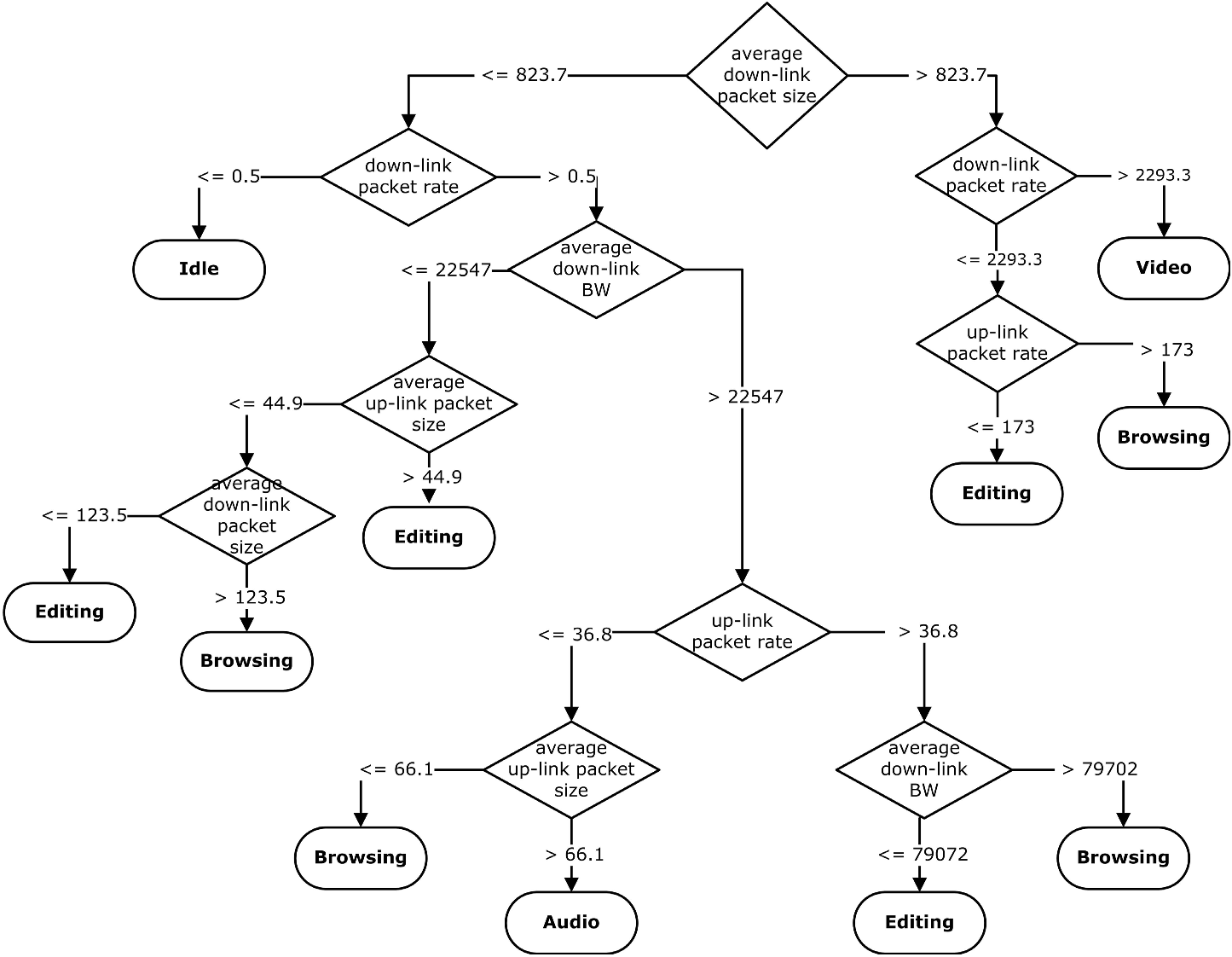 Figure 1: The J48 Decision Tree structure used to classify RDC behavior.
Experiments & Results: Real-World Reality Check
The study validated the model on a dataset from the University of Zagreb and then applied it to 18.5 GB of live traffic from the University of Ljubljana.
Key Performance Metrics:
- Classification Accuracy: Correctly identified 78% of time segments and 89.7% of the total byte volume.
- Traffic Characteristics: The most distinguishing feature was the Down-link packet count, which spikes during screen-heavy updates (browsing/video) but stays minimal during text editing.
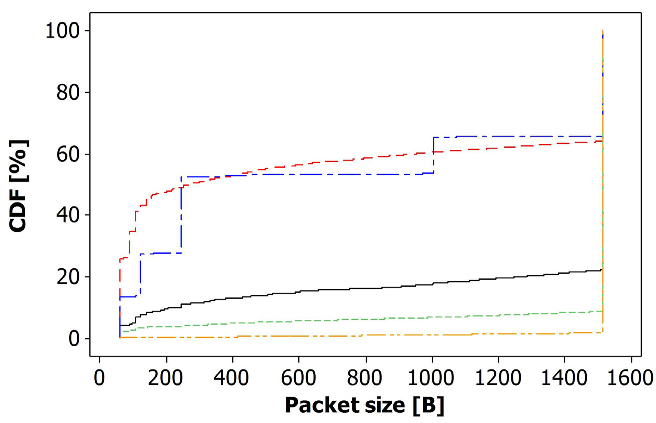 Figure 2: Statistical distribution of packet sizes and bandwidth for different behavior categories.
The "Idle" Revelation:
The researchers found that in a real academic environment, RDC sessions are idle for 92.9% of the time. Users often leave connections open for days, but active interaction (document editing and browsing) takes up less than 8% of the session. Video usage was virtually non-existent, likely due to the poor performance of RDP over high-latency WAN links.
Critical Analysis & Conclusion
This work provides a pragmatic bridge between raw network statistics and user-centric QoE.
The Takeaway: The massive percentage of idle time suggests that cloud service providers are significantly under-utilizing their hardware. By detecting these "silent" periods using ML, providers could implement smarter resource scheduling—such as prioritizing "active" users or dynamically scaling back bandwidth for idle sessions.
Limitations:
- Temporal Resolution: A 10-second window might be too slow to react to sudden "jerkiness" in a video stream.
- Evolving Protocols: Standards like RDP have evolved (using UDP/H.264) since this study; modern classifiers would likely need to incorporate packet inter-arrival times to catch the nuances of variable bit-rate encoding.
In conclusion, the study proves that even when we can't see the data, we can "feel" the user behavior through the pulse of the network traffic.