
Personalized Geographic Topic Analysis: Decoding User Interests Across the Digital and Physical Worlds
User characterization from geographic topic analysis in online social media
The paper introduces a Bayesian latent topic framework for User Characterization from Geographic Topic Analysis (PGTA). By jointly modeling the textual content, geographic coordinates, and user identities of tweets, the model uncovers "Geographic Topics" that capture both semantic interests and physical location patterns.
TL;DR
This paper presents a Bayesian framework that unites who said it, what they said, and where they were. By treating tweets as a mixture of "geographic topics," the authors enable a deeper understanding of social media users—mapping their online interests to their physical mobility and social influence.
Motivation: Why Topology and Text Aren't Enough
Online social networks are inherently heterogeneous. A dense cluster of users might form because they all love "Machine Learning" (a global interest) or because they are all experiencing a "Local Shooting" (a transient local event). Traditional models that look only at the graph (Links) or the text (LDA) fail to distinguish between these two.
The authors argue that location is the missing link. However, geo-tagged tweets are notoriously short and sparse. To solve this, the researchers propose shifting the analysis from single tweets to the user level, aggregating an individual's history to build a robust profile of their "Geographic Semantics."
Methodology: The RPGTA Model
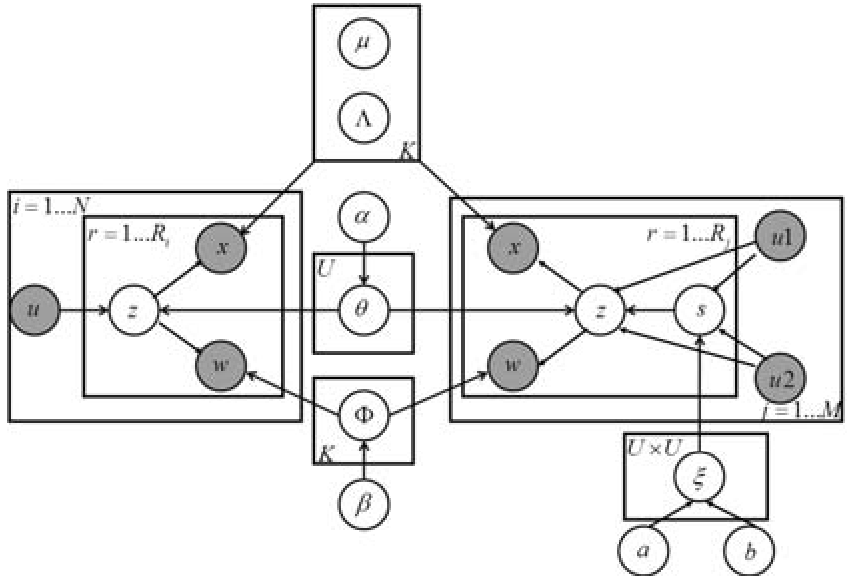
The core of the study is the RPGTA (Regularized Personalized Geographical Topic Analysis) model.
1. The Generative Vision
Instead of a topic being just a bag of words, in this model, a topic is a pairing:
- : A distribution over the vocabulary (Content).
- : A spatial mean and covariance (Geography).
2. User-Centric Modeling
Each user has a personal topic preference . When a user writes a tweet, they don't just pick a topic based on what they like; the model assumes the chosen topic must explain both the words used and the GPS coordinate of the tweet.
3. Regularizing via Interaction
One of the most sophisticated features is the handling of Interactive Tweets. If User A replies to User B, the model assumes the topic is drawn from a mixture of both users' interests. This acts as a "smooth" constraint: if you talk to someone, the model nudges your latent interest profiles closer together.
Experiments: Proving the Value of "Spatial Awareness"
The authors tested their model against several baselines, including GeoFolk (which ignores users) and the Author-Topic Model (ATM) (which ignores location).
Performance Highlights
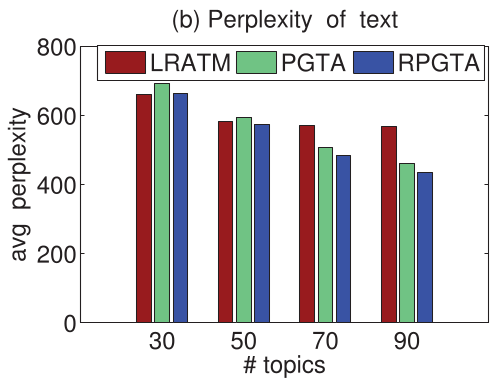
- Perplexity: RPGTA showed a much lower perplexity, meaning it predicts unseen data more accurately. This confirms that integrating user-specific history helps the model deal with the "noise" of Twitter.
- Location Prediction: By knowing a user’s general topical interests, the model could predict where a specific tweet was sent from much more accurately than models that only looked at the words in that single tweet.
Deep Insight: The "Globalness" of Interests
The most fascinating part of the paper is the empirical study on User Globalness.
- Global Topics: Topics like "Olympics" or "Elections" have high spatial dispersion.
- Local Topics: Topics like "Cantonese Food" or "Texas High School Sports" are spatially concentrated.
The researchers found a direct correlation between a user's interest profile and their social status:
- Connectivity: Users who focus on "Global Topics" tend to have a higher degree (more followers/friends).
- Distance: These "Global" users have friends distributed across much larger physical distances.
- Physical Mobility: Perhaps most surprisingly, users with global online interests actually travel more in the physical world (higher mobility diameter).
Critical Analysis & Conclusion
The PGTA framework successfully bridges the gap between digital content and physical presence. It provides a principled way to:
- Recommend links based on "Expertise + Proximity."
- Detect true "Local Events" vs. global news.
- Predict human mobility based on digital footprints.
Limitations: The model uses a 2D Gaussian for location, which assumes every topic has a single "center." In reality, a topic like "Surfing" might have multiple centers (California, Hawaii, Australia). Future iterations could benefit from Gaussian Mixture Models (GMMs) or Non-parametric methods to capture multi-modal geographic distributions.
Ultimately, this paper serves as a masterclass in how Bayesian modeling can turn "messy" social media data into structured, actionable insights about human behavior.